

In a proof-of-concept study led by the School of Veterinary Medicine, dogs identified positive samples with 96% accuracy.
Many long for a return to a post-pandemic “normal,” which, for some, may entail concerts, travel, and large gatherings. But how to keep safe amid these potential public health risks?
One possibility, according to a new study, is dogs. A proof-of-concept investigation published recently in the journal PLOS ONE suggests that specially trained detection dogs can sniff out COVID-19-positive samples with 96% accuracy.
“This is not a simple thing we’re asking the dogs to do,” says Cynthia Otto, senior author on the work and director of the University of Pennsylvania School of Veterinary Medicine Working Dog Center. “Dogs have to be specific about detecting the odor of the infection, but they also have to generalize across the background odors of different people: men and women, adults and children, people of different ethnicities and geographies.”
In this initial study, researchers found the dogs could do that, but training must proceed with great care and, ideally, with many samples. The findings are feeding into another investigation that Otto and colleagues have dubbed “the T-shirt study,” in which dogs are being trained to discriminate between the odors of COVID-positive, -negative, and -vaccinated individuals based on the volatile organic compounds they leave on a T-shirt worn overnight.
“We are collecting many more samples in that study—hundreds or more—than we did in this first one, and are hopeful that will get the dogs closer to what they might encounter in a community setting,” Otto says.
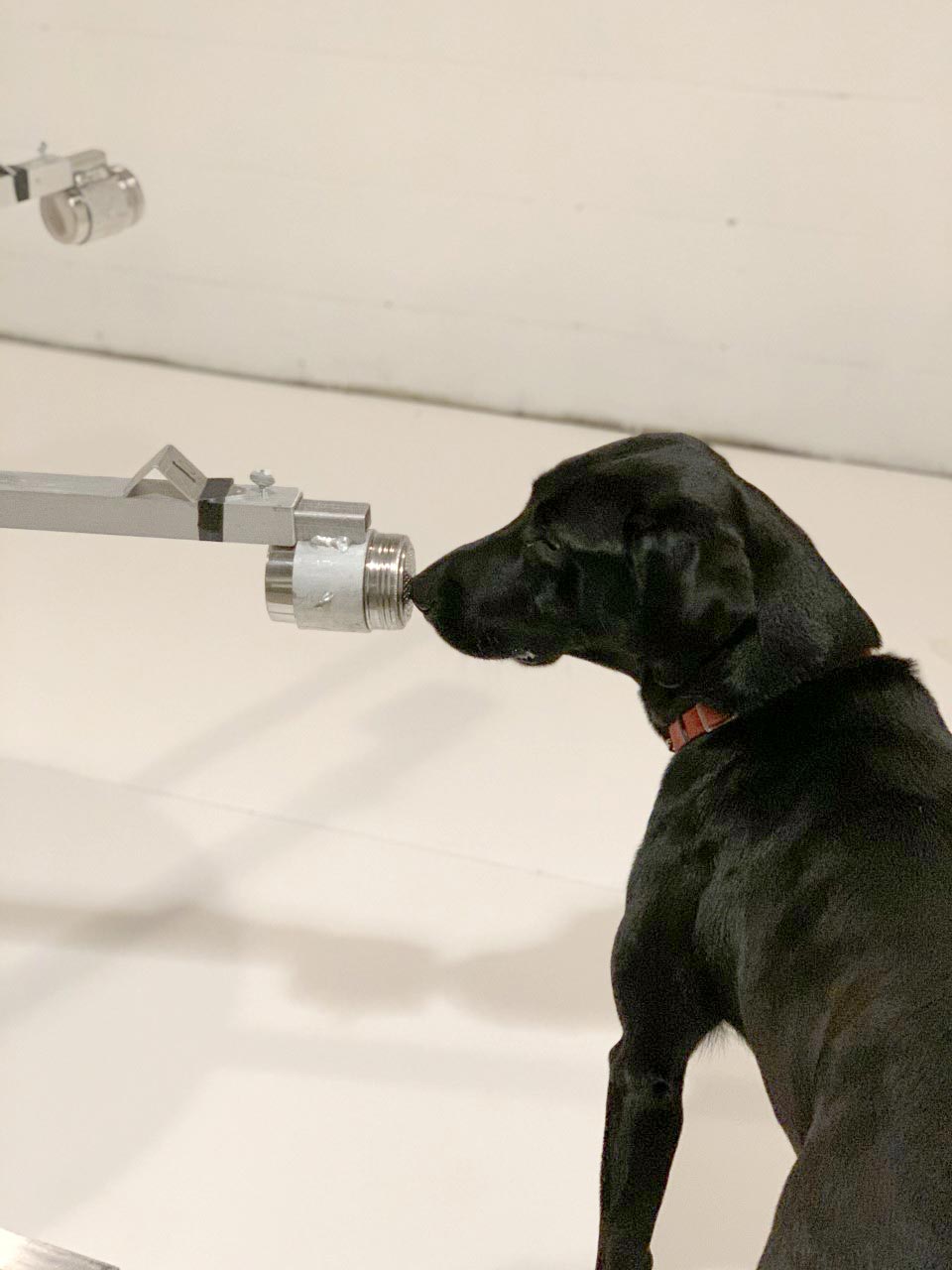
Through the Working Dog Center, she and colleagues have had years of experience training medical-detection dogs, including those that can identify ovarian cancer. When the pandemic arrived, they leveraged that expertise to design a coronavirus detection study.
Collaborators Ian Frank from the Perelman School of Medicine and Audrey Odom John from the Children’s Hospital of Philadelphia provided SARS-CoV-2-positive samples from adult and pediatric patients, as well as samples from patients who had tested negative to serve as experimental controls. Otto worked closely with coronavirus expert Susan Weiss of Penn Medicine to process some of the samples in Penn’s Biosafety Level 2+ laboratory to inactivate the virus so they would be safe for the dogs to sniff.
Because of workplace shutdowns due to the pandemic, instead of working with dogs at Penn Vet, the researchers partnered with Pat Nolan, a trainer with a facility in Maryland.
The Dogs and the Training Process
Eight Labrador retrievers and a Belgian Malinois that had not done medical-detection work before were used in the study. First, the researchers trained them to recognize a distinctive scent, a synthetic substance known as universal detection compound (UDC). They used a “scent wheel” in which each of the 12 ports was loaded with a different sample and rewarded the dog when it responded to the port containing UDC.
When the dogs consistently responded to the UDC scent, the team began training them to respond to urine samples from SARS-CoV-2 positive patients and discern positive from negative samples. The negative samples were subjected to the same inactivation treatment—either heat inactivation or detergent inactivation—as the positive samples.
Processing the results with assistance from Penn criminologist and statistician Richard Berk, the team found that after three weeks of training, all nine dogs were able to readily identify SARS-CoV-2 positive samples, with 96% accuracy on average. Their sensitivity, or ability to avoid false negatives, however, was lower, in part, the researchers believe, because of the stringent criteria of the study: If the dogs walked by a port containing a positive sample even once without responding, that was labeled a “miss.”
The researchers ran into many complicating factors in their study, such as the tendency of the dogs to discriminate between the actual patients, rather than between their SARS-CoV-2 infection status. The dogs were also thrown off by a sample from a patient who tested negative for SARS-CoV-2 but who had recently recovered from COVID-19.
“The dogs kept responding to that sample, and we kept telling them no,” Otto says. “But obviously there was still something in the patient’s sample that the dogs were keying in on.”
Lessons for the Future of Medical Detection Dogs
Major lessons learned from the study, besides confirming that there is a SARS-CoV-2 odor that dogs can detect, were that future training should entail large numbers of diverse samples and that dogs should not be trained repeatedly on the samples from any single individual.
“That’s something we can carry forward not only in our COVID training but in our cancer work and any other medical detection efforts we do,” says Otto. “We want to make sure that we have all the steps in place to ensure quality, reproducibility, validity, and safety for when we operationalize our dogs and have them start screening in community settings.”
Reference: “Discrimination of SARS-CoV-2 infected patient samples by detection dogs: A proof of concept study” by Jennifer L. Essler, Sarah A. Kane, Pat Nolan, Elikplim H. Akaho, Amalia Z. Berna, Annemarie DeAngelo, Richard A. Berk, Patricia Kaynaroglu, Victoria L. Plymouth, Ian D. Frank, Susan R. Weiss, Audrey R. Odom John and Cynthia M. Otto, 14 April 2021, PLOS ONE.
DOI: 10.1371/journal.pone.0250158
Cynthia M. Otto is a professor of working dog sciences & sports medicine and director of the Working Dog Center in the University of Pennsylvania School of Veterinary Medicine.
Otto’s coauthors on the study were Jennifer L. Essler, Sarah A. Kane, Annemarie DeAngelo, Patricia Kaynaroglu, and Victoria L. Plymouth of Penn Vet; Ian D. Frank and Susan R. Weiss of Penn’s Perelman School of Medicine; Elikplim H. Akaho, Amalia Z. Berna, and Audrey R. Odom John of the Children’s Hospital of Philadelphia; Richard A. Berk of Penn’s School of Arts & Sciences; and Pat Nolan of Tactical Directional Canine. Essler was the first author of the study.
The research was funded in large part by Vernon and Shirley Hill with additional support from the National Institutes of Health (grants AI144472, AI154370, DH105594, and R01-140442), the Burroughs Wellcome Fund, and the Ovarian Cancer Symptom Awareness fund.
Never miss a breakthrough: Join the SciTechDaily newsletter.
Follow us on Google and Google News.