

June is a treasure trove for skywatchers, with Venus and Saturn sharing the dawn, Mars cozying up to Regulus at dusk, and Mercury making a shy appearance at sunset. The solstice on June 20 marks the longest day of the year for the Northern Hemisphere, a celestial milestone honored by civilizations for millennia.
Even more stunning, the core of our Milky Way galaxy arcs across the night sky all month—an awe-inspiring sight for anyone under dark skies. Whether it’s planets, stars, or ancient rhythms of Earth, June is a cosmic showcase not to be missed.
Planets, Solstice, and the Galaxy
The night sky puts on a dazzling show in June. Venus and Saturn start the month close together in the early morning, then drift apart as the days pass. Mars lingers in the evening twilight, and later this month, Mercury sneaks into view. As if that weren’t enough, the June solstice brings the longest day of the year, and dark skies reveal the glowing core of our home galaxy, the Milky Way.
Skywatching Highlights
All Month – Planet Visibility:
- Venus shines brilliantly in the eastern sky before sunrise throughout June. It rises about two hours ahead of the Sun, glowing low on the horizon in the early morning.
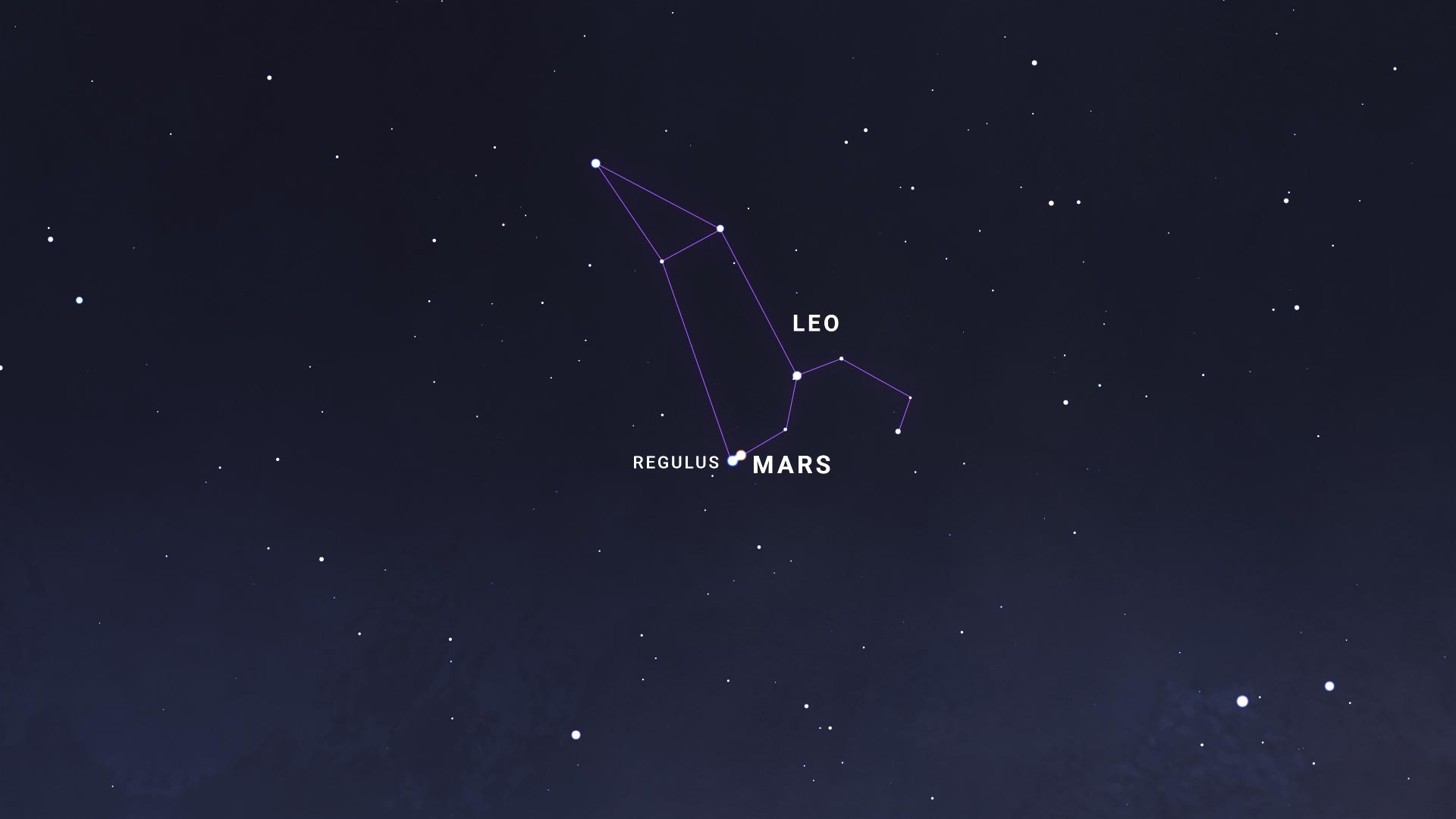
- Mars can be seen in the western sky after sunset. Although it dims as the month goes on, it offers a treat on June 16 and 17 when it passes very close to the bright star Regulus in the constellation Leo—just half a degree apart, about the width of the full Moon.
- Jupiter is visible low in the west after sunset during the first few days of June, but then disappears into the Sun’s glare. It will return to the morning sky in July.
- Mercury becomes visible in the final days of June. Look for it low on the western horizon about 30 to 45 minutes after sunset. A clear view of the horizon will help spot this elusive planet.
- Saturn rises in the early morning hours, around 3 a.m. at the beginning of the month and around 1 a.m. by the end. It starts the month of June near Venus in the dawn sky, but quickly climbs higher and shifts away as the month progresses.
Daily Highlights:
June 19 – Moon & Saturn – The third-quarter moon appears right next to Saturn this morning in the hours before dawn. The pair rises in the east together around 1:30 a.m.
June 22 – Moon & Venus – Venus rises this morning next to a slender and elegant crescent moon. Look for them in the east between about 3 a.m. and sunrise.
June 20 – June Solstice – The June solstice is on June 20 for U.S. time zones (June 21 UTC). The Northern Hemisphere’s tilt toward the Sun is greatest on this day. This means the Sun travels its longest, highest arc across the sky all year for those north of the equator.
June 16 & 17 – Mars & Regulus – Mars passes quite close to the bright bluish-white star Regulus, known as the “heart” of the lion constellation, Leo. They will appear about as far apart as the width of the full moon, and should be an excellent sight in binoculars or a small telescope.
June 21-30 – Mercury becomes visible – For those with a clear view to the western horizon, Mercury becomes visible for a brief period each evening at the end of June. Look for it quite low in the sky, starting 30 to 45 minutes after the Sun sets.
All month – Mars: The Red Planet can be observed for a couple of hours after dark all month. It is noticeably dimmer than it appeared in early May, as Earth speeds away in its orbit, putting greater distance between the two worlds.
All month – Milky Way core: The bright central bulge of our home galaxy, the Milky Way, is visible all night in June, continuing through August. It is best observed from dark sky locations far from bright city lights, and appears as a faint, cloud-like band arching across the sky toward the south.
Transcript
What’s Up for June? Mars grazes the lion’s heart, a connection to ancient times, and the galaxy in all its glory.
June Planet Observing
Starting with planet observing for this month, find Saturn and Venus in the eastern sky during the couple of hours before dawn each morning throughout the month. Saturn rapidly climbs higher in the sky each day as the month goes on. You’ll find the third-quarter moon next to Saturn on the 19th, and a crescent moon next to Venus on the 22nd.
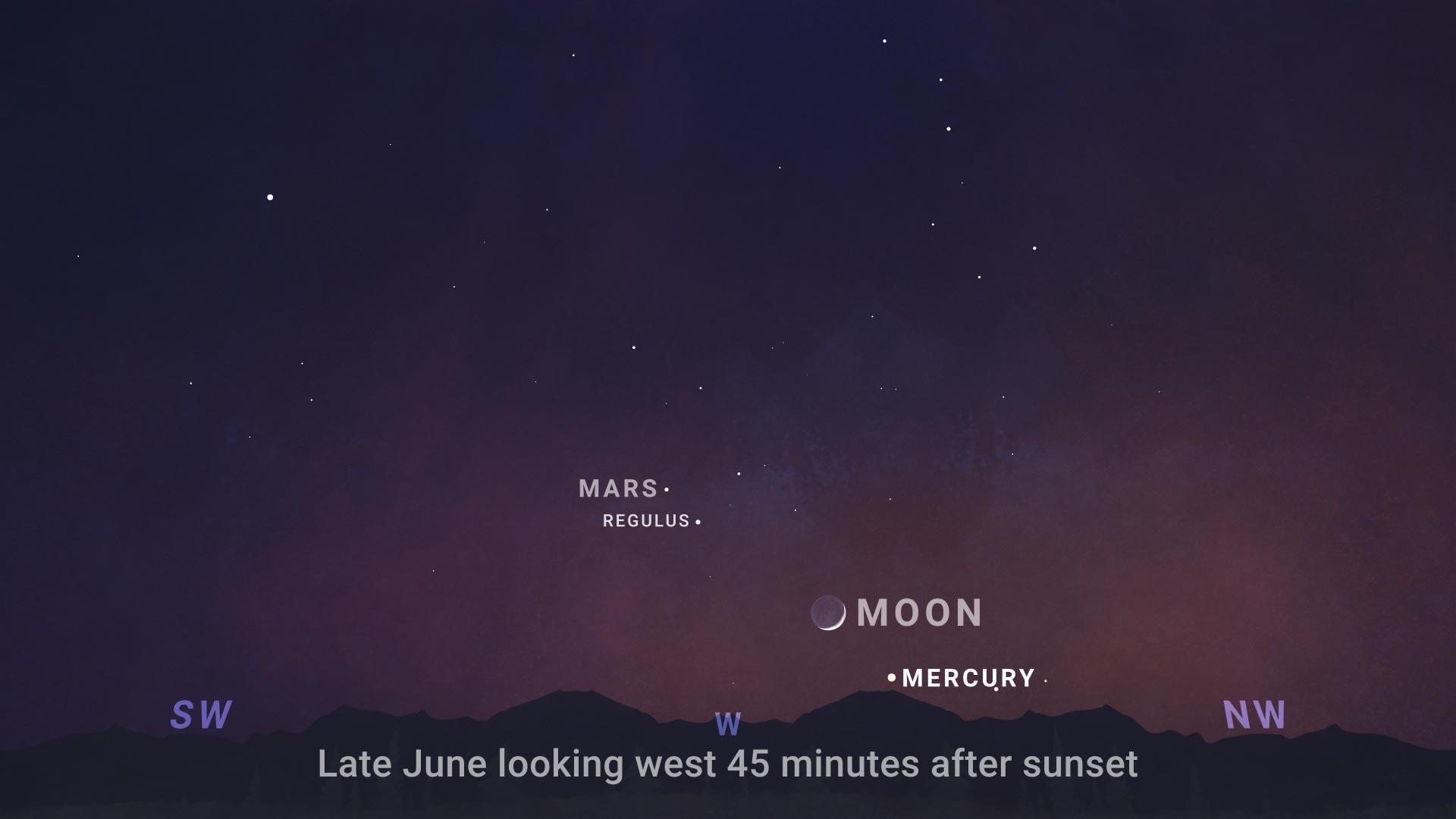
Mercury pops up toward the end of the month. Look for it quite low in the west, just as the glow of sunset is fading. It’s highest and most visible on the 27th.
Mars is still visible in the couple of hours after sunset toward the west, though it’s noticeably fainter than it was in early May. Over several days in mid-June, Mars passes quite close to Regulus, the bright star at the heart of the constellation Leo, the lion. Have a peek on the 16th and 17th with binoculars or a small telescope to see them as close as the width of the full moon.
Milky Way Core Season
June means that Milky Way “Core Season” is here. This is the time of year when the Milky Way is visible as a faint band of hazy light arching across the sky all night. You just need to be under dark skies, away from bright city lights, to see it. What you’re looking at is the bright central core of our home galaxy, seen edge-on, from our position within the galaxy’s disk.
Long-exposure photos make the Milky Way’s bright stars and dark dust clouds even clearer. And while our eyes see it in visible light, NASA telescopes observe the galaxy across the spectrum, peering through dust to help us better understand our origins.
However you observe it, getting out under the Milky Way in June is a truly remarkable way to connect with the cosmos.
June Solstice
June brings the summer solstice for those north of the equator, which is the winter solstice for those south of the equator. In the Northern Hemisphere, this is when the Sun is above the horizon longer than any other day, making it the longest day of the year. The situation is reversed for the Southern Hemisphere, where it’s the shortest day of the year.
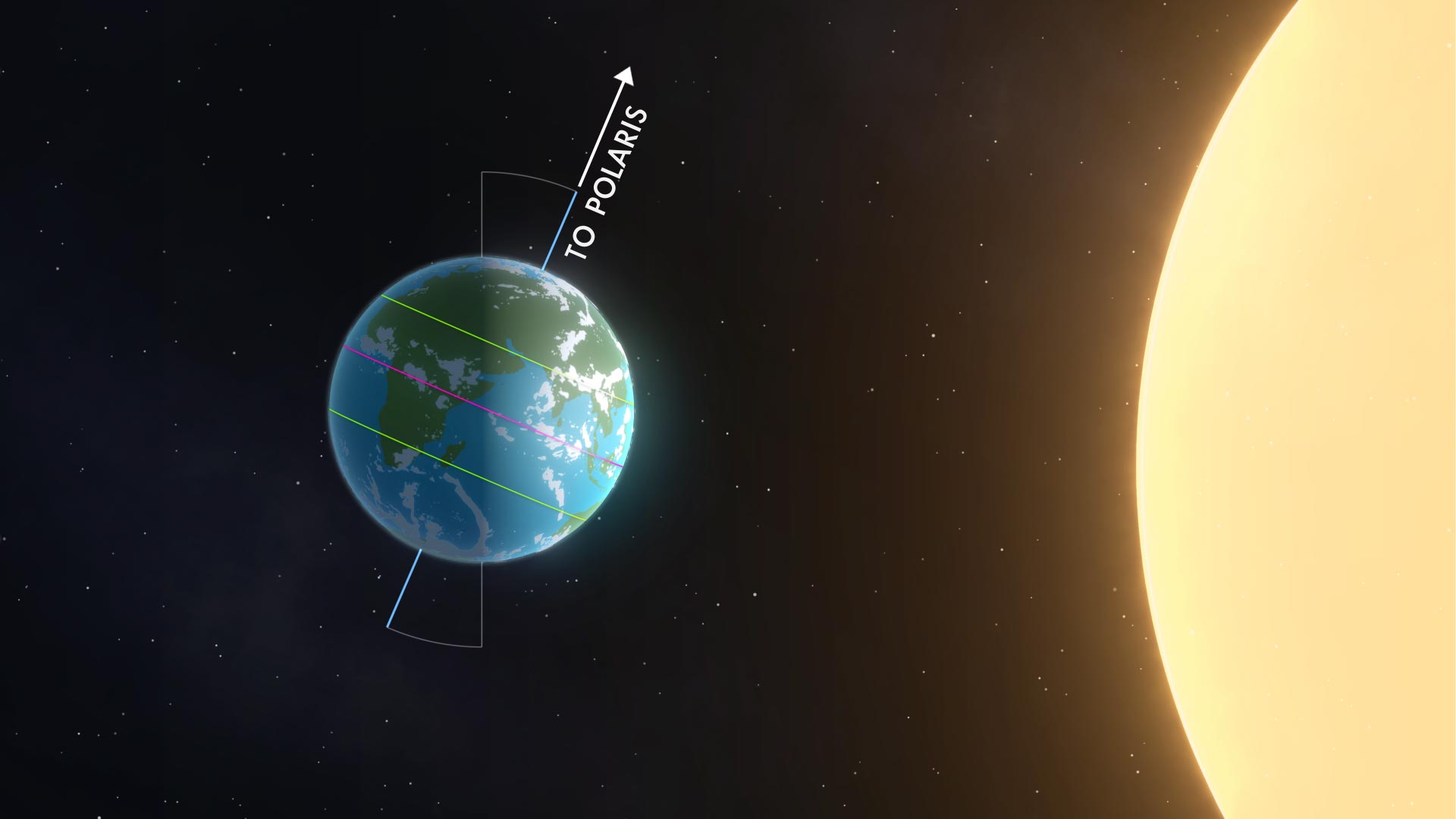
Earth’s tilted rotation is the culprit. The tilt is always in the same direction, with the North Pole always pointing toward Polaris, the North Star. And since that tilt stays the same, year round, when we’re on one side of the Sun in winter, the north part of the planet is tilted away from the Sun. But six months later, the planet moves halfway around its annual path, carrying us to the opposite side of Earth’s orbit, and the northern part of the planet now finds itself tilted toward the Sun. The June solstice is when this tilt is at its maximum. This is summertime for the north, bringing long days, lots more sunlight, and warmer temperatures.
The June solstice marks a precise moment in Earth’s orbit – a consistent astronomical signpost that humans have observed for millennia. Ancient structures from Stonehenge to Chichén Itzá were built, in part, to align with the solstices, demonstrating how important these celestial events were to many cultures.
So whether you’re experiencing long summer days in the northern hemisphere or the brief daylight hours of winter in the south, find a quiet spot to watch the sunset on this special day and you’ll be participating in one of humanity’s oldest astronomical traditions, connecting you to observers across thousands of years of human history.
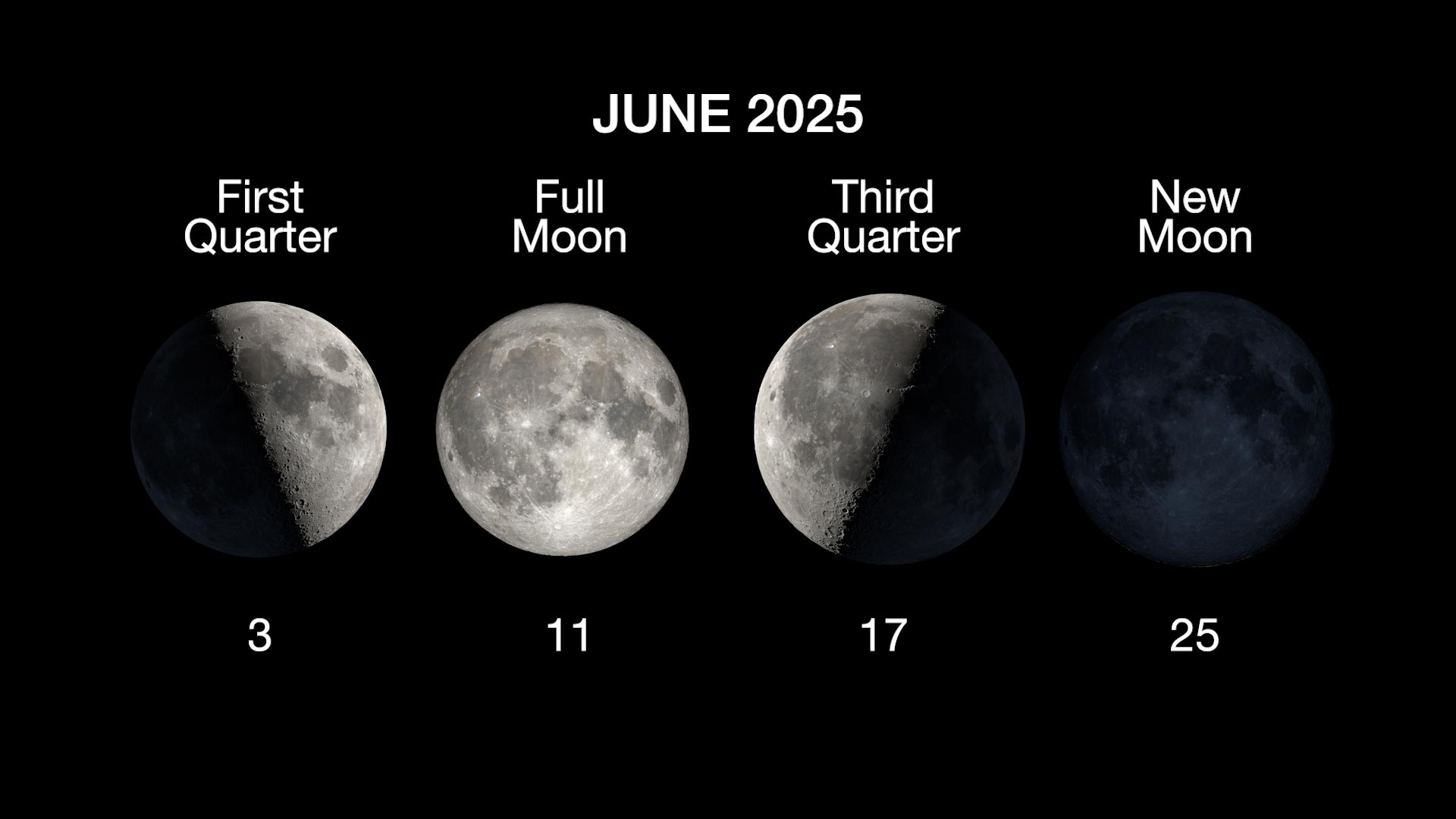
Here are the phases of the Moon for June.
Never miss a breakthrough: Join the SciTechDaily newsletter.
Follow us on Google and Google News.