
What are some skywatching highlights in January 2023?
Some lovely groupings this month include the Moon with Mars, and later with Jupiter, and a close conjunction of Venus and Saturn. The brilliant stars of the Northern Hemisphere’s winter sky are a dazzling sight all month long. And a comet discovered last March makes its closest approach to Earth in January, gracing pre-dawn skies.
What to look for:
Two conjunctions, winter stars, and a comet! The Moon and several planets have close encounters, a new comet graces morning skies, and the stars of Northern Hemisphere winter dazzle.
- All month – Comet C/2022 E3 (ZTF) is observable with binoculars or a small telescope in the predawn sky for Northern Hemisphere observers. It works its way swiftly across the northern sky during the month. (Check your favorite skywatching app for the comet’s position on the date you’re observing.)
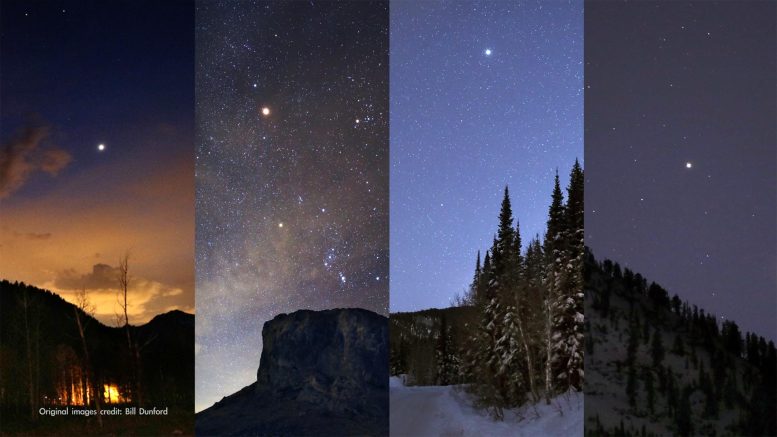
- All month – The January sky is filled with bright stars in the constellations Orion, Taurus, Gemini, Canis major, and Canis minor. Find these cosmic gems by looking toward the southeast in the first few hours after it gets dark.
- January 2 – After sunset, find the Moon and Mars high in the southeast, in a lovely grouping with the Pleiades and Aldebaran.
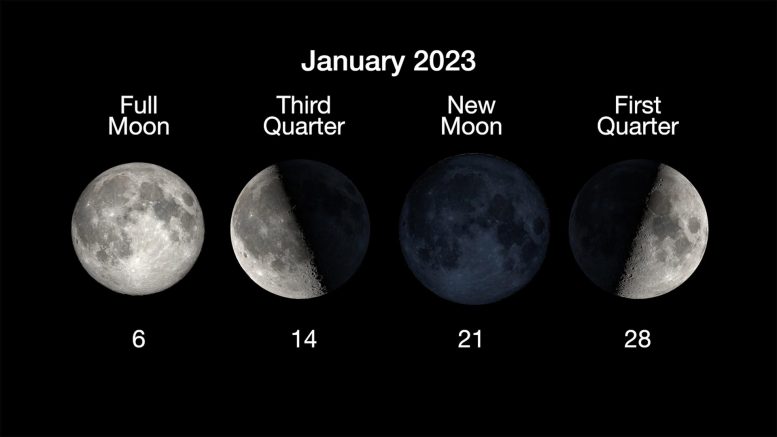
- January 6 – Full moon
- January 18-24 – Watch Venus cross paths with Saturn over several days after sunset. Look for the pair low in the southwest about 45 minutes after the Sun dips below the horizon.
- January 21 – New moon
- January 22 – Venus and Saturn are super close together in the sky after sunset. They’ll appear only a third of a degree apart – that’s a third of the width of your index finger held at arm’s length. Look for the pair low in the southwest about 45 minutes after the Sun dips below the horizon.
- January 23 – Venus and Saturn are just a degree apart in the sky – the width of your index finger held at arm’s length. The slim crescent Moon hangs just above them tonight. Look for the trio low in the southwest about 45 minutes after the Sun dips below the horizon.
- January 25 – Look to the southwest 30-45 minutes after sunset to find the Moon only a degree apart from Jupiter, about halfway up the sky.
- January 12 – Recently discovered comet C/2022 E3 (ZTF) is at its closest to the Sun today, and will pass Earth at a distance of 26.4 million miles (42.5 million km) on Feb. 2. The comet is visible with binoculars or a small telescope in the predawn sky.
Video Transcript:
What’s Up for January? The planets have some close encounters, the bright stars of winter, and a chance to catch a comet.
All month after sunset, you can see four planets without the aid of binoculars or a telescope. You’ll find Mars in the east, Jupiter high overhead, and Saturn in the southwest with Venus. January 2nd finds the Moon and Mars high in the southeast after sunset, in a lovely grouping with the Pleiades and Aldebaran. Then from about January 18th to the 24th, watch Venus cross paths with Saturn as the glow of sunset fades. Look for the pair low in the southwest about 45 minutes after the Sun dips below the horizon. The two planets appear at their closest on Jan. 22, when they’ll be only a third of a degree apart on the sky. You’ll be able to capture both of them in the same field of view through binoculars or a small telescope. On the 23rd, the two planets are still only a degree apart, and will be joined by a slim crescent moon. And on January 25th, looking to the southwest 30-45 minutes after sunset, look high above Venus and Saturn to find the Moon only a degree apart from Jupiter, about halfway up the sky.
January nights are filled with bright stars. Looking toward the south or southeast in the first few hours after dark, you’ll spy the bright constellations of winter in the Northern Hemisphere: Of course, there’s Orion the hunter; the big dog constellation Canis Major; and the lesser-known little dog, Canis Minor with its bright star Procyon. Y-shaped Taurus, the bull, includes the bright Hyades and Pleiades star clusters. And just east of Orion, you’ll find the bright stars Castor and Pollux, which form the heads of the twins in Gemini. Make sure you take a moment to appreciate the beauty of the January sky, which more than meets the definition of “star-studded,” with so much to marvel at.
A recently discovered comet is now passing through the inner solar system and should be visible with a telescope and likely with binoculars. The comet, which has a mouthful of a name – C/2022 E3 (ZTF) – was first sighted in March last year, when it was already inside the orbit of Jupiter. It makes its closest approach to the Sun on January 12, and then passes its closest to Earth on February 2.
Comets are notoriously unpredictable, but if this one continues its current trend in brightness, it’ll be easy to spot with binoculars, and it’s just possible it could become visible to the unaided eye under dark skies.
Observers in the Northern Hemisphere will find the comet in the morning sky, as it moves swiftly toward the northwest during January. (It’ll become visible in the Southern Hemisphere in early February.) This comet isn’t expected to be quite the spectacle that Comet NEOWISE was back in 2020. But it’s still an awesome opportunity to make a personal connection with an icy visitor from the distant outer solar system.
Stay up to date with all of NASA’s missions to explore the solar system and beyond at nasa.gov. I’m Preston Dyches from NASA’s Jet Propulsion Laboratory, and that’s What’s Up for this month.
Never miss a breakthrough: Join the SciTechDaily newsletter.
Follow us on Google and Google News.
1 Comment
It’s wonderful.