
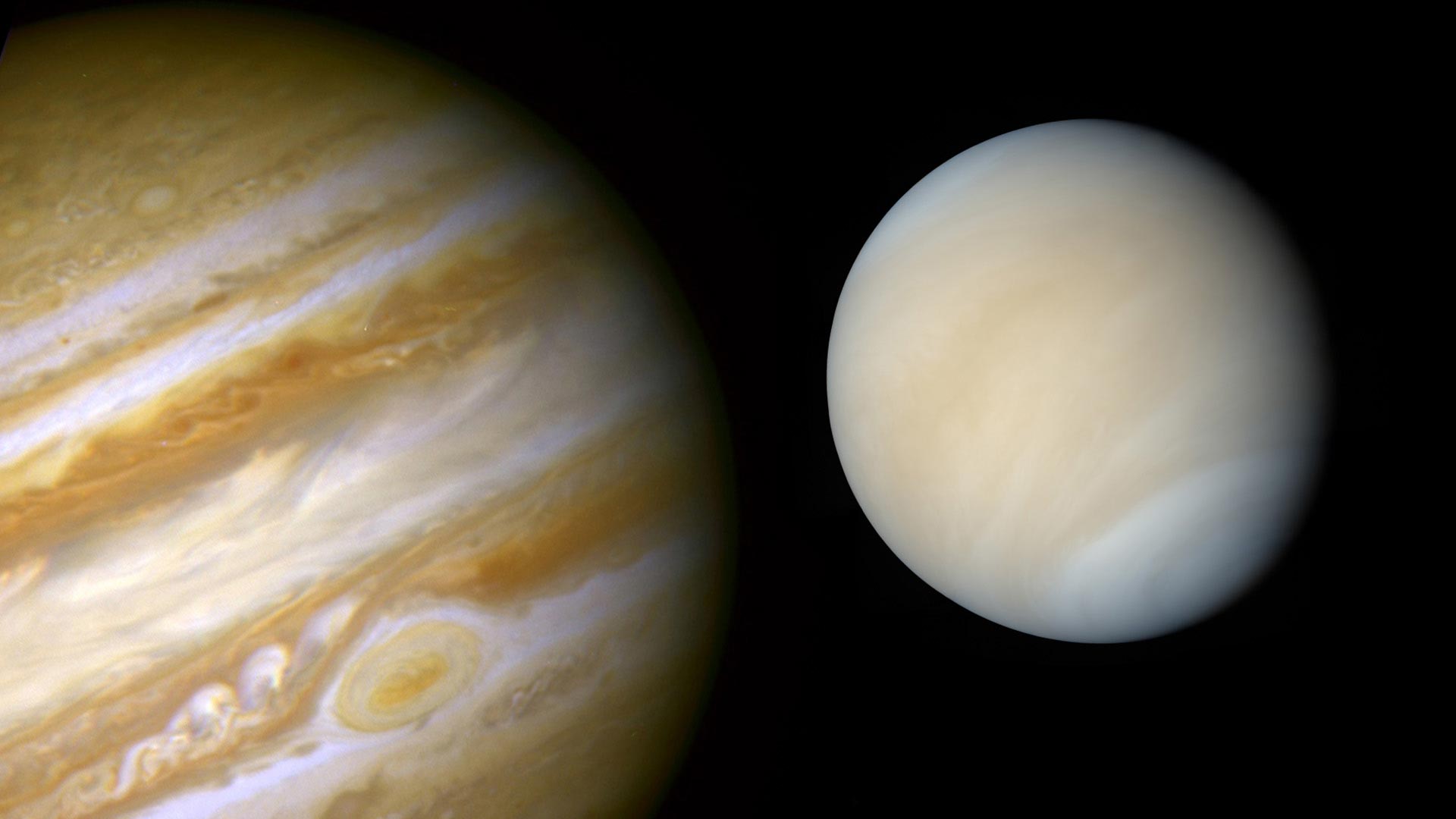
Venus-Jupiter Conjunction and Meteor Mojo
Venus and Jupiter shine together in a rare, close morning conjunction this August. The Perseid meteor shower is dimmed by moonlight, but Saturn, Mars, and the beautiful Dumbbell Nebula keep skywatchers entertained.
A close conjunction of Jupiter and Venus peaks on the 11th and 12th. Viewing the Perseid meteors will be hampered by a bright Moon. And look for the Dumbbell Nebula, which offers a peek into how stars like our Sun go out in style. Credit: NASA Jet Propulsion Laboratory
Skywatching Highlights
All Month – Planet Visibility:
- Mercury: Begins to make an appearance above the horizon in the second half of August. It stays very low in the sky, remaining under 10 degrees in altitude.
- Venus: Continues to shine exceptionally bright in the eastern sky each morning before sunrise. Look for it about 20 to 30 degrees above the horizon.
- Mars: Visible low in the western sky for about an hour after sunset. It is roughly as bright as the most prominent stars in the Big Dipper.
- Jupiter: Also rises in the east during the early morning hours, positioned near Venus. However, it appears significantly dimmer by comparison.
- Saturn: Best viewed between late night and dawn. It rises around 10:30 p.m. at the start of the month, shifting to about 8:30 p.m. by month’s end. As sunrise nears, it will be high in the southern sky.
Skywatching Highlights:
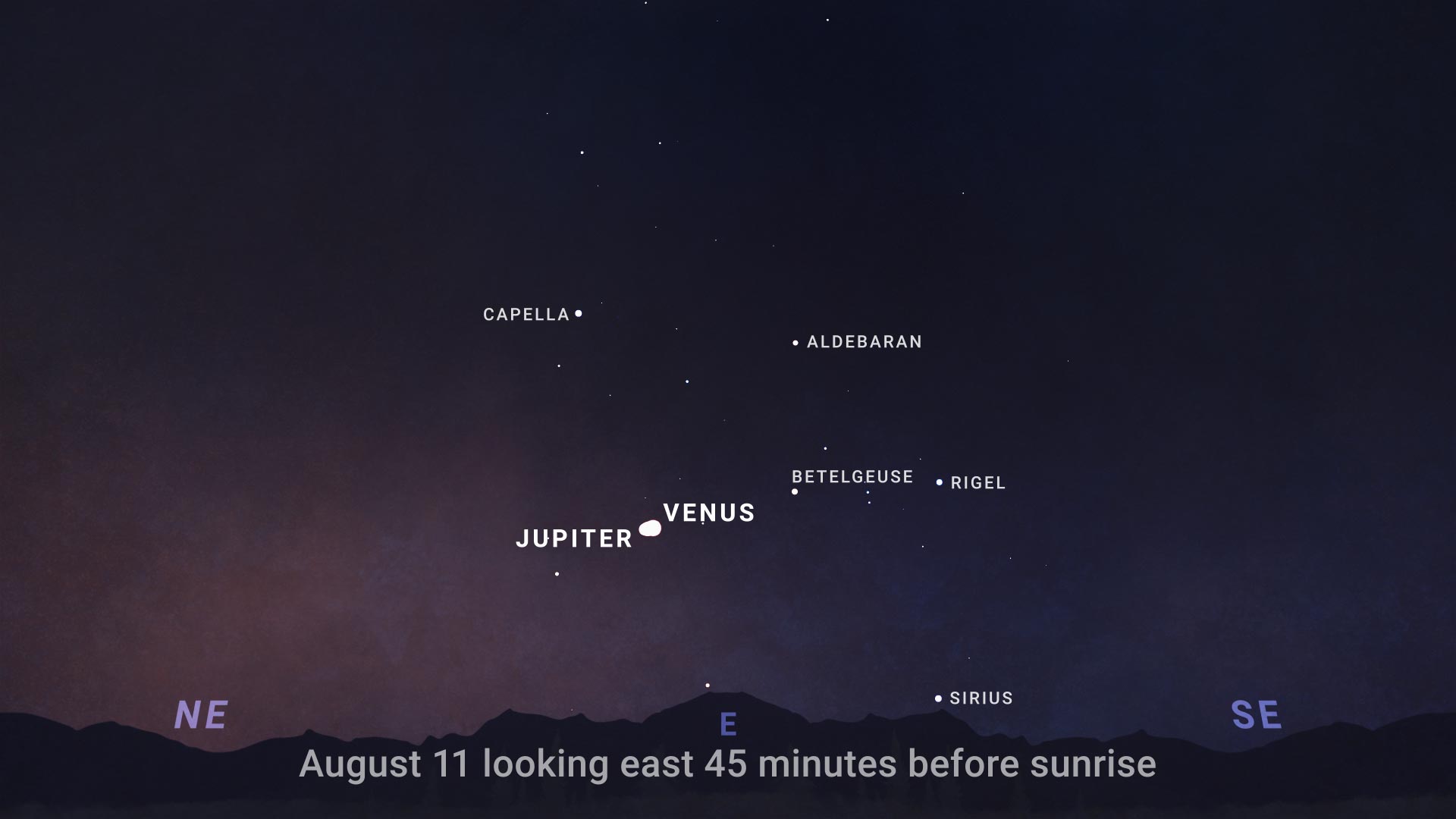
August 11 & 12 – Venus-Jupiter Conjunction – The two brightest planets in the sky will appear to move very close to each other over several days. They reach their closest point on August 11 and 12, separated by only about one degree.
August 19 & 20 – Moon with Jupiter & Venus – A thin crescent Moon will appear near Venus and Jupiter in the early morning sky. The planets remain fairly close after their earlier conjunction and can be seen in the eastern sky during the hours before sunrise.
August 12th-13th – Perseids Peak – The popular Perseids meteor shower reaches its peak overnight between August 12 and 13. However, an 84% full Moon will brighten the sky and reduce visibility. A few bright meteors might still be visible before dawn, but overall viewing conditions will be poor this year.
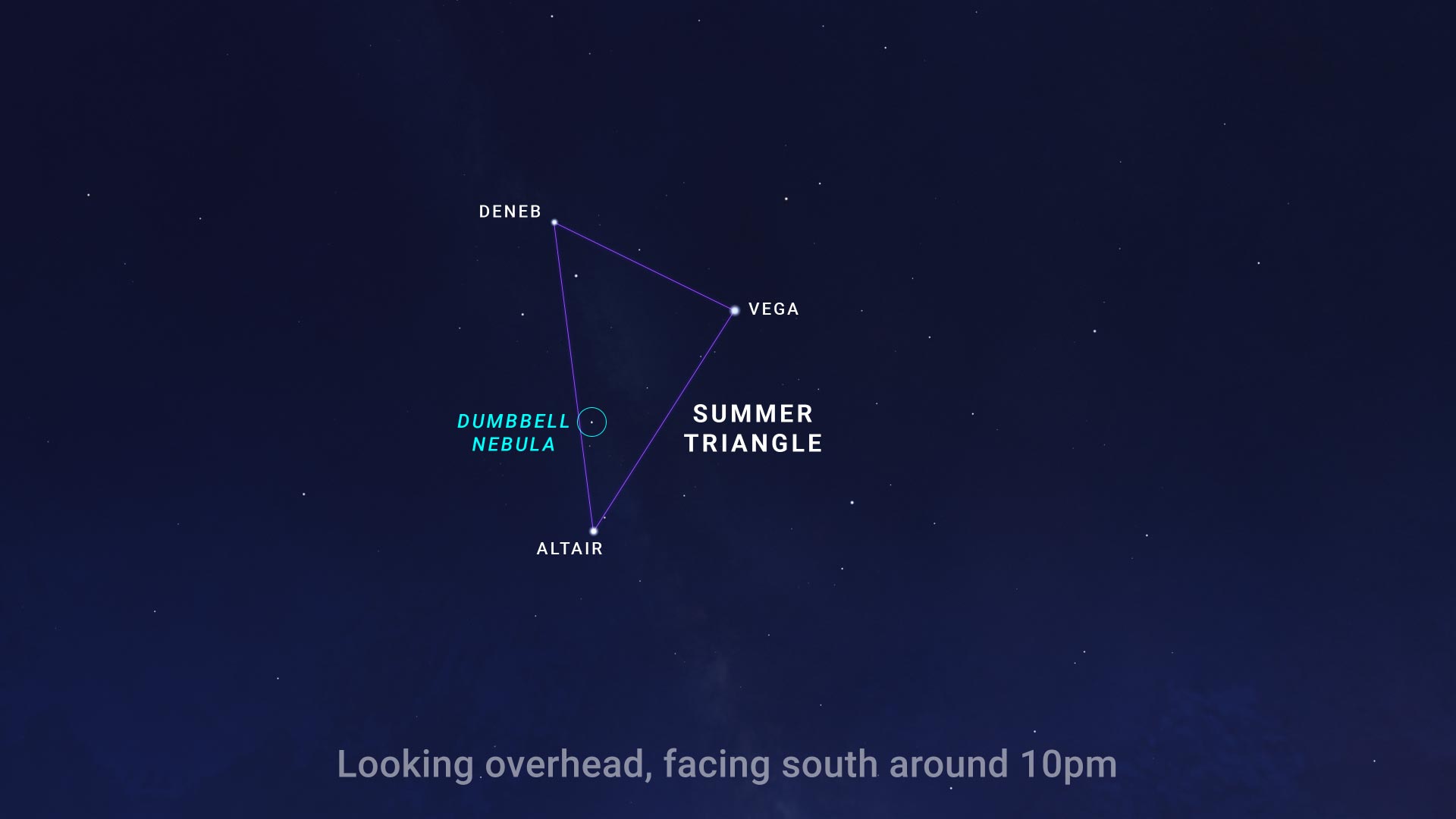
All month – The Dumbbell Nebula (M27) – The Dumbbell Nebula, also known as M27, is one of the easiest planetary nebulas to spot with a telescope or binoculars. It lies within the Summer Triangle star pattern and appears high overhead during the first half of the night.
Transcript
What’s Up for August? Jupiter and Venus have a morning meetup, we check out this year’s Perseid meteor shower, and peek into the future of our own Sun.
Mars is the lone planet in the early evening sky this month, visible low in the west for about an hour after the sky starts to darken. It’s now only about 60% as bright as it appeared back in May.
Saturn is rising by about 10 pm, and you’ll see it showing up a bit earlier each evening as the month goes on. You’ll find it in the east after dark with the constellations Cassiopeia and Andromeda. The Ringed Planet makes its way over to the western part of the sky by dawn, where early risers will find it on August mornings.
The real highlight of August is the close approach of Jupiter and Venus. They shine brightly in the east before sunrise throughout the month. The pair begins the month farther apart, but quickly approaches each other in the sky. They appear at their closest on the 11th and 12th — only about a degree apart. Their rendezvous happens against a backdrop of bright stars, including Orion, Taurus, Gemini, and Sirius. A slim crescent Moon joins the pair of planets after they separate again, on the mornings of the 19th and 20th.
One of the best annual meteor showers, the Perseids, peaks overnight on August 12th and into the 13th. Unfortunately, this year the Moon is nearly full on the peak night, and its glare will wash out all but the brightest meteors. While that’s not so great for Perseid watchers, the good news is that another favorite annual meteor shower, the Geminids, is poised for Moon-free viewing in December.
August is a great time to see one of the easiest-to-observe nebulas in the sky.
The Dumbbell Nebula, also known as M27, is high overhead on August nights. It’s a type of nebula called a “planetary nebula.”
A nebula is a giant cloud of gas and dust in space, and planetary nebulas are produced by stars like our Sun when they become old and nuclear fusion ceases inside them. They blow off their outer layers, leaving behind a small, hot remnant called a white dwarf. The white dwarf produces lots of bright ultraviolet light that illuminates the nebula from the inside, as the expanding shell of gas absorbs the UV light and re-radiates it as visible light.
The Dumbbell Nebula, nicknamed for its dumbbell-like shape, appears as a small, faint patch of light about a quarter of the width of the full moon in binoculars or a small telescope. It lies within the Summer Triangle, a pattern of stars that’s easy to find overhead in the August sky. You’ll find the nebula about a third of the way between its bright stars Altair and Deneb.
Here’s hoping you get a chance to observe this glimpse into the future that awaits our Sun about 5 billion years from now. It’s part of a cycle that seeds the galaxy with the ingredients for new generations of stars and planets — perhaps even some not too different from our own.
Here are the phases of the Moon for August.

Never miss a breakthrough: Join the SciTechDaily newsletter.
Follow us on Google and Google News.
6 Comments
Disappointed about the Perseids.
سلام چرا زهره معکوس میگردد یک روز و شب در زهره 243 روز زمینی است اما مشتری بااینکه از زهره دورتر از خورشید قرار دارد از همه سیارات سریع تر میگردد علت را در مقاله زیر میتوانید مرور کنید
In previous articles, I had said that the
Milky Way has collided with solar objects and the Sun 69 times. This calculation is exactly correct. You should also calculate that the reason for the collision of the two arms of the galaxy with the Sun and solar objects is the difference in speed between the Sun and the two large arms of the Milky Way. For more information, send me a short message: Dr. Kasheri’s WhatsApp number is 00989058221755.
How long does it take for the stars of the Milky Way to pass through the solar system? This time depends on the diameter of the Milky Way galaxy arm. The larger the diameter of the Milky Way, the longer the time for these two large arms to pass. I determined this time. If the diameter of the Milky Way is 120 light years, the stars of the large arms of the galaxy will take about one million years to pass through the solar system. This is if you consider the speed of the Milky Way arms to be 600 kilometers per second. At this speed and the speed of the Sun, which is 230 kilometers per second, the Milky Way will approach the Sun at a speed of 370 kilometers per second. This large arm of the galaxy will approach the Solar System by eleven billion and 688 million kilometers per year. In a period of one million years, dozens of stars and small planets will collide with the Sun and solar bodies. This collision took place 65 million years ago and the life of the dinosaurs that lived with humans on Earth was destroyed. However, before this incident, humans moved the soil of the Philippine Islands, Papua New Guinea, and Malaysia to form these islands. Dinosaurs changed their shape. This change in shape took at least tens of thousands of years. If we, modern humans, dig into the soil of the Papua New Guinea islands to a depth of several thousand meters, we will find machines and urban structures that were built by humans on this planet 65 million years ago. They must have left many secrets in the soil for us, modern humans. These secrets will be historical and cultural inscriptions with statues made of precious metals. If we obtain and prepare a map of the submerged lowlands of the Philippine Islands and feed these maps from the bottom to the surface of the ocean coasts of the Philippine Islands to a supercomputer and lower the ocean water to a height of several hundred meters, the true shape of the Papua New Guinea islands and the Philippines will appear in the computer, and the hands and feet of the dinosaur that humans created will appear in the real map of the Philippines and Papua New Guinea. The reason why Jupiter rotates rapidly around itself and Venus moves around itself is because of the passage of stars and objects of the Milky Way through the solar system. In the past, perhaps More than a dozen stars and very, very small planets collided with the Sun and the planets Jupiter and Venus, causing all these changes in the solar system
How long does it take for the stars of the Milky Way to pass through the solar system? This time depends on the diameter of the Milky Way galaxy arm. The larger the diameter of the Milky Way, the longer the time for these two large arms to pass. I determined this time. If the diameter of the Milky Way is 120 light years, the stars of the large arms of the galaxy will take about one million years to pass through the solar system. This is if you consider the speed of the Milky Way arms to be 600 kilometers per second. At this speed and the speed of the Sun, which is 230 kilometers per second, the Milky Way will approach the Sun at a speed of 370 kilometers per second. This large arm of the galaxy will approach the Solar System by eleven billion and 688 million kilometers per year. In a period of one million years, dozens of stars and small planets will collide with the Sun and solar bodies. This collision took place 65 million years ago and the life of the dinosaurs that lived with humans on Earth was destroyed. However, before this incident, humans moved the soil of the Philippine Islands, Papua New Guinea, and Malaysia to form these islands. Dinosaurs changed their shape. This change in shape took at least tens of thousands of years. If we, modern humans, dig into the soil of the Papua New Guinea islands to a depth of several thousand meters, we will find machines and urban structures that were built by humans on this planet 65 million years ago. They must have left many secrets in the soil for us, modern humans. These secrets will be historical and cultural inscriptions with statues made of precious metals. If we obtain and prepare a map of the submerged lowlands of the Philippine Islands and feed these maps from the bottom to the surface of the ocean coasts of the Philippine Islands to a supercomputer and lower the ocean water to a height of several hundred meters, the true shape of the Papua New Guinea islands and the Philippines will appear in the computer, and the hands and feet of the dinosaur that humans created will appear in the real map of the Philippines and Papua New Guinea. The reason why Jupiter rotates rapidly around itself and Venus moves around itself is because of the passage of stars and objects of the Milky Way through the solar system. In the past, perhaps More than a dozen stars and very, very small planets collided with the Sun and the planets Jupiter and Venus, causing all these changes in the solar system
In the article above, I said that it would take a million years for the large arm of the Milky Way to pass the Sun, but that would be if the Milky Way were more than a thousand light years wide, not 120 light years. If today’s humans could go to Mars before the stars of the Milky Way collided with the Sun and solar objects, and if they could farm on Mars to last a million years, they would return to Earth.
When the stars and very small planets of the Milky Way pass the Sun and the Solar System, which takes a million years for the large arm of the Milky Way to pass through this path, and if humans can live on Mars and return to Earth within a million years. It is true that humans on Mars will most likely be safe from meteorite impacts, but humans need agriculture and animal husbandry to live on Mars, and that is very, very difficult. A million years is a long time, which is the same time that the Milky Way passed through the Solar System. The earlier humans who lived with the dinosaurs 65 million years ago did not succeed in continuing their lives. Within a million years, when the large arm of the galaxy collided with the Sun and the Solar System. They continued. The stars and small planets of the Milky Way will take a million years to pass through the Solar System. Over the course of a million years, more than 60 stars that are up to a hundred times smaller than the Sun will collide with the Sun and the Solar System. It would be almost impossible for humans to survive a million years on Mars and return to Earth. Every year, the stars in the Milky Way’s large arm approach the Sun at a speed of 370 kilometers per second, or 11.89 billion kilometers. Considering the distance of the nearest star in the Milky Way, which is about 40 trillion kilometers from the Sun, in about 3,600 years this star will reach the Sun and 100% of the planets that accompany this star, Alpha Centauri, will collide with the Sun. This is just the beginning of the tragic incident of collisions of Milky Way stars with the Sun and solar bodies