
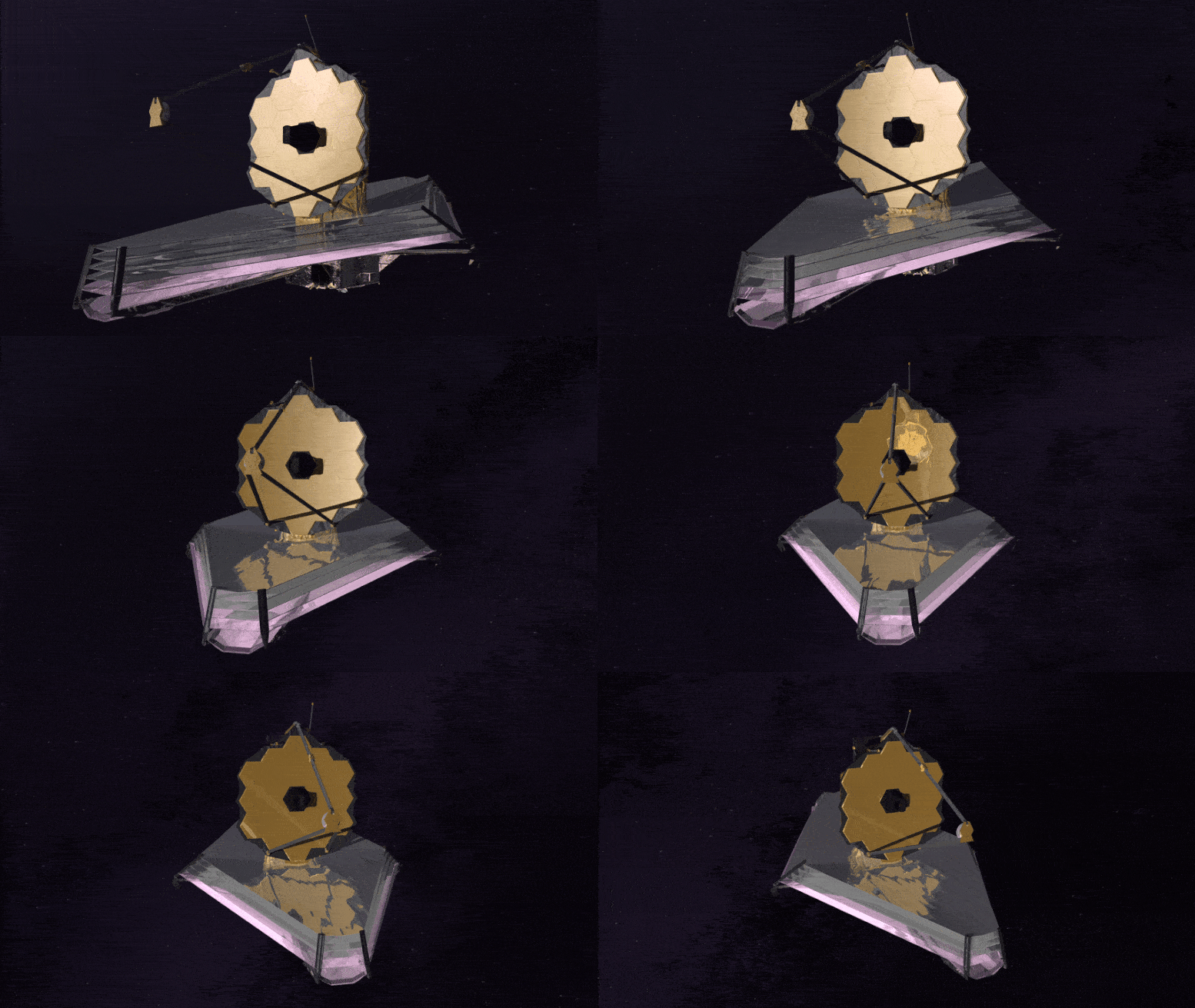
NASA’s Webb telescope now has enough fuel for well beyond a decade of science, thanks to a precise launch and efficient corrections.
After a successful launch of NASA’s James Webb Space Telescope on December 25, and completion of two mid-course correction maneuvers, the Webb team has analyzed its initial trajectory and determined the observatory should have enough propellant to allow support of science operations in orbit for significantly more than a 10-year science lifetime. (The minimum baseline for the mission is five years.)

The analysis shows that less propellant than originally planned for is needed to correct Webb’s trajectory toward its final orbit around the second Lagrange point known as L2, a point of gravitational balance on the far side of Earth away from the Sun. Consequently, Webb will have much more than the baseline estimate of propellant – though many factors could ultimately affect Webb’s duration of operation.
Webb has rocket propellant onboard not only for midcourse correction and insertion into orbit around L2, but also for necessary functions during the life of the mission, including “station keeping” maneuvers – small thruster burns to adjust Webb’s orbit — as well as what’s known as momentum management, which maintains Webb’s orientation in space.
The extra propellant is largely due to the precision of the Arianespace Ariane 5 launch, which exceeded the requirements needed to put Webb on the right path, as well as the precision of the first mid-course correction maneuver – a relatively small, 65-minute burn after launch that added approximately 45 mph (20 meters/sec) to the observatory’s speed. A second correction maneuver occurred on December 27, adding around 6.3 mph (2.8 meters/sec) to the speed.
Solar Array Deployed Early
The accuracy of the launch trajectory had another result: the timing of the solar array deployment. That deployment was executed automatically after separation from the Ariane 5 based on a stored command to deploy either when Webb reached a certain attitude toward the Sun ideal for capturing sunlight to power the observatory – or automatically at 33 minutes after launch. Because Webb was already in the correct attitude after separation from the Ariane 5 second stage, the solar array was able to deploy about a minute and a half after separation, approximately 29 minutes after launch.
From here on, all deployments are human-controlled so deployment timing – or even their order — may change. Explore what’s planned here.
Never miss a breakthrough: Join the SciTechDaily newsletter.
Follow us on Google and Google News.
11 Comments
Way-to-go NASA with the Web Scope launch!! Having all that extra fuel is great
to hear, because the tax payers get more bang for the buck; The big bang perhaps,
which would be awesome to see or know more about. Very best in 2022!
Might want to thank ESA for the launch. Not to downplay the incredible success NASA has had so far with the program.
Yes thanks ESA for learning so much from NASA that you helped out in this part of the JWT deployment. Now thank US taxpayers for footing the bill! Such an ungrateful world to USA. Think about it.
I think thanks to both. Of course most of credit goes to NASA and people who lobbied for the telescope but we should not forget Canadian and European space agencies which helped both financialy and technologicaly!
OMG, what an ignorant comment !
1°) Ariane Espace has been launching satellites for DECADES now and has acquired a sterling reputation for extreme reliability !! Which no doubt was the main reason why NASA trusted them with their “Crown Jewel” that is JWT, over any other potential competitors, American ones included !!!
The outstanding precision and quality of the launch just demonstrated how well advised NASA’s choice was. If ever a mission needed maximized fuel reserve it’s this incredibly ambitious project.
2°) For your information (which – obviously – you sorely need) ESA has always been entirely funded by Europeans countries and developed its technologies and top notch technical expertise without any help of the ever “much-put-upon” poor American taxpayer !!
(Meanwhile, BTW, said American taxpayer doesn’t seem to mind much the tens of billions of dollars wasted regularly on highly questionable or badly managed military hardware…Go figure…).
3°) As for the JWT, it is a FANTASTIC piece of engineering which is a credit to NASA as the project leader but also to the other participants such as the Canadian Space Agency and ESA, who developed and built several elements of the JWT.
So, as many space endeavours nowadays, JWT is the result of a trusting, intelligent and efficient international collaboration, everyone bringing their very best to the table.
Anyone who cares about space exploration and science is overjoyed with that success no matter their nationality : it’s a win for humankind, period.
Get your narrow and jingoistic mind wrapped around all that if you can (which I doubt).
(Jeez, some people are a piece work, really….)
Obviously, my reply was to “Rapido Conejo” an his asinine comment.
Well done to all individuals,this extra fuel 🤔. Prolonged life eeeegoreeee. Nice scientists😇👽
I hope they build in a way to refuel the telescope. Just like Hubble it will probably still be extremely valuable 10 years from now.
What happens after 10yrs or fuel depletion? Will Webb get pulled to sun or earth?
It should fall back to earth.
Great news!! Happy New Year NASA/ESA!!