
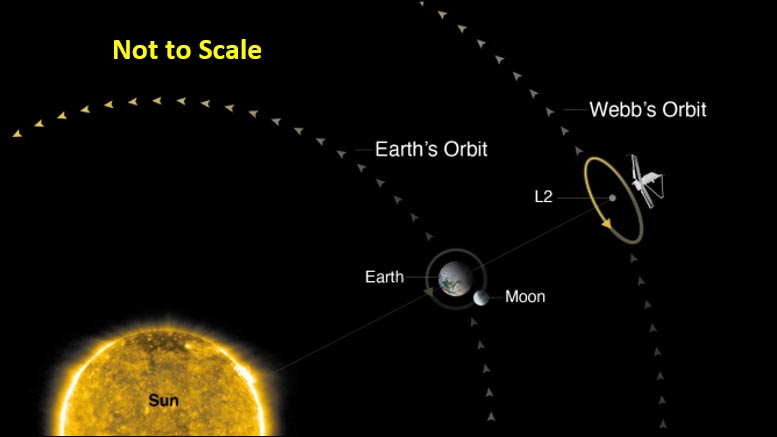
Webb completed its critical first burn, MCC-1a, guiding it toward L2. The burn was deliberately conservative, since Webb’s thrusters can only push away from the Sun, not back toward it. Engineers design these maneuvers to keep Webb safely on the uphill side of the gravitational slope.
On December 25, the Webb team successfully executed the first of three planned orbit corrections to get Webb into its halo orbit around the second Lagrange point, L2. To hear more about these important maneuvers, here is Randy Kimble, the Webb Integration, Test, and Commissioning Project Scientist, at NASA Goddard:
In sending the Webb Observatory into its orbit around the Sun-Earth L2 point, the vast majority of the energy required was provided by the Ariane 5 rocket. After release of the observatory from the rocket, several small tweaks to the trajectory are planned, to ease the observatory into its operating orbit about one month after launch.
The largest and most important mid-course correction (MCC), designated MCC-1a, has already been successfully executed as planned, beginning 12.5 hours after launch. This time was chosen because the earlier the course correction is made, the less propellant it requires. This leaves as much remaining fuel as possible for Webb’s ordinary operations over its lifetime: station-keeping (small adjustments to keep Webb in its desired orbit) and momentum unloading (to counteract the effects of solar radiation pressure on the huge sunshield).
The burn wasn’t scheduled immediately after launch to give time for the flight dynamics team to receive tracking data from three ground stations, widely separated over the surface of the Earth, thus providing high accuracy for their determination of Webb’s position and velocity, necessary to determine the precise parameters for the correction burn. Ground stations in Malindi Kenya, Canberra Australia, and Madrid Spain provided the necessary ranging data. There was also time to do a test firing of the required thruster before executing the actual burn. We are currently doing the analysis to determine just how much more correction of Webb’s trajectory will be needed, and how much fuel will be left, but we already know that the Ariane 5’s placement of Webb was better than requirements.
One interesting aspect of the Webb launch and the Mid-Course Corrections is that we always “aim a little bit low.” The L2 point and Webb’s loose orbit around it are only semi-stable. In the radial direction (along the Sun-Earth line), there is an equilibrium point where in principle it would take no thrust to remain in position; however, that point is not stable. If Webb drifted a little bit toward Earth, it would continue (in the absence of corrective thrust) to drift ever closer; if it drifted a little bit away from Earth, it would continue to drift farther away. Webb has thrusters only on the warm, Sun-facing side of the observatory. We would not want the hot thrusters to contaminate the cold side of the observatory with unwanted heat or with rocket exhaust that could condense on the cold optics. This means the thrusters can only push Webb away from the Sun, not back toward the Sun (and Earth). We thus design the launch insertion and the MCCs to always keep us on the uphill side of the gravitational potential, we never want to go over the crest – and drift away downhill on the other side, with no ability to come back.
Therefore, the Ariane 5 launch insertion was intentionally designed to leave some velocity in the anti-Sun direction to be provided by the payload. MCC-1a similarly was executed to take out most, but not all, of the total required correction (to be sure that this burn also would not overshoot). In the same way, MCC-1b, scheduled for 2.5 days after launch, and MCC-2, scheduled for about 29 days after launch (but neither time-critical), and the station-keeping burns throughout the mission lifetime will always thrust just enough to leave us a little bit shy of the crest. We want Sisyphus to keep rolling this rock up the gentle slope near the top of the hill – we never want it to roll over the crest and get away from him. The Webb team’s job, guided by the Flight Dynamics Facility at NASA Goddard, is to make sure it doesn’t.
-Randy Kimble, JWST Integration, Test, and Commissioning Project Scientist, NASA Goddard Space Flight Center
Never miss a breakthrough: Join the SciTechDaily newsletter.
Follow us on Google and Google News.