
Ripples in space-time caused by the death of massive spinning stars could be within the limits of detection of projects like LIGO and Virgo.
Collapsars, the collapsing remains of massive stars, may produce detectable gravitational waves, according to new simulations. These waves, created by material spiraling into black holes, could offer insights into the inner workings of stars and black holes, although identifying them remains a challenge.
Gravitational Waves From Star Deaths
The death of a massive, rapidly spinning star can shake the universe. And the resulting ripples — known as gravitational waves — could be felt by instruments on Earth, according to new research published on August 22 in The Astrophysical Journal Letters. These new sources of gravitational waves just await discovery, the scientists behind the research predict.
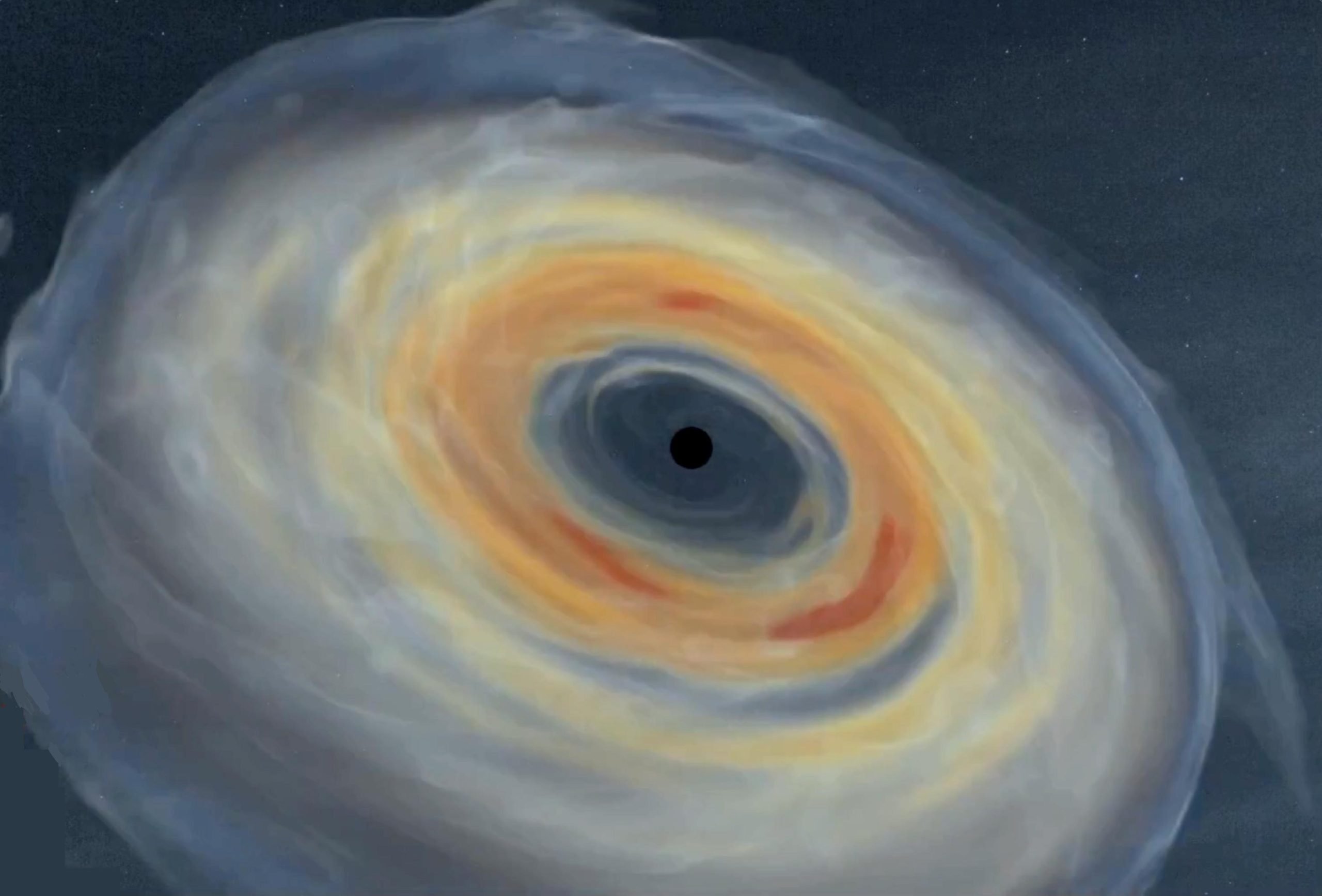
The gravitational waves emerge following the violent deaths of rapidly rotating stars 15 to 20 times the mass of the sun. Upon running out of fuel, these stars implode, then explode, in an event known as a collapsar. This leaves behind a black hole surrounded by a large disk of leftover material that quickly whirls into the black hole’s maw. The spiraling of material — which lasts just minutes — is so great that it distorts the space around it, creating gravitational waves that travel across the universe.
A simulation showing the distribution of matter around a newborn black hole following a collapsar event. Warmer colors denote higher densities of matter. Credit: Ore Gottlieb
Simulating Gravitational Wave Detection
Using cutting-edge simulations, the scientists determined that these gravitational waves could be detectable with instruments like the Laser Interferometer Gravitational-Wave Observatory (LIGO), which made the first direct observations of gravitational waves from merging black holes in 2015. If spotted, the collapsar-driven waves would help scientists understand the mysterious inner workings of collapsars and black holes.
“Currently, the only gravitational wave sources that we have detected come from a merger of two compact objects — neutron stars or black holes,” says study lead Ore Gottlieb, a research fellow at the Flatiron Institute’s Center for Computational Astrophysics (CCA) in New York City. “One of the most interesting questions in the field is: What are the potential non-merger sources that could produce gravitational waves that we can detect with current facilities? One promising answer is now collapsars.”
Detectable Gravitational Waves From Collapsars
Gottlieb, along with CCA visiting scholar and Columbia professor Yuri Levin and Tel Aviv University professor Amir Levinson, simulated the conditions — including magnetic fields and cooling rates — found in the aftermath of a massive rotating star’s collapse. The simulations showed that collapsars can produce gravitational waves powerful enough to be visible from about 50 million light-years away. That distance is less than one-tenth the detectable range of the more powerful gravitational waves from mergers of black holes or neutron stars, though it’s still stronger than any non-merger event yet simulated.
Unexpected Findings in Gravitational Wave Patterns
The new findings come as a surprise, Gottlieb says. Scientists thought the chaotic collapse would create a jumble of waves that would be hard to pick out amid the universe’s background noise. Think of an orchestra warming up. When each musician plays their own notes, it can be hard to distinguish the melody coming from a single flute or tuba. On the other hand, gravitational waves from the merger of two objects create clear, strong signals like an orchestra playing together. This is because when two compact objects are about to merge, they dance in a tight orbit that creates gravitational waves with each turn. This rhythm of near-identical waves amplifies the signal to a level that can be detected. The new simulations showed that the rotating disks around collapsars can also emit gravitational waves that amplify together, very much like the orbiting compact objects in mergers.
The Strength of Collapsar-Driven Waves
“I thought that the signal would be much messier because the disk is a continuous distribution of gas with material spinning in different orbits,” Gottlieb says. “We found that the gravitational waves from these disks are emitted coherently, and they’re also rather strong.”
Not only is the predicted signal from collapsar disks strong enough to be detected by LIGO, but Gottlieb’s calculations suggest that a few events might already be in existing datasets. Proposed gravitational wave detectors such as the Cosmic Explorer and Einstein Telescope could spot dozens a year.
Strategies for Detecting Collapsar Events
The gravitational wave community is already interested in looking for these events, but it is not an easy task. The new work calculated gravitational wave signatures for a modest number of potential collapsar events. Stars, however, span a wide range of mass and rotation profiles, which would create differences in the calculated gravitational wave signals.
“In principle, we would ideally simulate 1 million collapsars to be able to create a generic template, but unfortunately, these are very expensive simulations,” Gottlieb says. “So, for now, we have to pick other strategies.”
Scientists can look into historical data to see if any events are similar to the one Gottlieb simulated. Given the variety of stars, though, each with a potentially unique signal, finding a match for one of the simulated signals is probably unlikely. Another strategy is to use other signals from close by collapsar events — such as supernovae or gamma-ray bursts that are emitted during the star’s collapse — and then search the data archives to see if any gravitational waves were detected in that area of the sky around the same time.
Implications for Understanding Black Holes
Detecting collapsar-generated gravitational waves would help scientists better understand the inner structure of the star upon collapse and would also enable them to learn about the properties of black holes — two topics that remain poorly understood.
“These are things that we can otherwise not detect,” Gottlieb says. “The only way for us to study these inner stellar regions around the black hole is through gravitational waves.”
Reference: “In LIGO’s Sight? Vigorous Coherent Gravitational Waves from Cooled Collapsar Disks” by Ore Gottlieb, Amir Levinson and Yuri Levin, 22 August 2024, The Astrophysical Journal Letters.
DOI: 10.3847/2041-8213/ad697c
Never miss a breakthrough: Join the SciTechDaily newsletter.
Follow us on Google and Google News.