
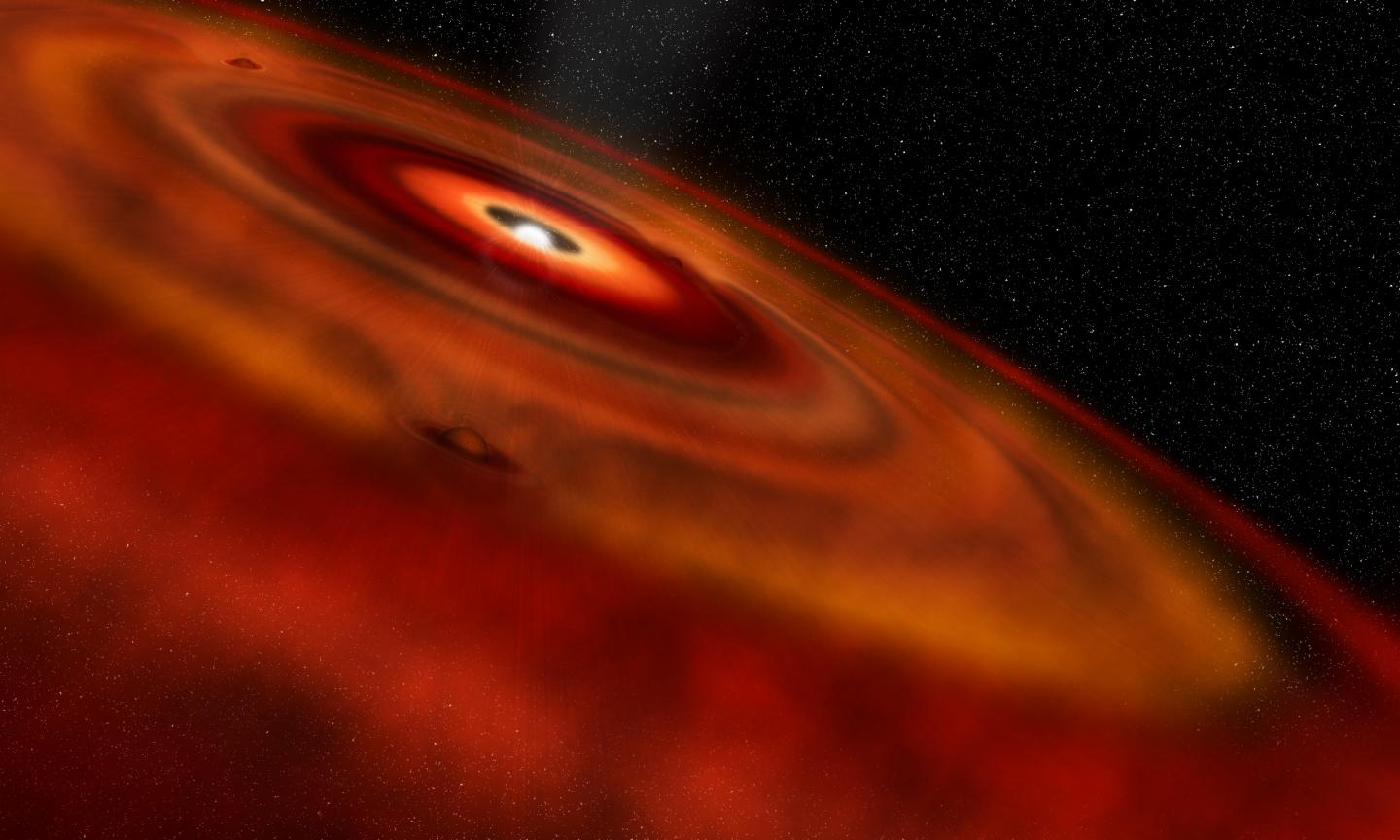
Astronomers see gestating baby planets, reveal the source of their formative atmospheres.
What does a gestating baby planet look like? New research in Nature by a team including Carnegie’s Jaehan Bae investigated the effects of three planets in the process of forming around a young star, revealing the source of their atmospheres.
In their youth, stars are surrounded by a rotating disk of gas and dust from which planets are born. Studying the behavior of the material that makes up these disks can reveal new details about planet formation, and the evolution of a planetary system as a whole.
The disk around a young star called HD 163296 is known to include several rings and gaps. Using 3-D visualizations taken by the Atacama Large Millimeter/submillimeter Array, or ALMA—a radio telescope made up of 66 antennas—Bae teamed with University of Michigan’s Richard Teague and Ted Bergin to determine the velocities of some of the gas spinning in this disk.
“We were struck by how dynamic the disk is,” Bae said. “There’s a lot going on around this star.”
They found three areas on either side of which the gas appears to be cascading into gaps in the disk, a good indication that planets could be forming in these locations. They were spotted at 87, 140, and 237 astronomical units, or AUs, from the star, with an AU being the distance between the Earth and our Sun.
They tested these findings by creating a computational model of the stellar system and inserting three planets—one half Jupiter’s mass, one equivalent to Jupiter, and one twice Jupiter’s mass—at the same distances from HD 163296 as the gas disturbances found by ALMA. Their simulation indicated that the observed cascades of disk gas could be well explained by the existence of the three planets.
Last year, Teague, Bae, and Bergin were part of a team that used one-dimensional measurements of the velocity of the gas in the same disk to demonstrate a new technique for finding young planets. This latest paper takes that tool to the next level, enabling an even deeper understanding of the planet-formation process.
“This gives us a much more complete picture of planet formation than we ever dreamed,” said Bergin.
Their efforts also confirmed a long-standing theory about how planets acquire their atmospheres.
“Planets form in the middle layer of the disk, the so-called midplane. This is a cold place, shielded from radiation from the star,” explained lead author Teague. “We think that the gaps caused by planets bring in warmer gas from the more chemically active outer layers of the disk, and that this gas will form the atmosphere of the planet.”
The next step is to determine the chemical composition of the gas added to planets’ atmospheres during this formative period.
“Looking ahead, analyzing the movement of material in a disk around a young star could help us find exoplanets while they are still in their most-formative stages,” Bae concluded. “This could really help us understand how the architecture of a planetary system comes to be and maybe even unlock mysteries about the evolution of our own Solar System.”
###
This work was supported, in part, by NASA.
ALMA is a partnership of the European Southern Observatory, the U.S. National Science Foundation, and the Japanese National Institutes of Natural Sciences, together with the Canadian National Research Council, the Academia Sinica Institute of Astronomy and Astrophysics in Taiwan, and the Korea Astronomy and Space Science Institute, in cooperation with Chile. The Joint ALMA Observatory is operated by ESO, Associated Universities,
Inc/National Radio Astronomy Observatory, and National Astronomical Observatory of Japan. The National Radio Astronomy Observatory is a facility of the National Science Foundation operated under a cooperative agreement by Associated Universities, Inc.
Computing resources are provided by the NASA High-End Computing (HEC) Program through the NASA Advanced Supercomputing Division at Ames Research Center and by the Extreme Science and Engineering Discovery Environment, which is supported by the U.S. National Science Foundation.
Reference: “Meridional flows in the disk around a young star” by Richard Teague, Jaehan Bae and Edwin A. Bergin, 16 October 2019, Nature.
DOI: 10.1038/s41586-019-1642-0
Never miss a breakthrough: Join the SciTechDaily newsletter.
Follow us on Google and Google News.