
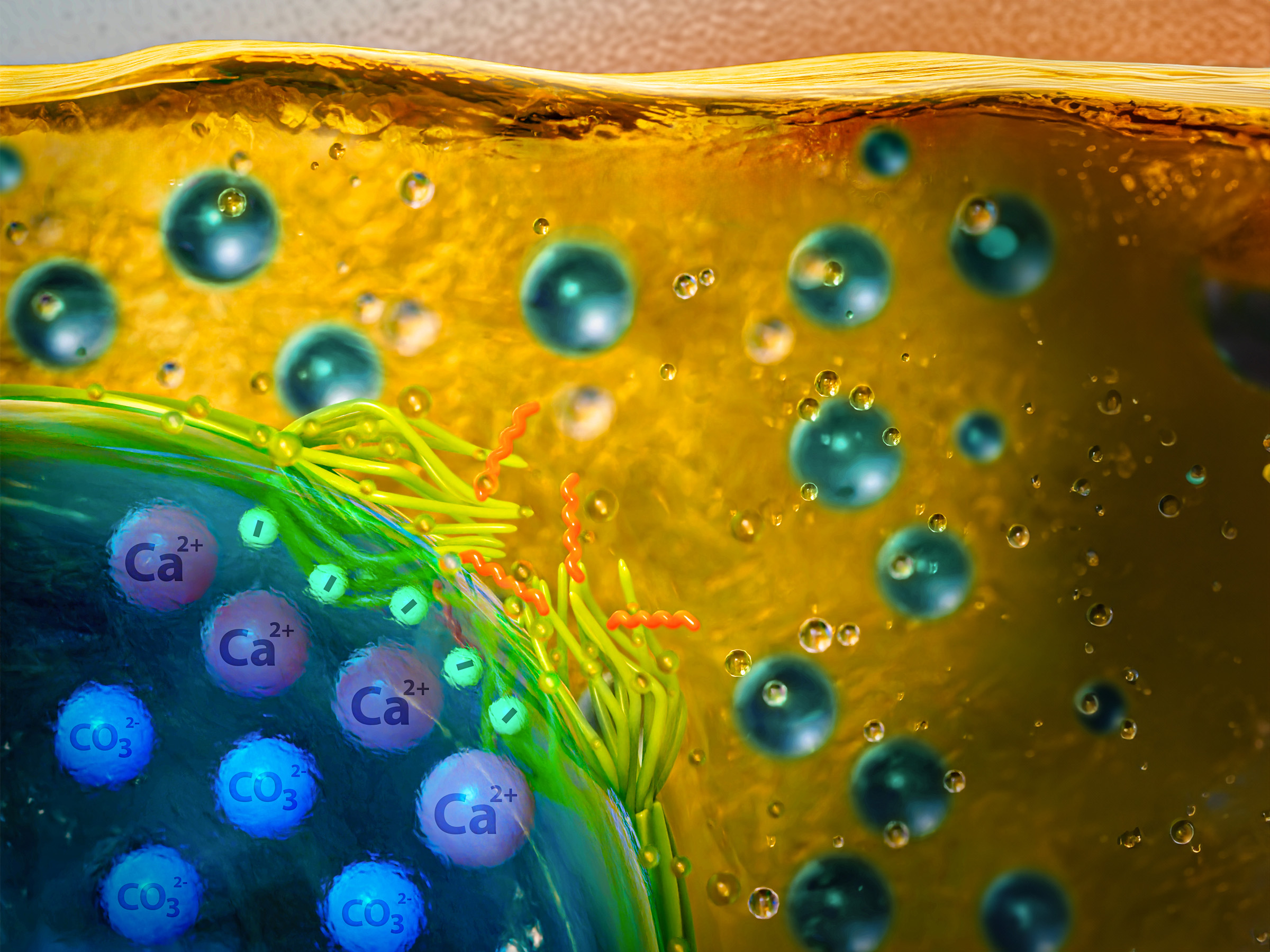
The development has the potential to enhance safety and minimize environmental impact, according to researchers.
During oil extraction, the accumulation of hard mineral deposits inside pipes and equipment can lead to severe operational damage, safety hazards like pipe explosions, and substantial economic losses. However, current methods for removing these mineral deposits can have harmful effects on the environment.
Penn State researchers have developed a new nanoparticle that can prevent scaling and stabilize a commonly used emulsion, or liquid mixture, potentially making the oil extraction processes more efficient and less harmful to the environment, according to the team. The material can also be used in other equipment handling water-oil emulsions.
Their results were published in ACS Applied Materials & Interfaces. The work was also featured on the journal’s supplementary cover.
“We aimed to tackle the challenge of calcium carbonate formation, known as scaling, in two-phase oil-water systems, dealt with in numerous water-based industries, such as oil and gas sectors,” said corresponding author Amir Sheikhi, associate professor of chemical engineering and the Dorothy Foehr Huck and J. Lloyd Huck Early Career Chair in Biomaterials and Regenerative Engineering.
The Challenge of Scaling in Industry
In many industries, such as oil and gas, pharmaceuticals, cosmetics, and food, water co-exists with an immiscible phase — such as an oil or an organic solvent unable to mix with water — making a two-phase system. If this system undergoes scaling, it may cause serious operational and safety hazards, according to Sheikhi, as it blocks pipes and destroys equipment.
“Current anti-scaling solutions either have adverse environmental impacts or are limited to working only in single-phase aqueous media,” Sheikhi said.
Developing a New Nanoparticle
To solve this problem, Sheikhi and his team first synthesized a cellulose-based nanoparticle, called anionic hairy cellulose nanocrystals (AHCNC), which was capable of preventing scale formation but was unable to stabilize water-in-oil emulsions. They then developed a new type of multifunctional, bio-based nanoparticle, called amphiphilic hairy cellulose nanocrystals (AmHCNC), with unique chemical and structural properties that not only prevent scale formation but also stabilize water-in-oil emulsions, which are common in oil extraction processes, according to the researchers.
“Our innovation lies in the nanoengineering of a type of nanoparticle — AmHCNC — that simultaneously prevents scaling and stabilizes water-in-oil emulsions via the Pickering mechanism — a combination that hasn’t been achieved,” said Sheikhi, explaining that the Pickering mechanism refers to a process that stabilizes the interface between two immiscible solvents with small solid particles, such as nanoparticles. “These anti-scaling particles are bio-based, environmentally safe, and cost-effective, offering a sustainable solution to the longstanding industrial problem of scaling.”
The researchers are now looking for partners to test their technology in real-world settings, such as in enhanced oil recovery, to evaluate its performance at a larger scale. They also plan to explore potential applications in other industries, such as cosmetics and food.
“This technology may provide new opportunities for sustainable and safer industrial practices,” said Sheikhi, who also has a courtesy appointment with the Department of Biomedical Engineering in the College of Engineering, the Department of Chemistry in the Eberly College of Science, and The Department of Neurosurgery in the College of Medicine.
Reference: “Antiscaling Pickering Emulsions Enabled by Amphiphilic Hairy Cellulose Nanocrystals” by Roya Koshani, Shang-Lin Yeh, Mica L. Pitcher and Amir Sheikhi, 5 August 2024, ACS Applied Materials & Interfaces.
DOI: 10.1021/acsami.4c03451
The papers co-authors are Roya Koshani, a postdoctoral scholar in the Penn State Department of Chemical Engineering; Shang-Lin Yeh, a doctoral student in chemical engineering at Penn State at the time of the research who is now working at PPG; and Mica L. Pitcher, a doctoral student in chemistry in the Penn State Eberly College of Science at the time of the research who is now working at PPG. Support from the donors of the American Chemical Society Petroleum Research Fund (research grant 61953-DNI5) partially covered the AHCNC studies. The development of AmHCNC was supported by the Penn State startup fund and the Dorothy Foehr Huck and J. Lloyd Huck Early Career Chair.
Never miss a breakthrough: Join the SciTechDaily newsletter.
Follow us on Google and Google News.