
Close Menu
    Facebook X (Twitter) Instagram
    SciTechDaily
    • Biology
    • Chemistry
    • Earth
    • Health
    • Physics
    • Science
    • Space
    • Technology
    Facebook X (Twitter) Pinterest YouTube RSS
    SciTechDaily
    Home»Space»Eerie Eclipse on the Red Planet: NASA’s Perseverance Spots “Googly Eye” in Mars Sky [Video]
    Space

    Eerie Eclipse on the Red Planet: NASA’s Perseverance Spots “Googly Eye” in Mars Sky [Video]

    By Jet Propulsion LaboratoryOctober 31, 2024No Comments5 Mins Read
    Facebook Twitter Pinterest Telegram LinkedIn WhatsApp Email Reddit
    Share
    Facebook Twitter LinkedIn Pinterest Telegram Email Reddit
    Googly Eye Mars Solar Eclipse
    NASA’s Perseverance rover recently captured an unusual “googly eye” effect on Mars, as the Martian moon Phobos passed in front of the Sun, obscuring part of it. Credit: NASA/JPL-Caltech/ASU/MSSS

    NASA’s Perseverance rover captured an intriguing astronomical event from Mars’ Jezero Crater: a transit of the Martian moon Phobos across the Sun.

    This rare event, resembling a “googly eye,” revealed not only the celestial dynamics of Mars’ moons but also offered insights into their orbit and future.

    Unusual Celestial Event Captured by Perseverance Rover

    From its vantage point on the western wall of Mars’ Jezero Crater, NASA’s Perseverance rover recently captured an unusual sight resembling a “googly eye” peering down from space. In this cosmic view, the “pupil” is Mars’ moon Phobos, while the “iris” is our Sun.

    On September 30, during the 1,285th Martian day of Perseverance’s mission, the rover’s Mastcam-Z captured Phobos—a potato-shaped moon—as it passed directly between the Sun and Mars, partially obscuring the Sun’s disc. As Phobos appeared as a large black circle swiftly crossing the Sun, its shadow, known as the antumbra, moved across Mars’ surface.


    NASA’s Perseverance Mars rover used its Mastcam-Z camera to capture the silhouette of Phobos, one of the two Martian moons, as it passed in front of the Sun on September 30, 2024, the 1,285th Martian day, or sol, of the mission. Perseverance has captured several Phobos transits since its landing at Mars’ Jezero Crater in February 2021. The video shows the transit speeded up by four times, followed by the eclipse in real time. Credit: NASA/JPL-Caltech/ASU/MSSS

    Historical and Astronomical Significance of Phobos

    Phobos was named in 1877 by astronomer Asaph Hall after the Greek god of fear and panic. (The word “phobia” comes from Phobos. And the word for fear of potatoes, and perhaps potato-shaped moons, is potnonomicaphobia.) Hall also named Mars’ second moon, Deimos, after Phobos’ mythological twin. Phobos, about 17 miles (27 kilometers) across at its widest, is roughly 157 times smaller than Earth’s Moon, and Deimos is even smaller.

    Roughly 157 times smaller in diameter than Earth’s Moon, Phobos is only about 17 miles (27 kilometers) at its widest point. Deimos is even smaller.

    Perseverance Captures Phobos Solar Eclipse
    NASA’s Perseverance Mars rover used its Mastcam-Z camera system to shoot video of Phobos, one of Mars’ two moons, eclipsing the Sun. It’s the most zoomed-in, highest-frame-rate observation of a Phobos solar eclipse ever taken from the Martian surface. Credit: NASA/JPL-Caltech/ASU/MSSS/SSI

    Observing the Skies of Mars

    Because Phobos’ orbit is almost perfectly in line with the Martian equator and relatively close to the planet’s surface, transits of the moon occur on most days of the Martian year. Due to its quick orbit (about 7.6 hours to do a full loop around Mars), a transit of Phobos usually lasts only 30 seconds or so.

    This is not the first time that a NASA rover has witnessed Phobos blocking the Sun’s rays. Perseverance has captured several Phobos transits (see images above and below) since landing at Mars’ Jezero Crater in February 2021. Curiosity captured a video in 2019. And Opportunity captured an image in 2004.

    By comparing the various images, scientists can refine their understanding of the moon’s orbit to learn how it’s changing. Phobos is getting closer to Mars and is predicted to collide with it in about 50 million years.
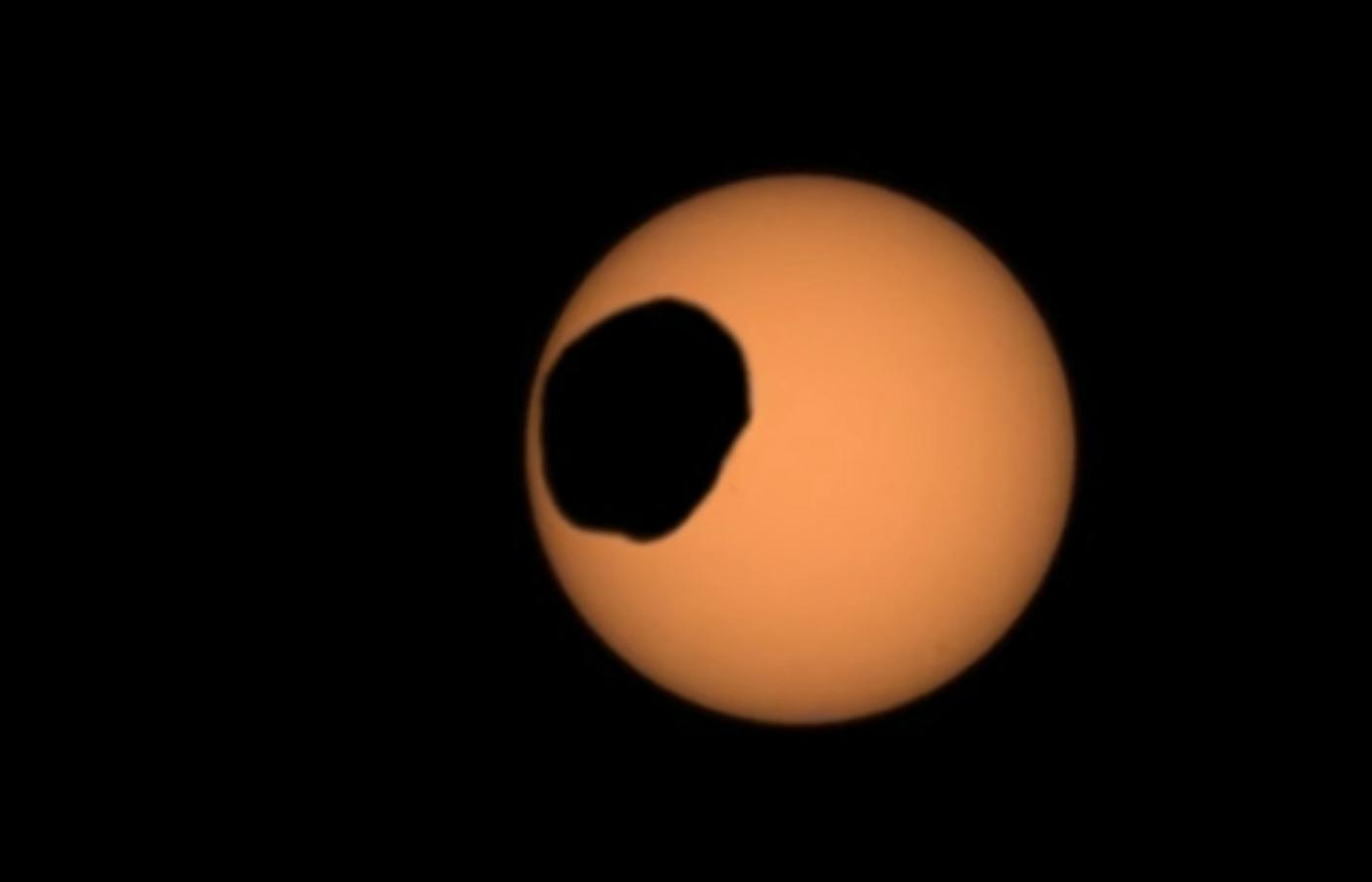
    Perseverance Views a Transit of Phobos February 2024
    NASA’s Perseverance Mars rover used its Mastcam-Z camera to capture the silhouette of Phobos, one of the two Martian moons, as it passed in front of the Sun on February 8, 2024, the 1,056th Martian day, or sol, of the mission. This is one of several transits of Phobos that NASA’s Mars rovers have captured. By comparing the various recordings, scientists can refine their understanding of the potato-shaped moon’s orbit, learning how it’s changing. Eons from now, Phobos’ orbit is expected to eventually send the moon toward the Red Planet’s surface. Credit: NASA/JPL-Caltech/ASU/MSSS/SSI

    Perseverance’s Mission Objectives and Collaborations

    The Mars 2020 Perseverance rover, managed by NASA’s Jet Propulsion Laboratory in California, is a pioneering mission focused on astrobiology and Mars exploration. A core goal of Perseverance is to search for signs of ancient microbial life on Mars, providing insights into the planet’s geological history and climate. This mission marks the first attempt to collect and cache Martian rock and regolith, with future NASA and ESA missions planned to retrieve these samples and return them to Earth for detailed study.

    The rover is equipped with advanced scientific tools, including the Mastcam-Z camera system, operated by Arizona State University in collaboration with Malin Space Science Systems and the Niels Bohr Institute. This camera system aids in capturing high-resolution imagery and supporting the mission’s geological studies. Perseverance is part of NASA’s broader Moon to Mars exploration strategy, where Artemis missions to the Moon will help lay the groundwork for eventual human exploration of Mars.

    Never miss a breakthrough: Join the SciTechDaily newsletter.
    Follow us on Google and Google News.

    JPL Mars Mars 2020 Perseverance Rover NASA Solar Eclipse
    Share. Facebook Twitter Pinterest LinkedIn Email Reddit

    Related Articles

    Incredible Video of Solar Eclipse on Mars – Captured by NASA’s Perseverance Rover

    Why NASA’s Mars 2020 Rover Has a SuperCam Laser Powerful Enough to Vaporize Rock

    Finalists Chosen in NASA’s Mars 2020 Rover Naming Contest – Vote for Your Favorite

    NASA Narrows Down Mars 2020 Rover Names – Here Are the Semifinalists

    NASA’s Mars 2020 Rover Will Hunt for Evidence of Life on Mars in Microscopic Fossils

    NASA’s Mars 2020 Rover Heads Into Huge Vacuum Chamber for Testing

    That’s One Small Step for a Mars Rover – Mars 2020 Stands on Its Own Six Wheels for the First Time

    NASA Engineers and Technicians Test Mars 2020 Rover Descent-Stage Separation

    Rover McRoverface: NASA Invites Students to Name Mars 2020 Rover

    Leave A Reply Cancel Reply

    • Facebook
    • Twitter
    • Pinterest
    • YouTube

    Don't Miss a Discovery

    Subscribe for the Latest in Science & Tech!

    Trending News

    Artificial Sweeteners May Harm Future Generations, Study Suggests

    Splashdown! NASA Artemis II Returns From Record-Breaking Moon Mission

    What If Consciousness Exists Beyond Your Brain

    Scientists Finally Crack the 100-Million-Year Evolutionary Mystery of Squid and Cuttlefish

    Beyond “Safe Levels”: Study Challenges What We Know About Pesticides and Cancer

    Researchers Have Found a Dietary Compound That Increases Longevity

    Scientists Baffled by Bizarre “Living Fossil” From 275 Million Years Ago

    Your IQ at 23 Could Predict Your Wealth at 27, Study Finds

    Follow SciTechDaily
    • Facebook
    • Twitter
    • YouTube
    • Pinterest
    • Newsletter
    • RSS
    SciTech News
    • Biology News
    • Chemistry News
    • Earth News
    • Health News
    • Physics News
    • Science News
    • Space News
    • Technology News
    Recent Posts
    • What if Dark Matter Has Two Forms? Bold New Hypothesis Could Explain a Cosmic Mystery
    • Researchers Expose Hidden Chemistry of “Ore-Forming” Elements in Biology
    • Geologists Reveal the Americas Collided Earlier Than We Thought
    • 20x Difference: Study Reveals True Source of Airborne Microplastics
    • Scientists Uncover Hidden Force Powering Yellowstone’s Supervolcano
    Copyright © 1998 - 2026 SciTechDaily. All Rights Reserved.
    • Science News
    • About
    • Contact
    • Editorial Board
    • Privacy Policy
    • Terms of Use

    Type above and press Enter to search. Press Esc to cancel.