

The Einstein Probe is revolutionizing our view of the distant X-ray universe, offering an unprecedented look at some of the most powerful explosions in space.
Just under three months after its launch, the spacecraft has already made a groundbreaking discovery — an enigmatic burst of X-rays that could challenge what we thought we knew about gamma-ray bursts. This unexpected find hints at the possibility of reshaping our understanding of these extraordinary cosmic events and unlocking new secrets of the universe.
Unveiling a Cosmic Phenomenon
On March 15, 2024, the Einstein Probe’s Wide-field X-ray Telescope (WXT) detected a burst of low-energy X-rays. Astronomers refer to these as ‘soft’ X-rays, even though they carry much more energy than visible or ultraviolet light. The burst lasted over 17 minutes, fluctuating in brightness before gradually fading away. This type of event is known as a fast X-ray transient (FXRT), and it was designated EP240315a.
For Yuan Liu, from the National Astronomical Observatories of the Chinese Academy of Sciences (NAO, CAS), and the lead author of the study, this discovery was particularly meaningful. He had designed the software that triggered the detection onboard WXT. “It was really good to see the algorithm working fine for this event,” he said.
A Glimpse into the Ancient Universe
About an hour after the X-ray burst was detected, a telescope in South Africa, part of the Asteroid Terrestrial-Impact Last Alert System (ATLAS), observed visible light coming from the same location. Additional observations from the Gemini-North telescope in Hawaii and the Very Large Telescope in Chile provided redshift measurements, confirming that the burst originated about 12.5 billion light-years away. This means the explosion occurred when the Universe was only 10 percent of its current age.
This marks the first time astronomers have detected soft X-rays from such an ancient cosmic event, lasting for such an extended period.
“The detection of EP240315a demonstrates Einstein Probe’s great potential for discovering transients from the early Universe. The mission will play an important role in international observations and collaborations,” said Xuefeng Wu, a researcher at the Purple Mountain Observatory, CAS, and one of the paper’s authors.
A Mystery to be Solved
The rapid detection of EP240315a also allowed the team to collaborate with Roberto Ricci, University of Rome Tor Vergata, Italy. They began watching the burst at radio wavelengths using the Australian Telescope Compact Array (ATCA). Monitoring it for three months, they established that the energy output was consistent with a typical gamma-ray burst (GRB).
GRBs are extremely powerful events that release extraordinary amounts of energy. Typically, long GRBs come from the explosion of massive stars.
In later analyses, the X-rays were indeed found to be coincident with a gamma-ray burst known as GRB 240315C. This burst had been seen by the Burst Alert Telescope (BAT) on NASA’s Neil Gehrels Swift Observatory and the Russian Federations’ Konus instrument on NASA’s Wind spacecraft.
“These results show that a substantial fraction of FXRTs may be associated with GRBs and that sensitive X-ray monitors, such as Einstein Probe can pinpoint them in the distant Universe,” said Roberto. “Combining the power of X-ray and radio observations hands us a new way to explore these ancient explosions even without detecting their gamma rays.”
Yet there is a mystery to be solved. Although GRBs are associated with X-rays, EP240315a is different.
Rethinking Gamma-Ray Burst Theories
Usually, the X-rays are observed to precede the gamma rays by a few tens of seconds, but EP240315a was seen more than six minutes (372 seconds) before GRB 240315C. “Such a long delay has never been previously observed,” said Hui Sun, a team member from the Einstein Probe Science Center at the NAO, CAS.
Combine this with the unexpectedly long duration of the X-rays and it could be telling us that we do not understand how GRBs explode as well as we thought.
“This tells us something really new and maybe we have to rethink the models we have for gamma-ray bursts,” said Weimin Yuan, NAO, CAS Einstein Probe Principal Investigator.
Time and more data will help. Although past missions have been able to detect soft X-rays, Einstein Probe’s superior sensitivity and field of view really opens this window. “This is just the starting point and really demonstrates the potential of Einstein Probe to detect cosmic explosions from the early Universe,” said Weimin.
“As soon as we opened the eyes of Einstein Probe to the sky, it found interesting new phenomena. That’s pretty good and should mean that there are a lot more interesting discoveries to come,” said Erik Kuulkers, ESA Einstein Probe Project Scientist.
References:
“Soft X-ray prompt emission from the high-redshift gamma-ray burst EP240315a” by Y. Liu, H. Sun, D. Xu, D. S. Svinkin, J. Delaunay, N. R. Tanvir, H. Gao, C. Zhang, Y. Chen, X.-F. Wu, B. Zhang, W. Yuan, J. An, G. Bruni, D. D. Frederiks, G. Ghirlanda, J.-W. Hu, A. Li, C.-K. Li, J.-D. Li, D. B. Malesani, L. Piro, G. Raman, R. Ricci, E. Troja, S. D. Vergani, Q.-Y. Wu, J. Yang, B.-B. Zhang, Z.-P. Zhu, A. de Ugarte Postigo, A. G. Demin, D. Dobie, Z. Fan, S.-Y. Fu, J. P. U. Fynbo, J.-J. Geng, G. Gianfagna, Y.-D. Hu, Y.-F. Huang, S.-Q. Jiang, P. G. Jonker, Y. Julakanti, J. A. Kennea, A. A. Kokomov, E. Kuulkers, W.-H. Lei, J. K. Leung, A. J. Levan, D.-Y. Li, Y. Li, S. P. Littlefair, X. Liu, A. L. Lysenko, Y.-N. Ma, A. Martin-Carrillo, P. O’Brien, T. Parsotan, J. Quirola-Vásquez, A. V. Ridnaia, S. Ronchini, A. Rossi, D. Mata-Sánchez, B. Schneider, R.-F. Shen, A. L. Thakur, A. Tohuvavohu, M. A. P. Torres, A. E. Tsvetkova, M. V. Ulanov, J.-J. Wei, D. Xiao, Y.-H. I. Yin, M. Bai, V. Burwitz, Z.-M. Cai, F.-S. Chen, H.-L. Chen, T.-X. Chen, W. Chen, Y.-F. Chen, Y.-H. Chen, H.-Q. Cheng, B. Cordier, C.-Z. Cui, W.-W. Cui, Y.-F. Dai, Z.-G. Dai, J. Eder, R. A. J. Eyles-Ferris, D.-W. Fan, C. Feldman, H. Feng, Z. Feng, P. Friedrich, X. Gao, J.-F. Gonzalez, J. Guan, D.-W Han, J. Han, D.-J. Hou, H.-B. Hu, T. Hu, M.-H. Huang, J. Huo, I. Hutchinson, Z. Ji, S.-M. Jia, Z.-Q. Jia, B.-W. Jiang, C.-C. Jin, G. Jin, J.-J. Jin, A. Keereman, H. Lerman, J.-F. Li, L.-H. Li, M.-S. Li, W. Li, Z.-D. Li, T.-Y. Lian, E.-W. Liang, Z.-X. Ling, C.-Z. Liu, H.-Y. Liu, H.-Q. Liu, M.-J. Liu, Y.-R. Liu, F.-J. Lu, H.-J. Lü, L.-D. Luo, F. L. Ma, J. Ma, J.-R. Mao, X. Mao, M. McHugh, N. Meidinger, K. Nandra, J. P. Osborne, H.-W. Pan, X. Pan, M. E. Ravasio, A. Rau, N. Rea, U. Rehman, J. Sanders, A. Santovincenzo, L.-M. Song, J. Su, L.-J. Sun, S.-L. Sun, X.-J. Sun, Y.-Y. Tan, Q.-J. Tang, Y.-H. Tao, J.-Z. Tong, C.-Y. Wang, H. Wang, J. Wang, L. Wang, W.-X. Wang, X.-F. Wang, X.-Y. Wang, Y.-L. Wang, Y.-S. Wang, D.-M. Wei, R. Willingale, S.-L. Xiong, H.-T. Xu, J.-J. Xu, X.-P. Xu, Y.-F. Xu, Z. Xu, C.-B. Xue, Y.-L. Xue, A.-L. Yan, F. Yang, H.-N. Yang, X.-T. Yang, Y.-J Yang, Y.-W. Yu, J. Zhang, M. Zhang, S.-N. Zhang, W.-D. Zhang, W.-J. Zhang, Y.-H. Zhang, Z. Zhang, Z. Zhang, Z.-L. Zhang, D.-H. Zhao, H.-S. Zhao, X.-F. Zhao, Z.-J. Zhao, L.-X. Zhou, Y.-L. Zhou, Y.-X. Zhu, Z.-C. Zhu and X.-X. Zuo, 23 January 2025, Nature Astronomy.
DOI: 10.1038/s41550-024-02449-8
“Long-term Radio Monitoring of the Fast X-Ray Transient EP 240315a: Evidence for a Relativistic Jet” by Roberto Ricci, Eleonora Troja, Yu-Han Yang, Muskan Yadav, Yuan Liu, Hui Sun, Xuefeng Wu, He Gao, Bing Zhang and Weimin Yuan, 23 January 2025, The Astrophysical Journal Letters.
DOI: 10.3847/2041-8213/ad8b3f
About Einstein Probe
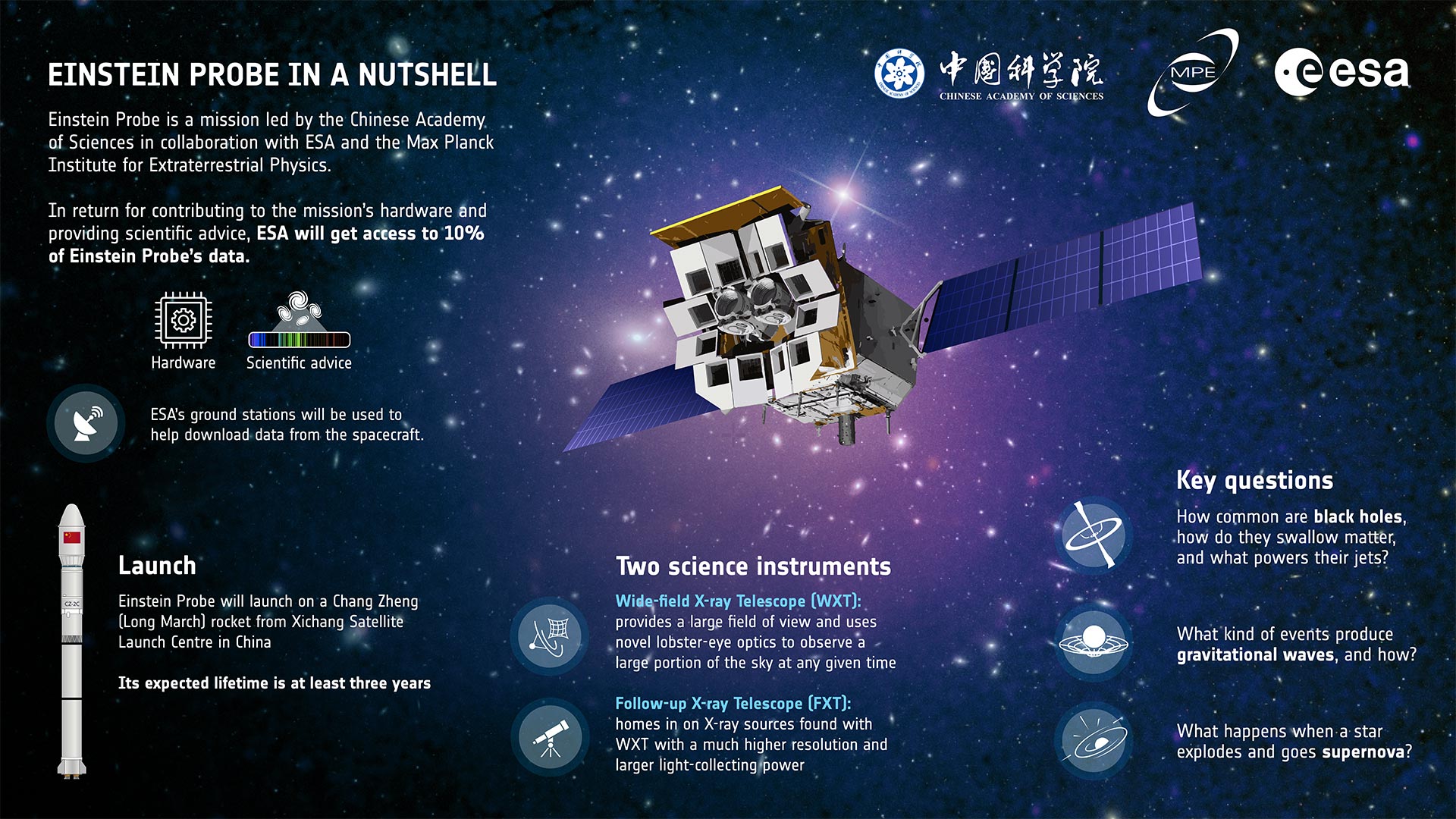
The Einstein Probe (EP) is a space mission led by the Chinese Academy of Sciences (CAS) in collaboration with the European Space Agency (ESA), the Max-Planck-Institute for Extraterrestrial Physics (MPE) in Germany, and the Centre National d’Études Spatiales (CNES) in France. Launched on January 9, 2024, from the Xichang Satellite Launch Centre in China, the mission is designed to explore the dynamic X-ray universe and uncover new insights into high-energy cosmic events.
Einstein Probe is equipped with two advanced instruments: the Wide-field X-ray Telescope (WXT), which continuously scans a vast portion of the sky to detect unexpected X-ray sources, and the Follow-up X-ray Telescope (FXT), which provides detailed observations of the sources detected by WXT. Together, these instruments enable EP to rapidly identify and study transient cosmic phenomena such as supernovae, gamma-ray bursts, and other energetic explosions in the distant universe.
Never miss a breakthrough: Join the SciTechDaily newsletter.
Follow us on Google and Google News.