
Noctilucent clouds form so high in the atmosphere that they continue to reflect sunlight hours after sunset, creating a shimmering nighttime spectacle.
Clouds illuminated during the daytime by the Sun or at nighttime by the Moon are a common sight. It is rarer, however, to see clouds that form so high in the atmosphere that they continue to reflect sunlight hours after sunset, creating a spectacular display in the nighttime sky.
Noctilucent clouds, also called polar mesospheric clouds or “night-shining” clouds, occur most often near the poles and occasionally at lower latitudes. The phenomenon is seasonal and depends on just the right combination of atmospheric conditions.
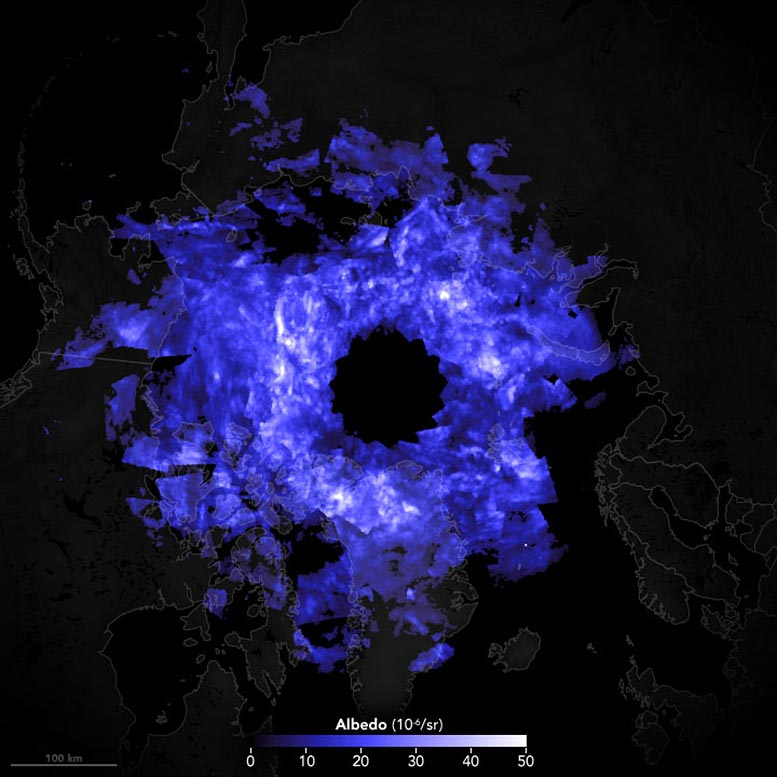
The image above shows a satellite-based view of noctilucent clouds on June 16, 2021. The image is centered on the North Pole and is stitched together from data acquired during several orbital passes by NASA’s Aeronomy of Ice in the Mesosphere (AIM) spacecraft. The satellite’s Cloud Imaging and Particle Size (CIPS) instrument measures albedo, or the amount of light reflected back to space by the clouds. Researchers use data from AIM to better understand the complexities of the mesosphere, and its relationship to other parts of the atmosphere, weather, and climate.
Highest and Rarest Clouds on Earth
Scientists have called noctilucent clouds “the highest, driest, coldest, and rarest clouds on Earth.” Indeed, most of the planet’s clouds form in the tropopause, the layer of atmosphere closest to the ground, and occasionally in the stratosphere. In contrast, noctilucent clouds form in the mesosphere, at an altitude of just over 50 miles (80 kilometers). They develop when water vapor aggregates and freezes around specks of meteor dust floating in the mesosphere. The amount of dust fluctuates, but there is generally enough to allow the clouds to grow when there is plenty of water vapor and when mesospheric temperatures plunge.
Given that the clouds rely on extra-cold conditions, it might seem counterintuitive that they show up over the planet’s polar regions during late spring and summer. Cora Randall, the principal investigator for AIM-CIPS at the University of Colorado-Boulder, explained that air in the polar mesosphere ascends in the summer and descends in the winter. “So mesospheric air becomes colder in the summer and warmer in the winter,” she said. “This is just the opposite of what you might expect if the temperature were controlled just by sunlight.”
The CIPS instrument makes consistent observations of noctilucent clouds throughout their brief seasonal existence over the planet’s polar regions. Observers on the ground, however, can only see them when skies are free of low-level clouds. And because mesospheric clouds are so faint—dimmer than the daytime sky—they are only visible from the ground when the viewer is in darkness and the Sun is at an angle to illuminate the clouds from below.
Low-Latitude Sightings Increasing
In recent years, skywatchers have observed the noctilucent clouds at especially low latitudes, spotting them from as far south as southern California in 2019 and 2020. According to Randall, data from NASA’s Microwave Limb Sounder indicates that conditions are favorable again this year for low-latitude viewing. High-altitude temperatures are lower than average and water vapor is higher than average, making it more likely that water vapor will condense into ice.
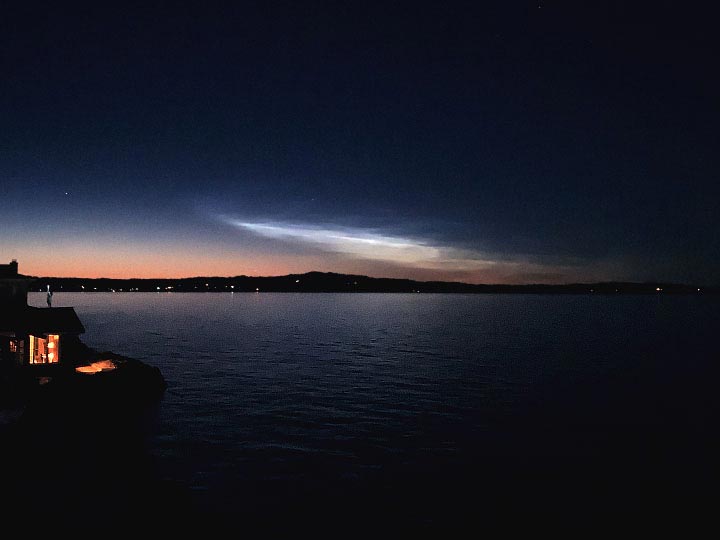
“If viewing conditions are favorable on the ground, I would not be surprised to see more reports in the next week of noctilucent clouds down to 40 degrees north or even a bit lower,” Randall said. The photo above shows noctilucent clouds as viewed from Bainbridge Island, Washington (47.7 degrees north latitude) on June 16, 2021.
Randall noted that one reason for the favorable cloud conditions could be an overall strengthening of atmospheric circulation. More ascending air can cause both more cooling and an increase in water vapor. Another reason could be the weak solar cycle, which means there is less ultraviolet radiation to break up water molecules at high altitudes. “I suspect the answer is complex,” Randall said, “and probably involves atmospheric wave activity.”
NASA Earth Observatory image by Joshua Stevens, using data from the University of Colorado Laboratory for Atmospheric and Space Physics. Story and photograph by Kathryn Hansen.
Never miss a breakthrough: Join the SciTechDaily newsletter.
Follow us on Google and Google News.