
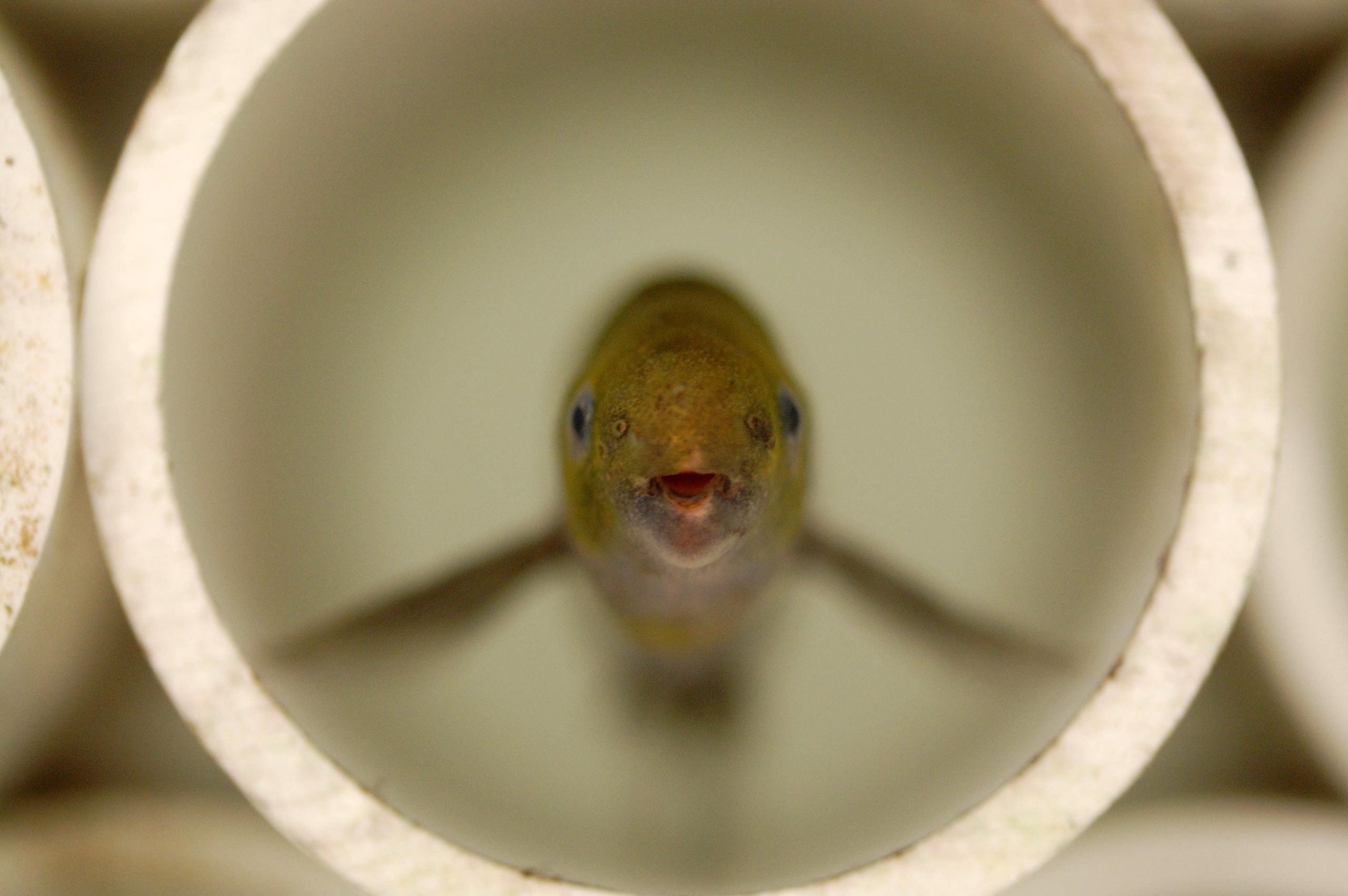
Electric fish pause before emitting bursts of electric signals, much like human speakers do before key words.
American writer and humorist Mark Twain, a master of language and noted lecturer, once offered, “The right word may be effective, but no word was ever as effective as a rightly timed pause.”
Electric fish and today’s TED talk speakers take a page from Twain’s playbook. They pause before sharing something particularly meaningful. Pauses also prime the sensory systems to receive new and important information, according to research from Washington University in St. Louis.
“There is an increased response in listeners to words — or in this case, electrical pulses — that happens right after a pause,” said Bruce Carlson, professor of biology in Arts & Sciences and corresponding author of the study published May 26, 2021, in Current Biology. “Fish are basically doing the same thing we do to communicate effectively.”
Neural Reset Through Pauses
Beyond discovering interesting parallels between human language and electric communication in fish, the research reveals an underlying mechanism for how pauses allow neurons in the midbrain to recover from stimulation.
Carlson and collaborators, including first author Tsunehiko Kohashi, formerly a postdoctoral research associate at Washington University, conducted their study with electric fish called mormyrids. These fish use weak electric discharges, or pulses, to locate prey and to communicate with one another.
The scientists tracked the banter between fish housed under different conditions. They observed that electric fish that were alone in their tanks tend to hum along without stopping very much, producing fewer and shorter pauses in electric output than fish housed in pairs. What’s more, fish tended to produce high frequency bursts of pulses right after they paused.
The scientists then tried an experiment where they inserted artificial pauses into ongoing communication between two fish. They found that the fish receiving a pause — the listeners — increased their own rates of electric signaling just after the artificially inserted pauses. This result indicates that pauses were meaningful to the listeners.
Other researchers have studied the behavioral significance of pauses in human speech. Human listeners tend to recognize words better after pauses, and effective speakers tend to insert pauses right before something that they want to have a significant impact.
Electric Bursts and Information Density
“Human auditory systems respond more strongly to words that come right after a pause, and during normal, everyday conversations, we tend to pause just before speaking words with especially high-information content,” Carlson said. “We see parallels in our fish where they respond more strongly to electrosensory stimuli that come after a pause. We also find that fish tend to pause right before they produce a high-frequency burst of electric pulses, which carries a large amount of information.”

The scientists wanted to understand the underlying neural mechanism that causes these effects. They applied stimulation to electrosensory neurons in the midbrain of the electric fish and observed that continually stimulated neurons produced weaker and weaker responses. This progressive weakness is referred to as short-term synaptic depression.
Cue Mark Twain and his well-timed pauses.
The scientists inserted pauses into the continuous stimulation. They found that pauses as short as about one second allowed the synapses to recover from short-term depression and increased the response of the postsynaptic neurons to stimuli following the pause.
A Shared Mechanism Across Species
“Pauses inserted in electric speech reset the sensitivity of the listener’s brain, which was depressed during the continuous part of the speech,” Kohashi said. “Pauses seem to make the following message as clear as possible for the listener.”
Similar to humans.
Synaptic depression and recovery are universal in the nervous system, the researchers noted.
“We expect the same mechanism, more or less, plays a role in pauses during communication in other animals, including humans,” Carlson said.
Reference: “Pauses during communication release behavioral habituation through recovery from synaptic depression” by Tsunehiko Kohashi, Adalee J. Lube, Jenny H. Yang, Prema S. Roberts-Gaddipati and Bruce A. Carlson, 26 May 2021, Current Biology.
DOI: 10.1016/j.cub.2021.04.056
Never miss a breakthrough: Join the SciTechDaily newsletter.
Follow us on Google and Google News.