
Close Menu
    Facebook X (Twitter) Instagram
    SciTechDaily
    • Biology
    • Chemistry
    • Earth
    • Health
    • Physics
    • Science
    • Space
    • Technology
    Facebook X (Twitter) Pinterest YouTube RSS
    SciTechDaily
    Home»Technology»Electric Machines on a Molecular Scale: Researchers Create Molecule That Can Pave Way for Mini-Transistors
    Technology

    Electric Machines on a Molecular Scale: Researchers Create Molecule That Can Pave Way for Mini-Transistors

    By Lund UniversityFebruary 15, 20222 Comments3 Mins Read
    Facebook Twitter Pinterest Telegram LinkedIn WhatsApp Email Reddit
    Share
    Facebook Twitter LinkedIn Pinterest Telegram Email Reddit
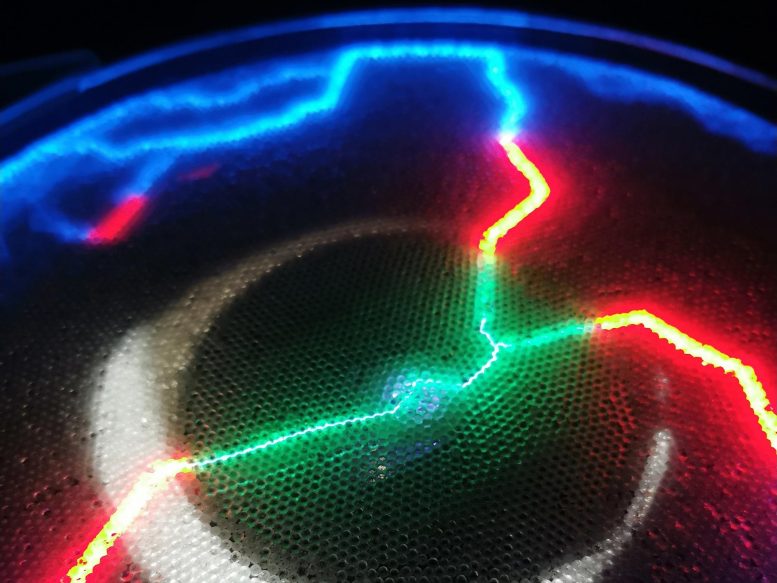
    Abstract Electric Molecule Art
    Researchers developed a simple hydrocarbon molecule with a logic gate function similar to transistors. These molecules change form with electric potential, paving the way for energy-efficient computer architectures and future molecular-scale electric machines.

    Lund University researchers created a hydrocarbon molecule with transistor-like functions. It changes from insulating to conductive when exposed to electricity, paving the way for future molecular-scale electronics.

    Researchers at Lund University in Sweden have succeeded in developing a simple hydrocarbon molecule with a logic gate function, similar to that in transistors, in a single molecule. The discovery could make electric components on a molecular scale possible in the future. The results are published in Nature Communications.

    Manufacturing very small components is an important challenge in both research and development. One example is transistors – the smaller they are, the faster and more energy-efficient our computers become. But is there a limit to how small logic gates can become? And is it possible to create electric machines on a molecular scale? Yes, perhaps, is the answer from a chemistry research team at Lund University.

    A Molecular Switch

    “We have developed a simple hydrocarbon molecule that changes its form, and at the same time goes from insulating to conductive, when exposed to electric potential. The successful formula was to design a so-called anti-aromatic ring in a molecule so that it becomes more robust and can both receive and relay electrons,” says Daniel Strand, chemistry researcher at Lund University.

    Electrons Aromatic Rings Hydrocarbon Molecule
    Illustration of electrons transferred between aromatic and non-aromatic rings in a hydrocarbon molecule. Credit: Daniel Strand/Jonas Ahlstedt

    Many organic molecules consist of aromatic benzene rings, ie flat rings made up of six carbon atoms. A simple example is graphene. However, such molecules do not change properties or shape if subjected to electric potential. Therefore, the research group chose to look at hydrocarbons made up of rings with eight carbon atoms. These are anti-aromatic and bent into a tub-shape. If two electrons are injected into such a molecule, it flattens and goes from insulating to conducting – a function similar to that of a transistor switching from 0 to 1.

    Simple Hydrocarbon, Big Possibilities

    “A unique aspect of the molecules is that they are so simple. They only consist only of carbon and hydrogen atoms which makes them easier to produce synthetically,” says Daniel Strand.

    The discovery means researchers can now think about how to develop both electrical switches and new mechanical systems at the single-molecule level using anti-aromatic hydrocarbons.

    “Molecules that change form in response to electric potential lead to exciting possibilities. One can imagine energy-efficient computer architectures and in the future perhaps electric machines on a molecular scale,” concludes Daniel Strand.

    Reference: “Electro-mechanically switchable hydrocarbons based on [8]annulenes” by Magdalena Tasic, Jakov Ivkovic, Göran Carlström, Michaela Melcher, Paolo Bollella, Jesper Bendix, Lo Gorton, Petter Persson, Jens Uhlig and Daniel Strand, 14 February 2022, Nature Communications.
    DOI: 10.1038/s41467-022-28384-8

    The study was an interdisciplinary collaboration between research groups in organic, analytical, and theoretical chemistry as well as chemical physics at Lund University and the University of Copenhagen.

    Never miss a breakthrough: Join the SciTechDaily newsletter.
    Follow us on Google and Google News.

    Lund University Transistors
    Share. Facebook Twitter Pinterest LinkedIn Email Reddit

    Related Articles

    Processing Data at the Speed of Light – “Nano-Excitonic Transistor”

    Innovative New Magneto-Electric Transistor Could Cut 5% From World’s Digital Energy Budget

    Speeding Through Semiconductor Nanowires: New Basis for Ultrafast Transistors

    “Fundamental Discovery” Used To Turn Nanotube Into Tiny Transistor – 25,000x Smaller Than Width of a Human Hair

    Revolutionary New Intelligent Transistor Developed

    New Extremely Energy-Efficient Optical “Transistor” Speeds Up Computation Up to 1,000 Times

    Nanotechnology Advance Enables Tinier Transistors With Extraordinary Performance

    New Brain-Like Computing Device With Electrochemical “Synaptic Transistors” Simulates Human Learning

    New Nanotransistors Keep Their Cool at High Voltages – Perform Highly Efficient Power Conversion

    2 Comments

    1. Mt. B on February 16, 2022 6:06 am

      Is there any possibility that research like this could result in much cheaper fabs

      Reply
    2. Deer on February 16, 2022 10:23 am

      @Mt. B: Possibly, yes, although that’s at least twenty years down the line IF it takes off. There are so many different approaches being worked on currently, it’s too early to say which one(s) will prevail in the end.

      Reply
    Leave A Reply Cancel Reply

    • Facebook
    • Twitter
    • Pinterest
    • YouTube

    Don't Miss a Discovery

    Subscribe for the Latest in Science & Tech!

    Trending News

    Massive Study Warns Marijuana Use in Teens Is Linked to Serious Mental Illness

    Scientists Discover a Completely Unexpected Way T Cells Kill Cancer

    Scientists Just Found the Solar System’s Original “Planet Factory”

    Study Warns Widely Used Food Preservatives Linked to High Blood Pressure and Heart Disease

    New Treatment Could Reverse Osteoarthritis Within Weeks

    Physicists Have Measured “Negative Time” in Bizarre Quantum Experiment

    The Deadly Tapeworm Spreading Across America Has Reached the Pacific Northwest

    Could Low Vitamin D Be Making Your Pain Worse?

    Follow SciTechDaily
    • Facebook
    • Twitter
    • YouTube
    • Pinterest
    • Newsletter
    • RSS
    SciTech News
    • Biology News
    • Chemistry News
    • Earth News
    • Health News
    • Physics News
    • Science News
    • Space News
    • Technology News
    Recent Posts
    • Stanford’s Revolutionary New Microscope Reveals Living Cells in Stunning Detail
    • Scientists Discover a Sea Slug Smaller Than a Sesame Seed in Taiwan
    • Wasp Colonies Explode Into Violence After Losing Their Queen
    • Antarctica Suddenly Became Far More Sensitive to Climate Change 1 Million Years Ago
    • A Hidden Arctic Ocean Crisis Is Unfolding Beneath the Melting Ice
    Copyright © 1998 - 2026 SciTechDaily. All Rights Reserved.
    • Science News
    • About
    • Contact
    • Editorial Board
    • Privacy Policy
    • Terms of Use

    Type above and press Enter to search. Press Esc to cancel.