
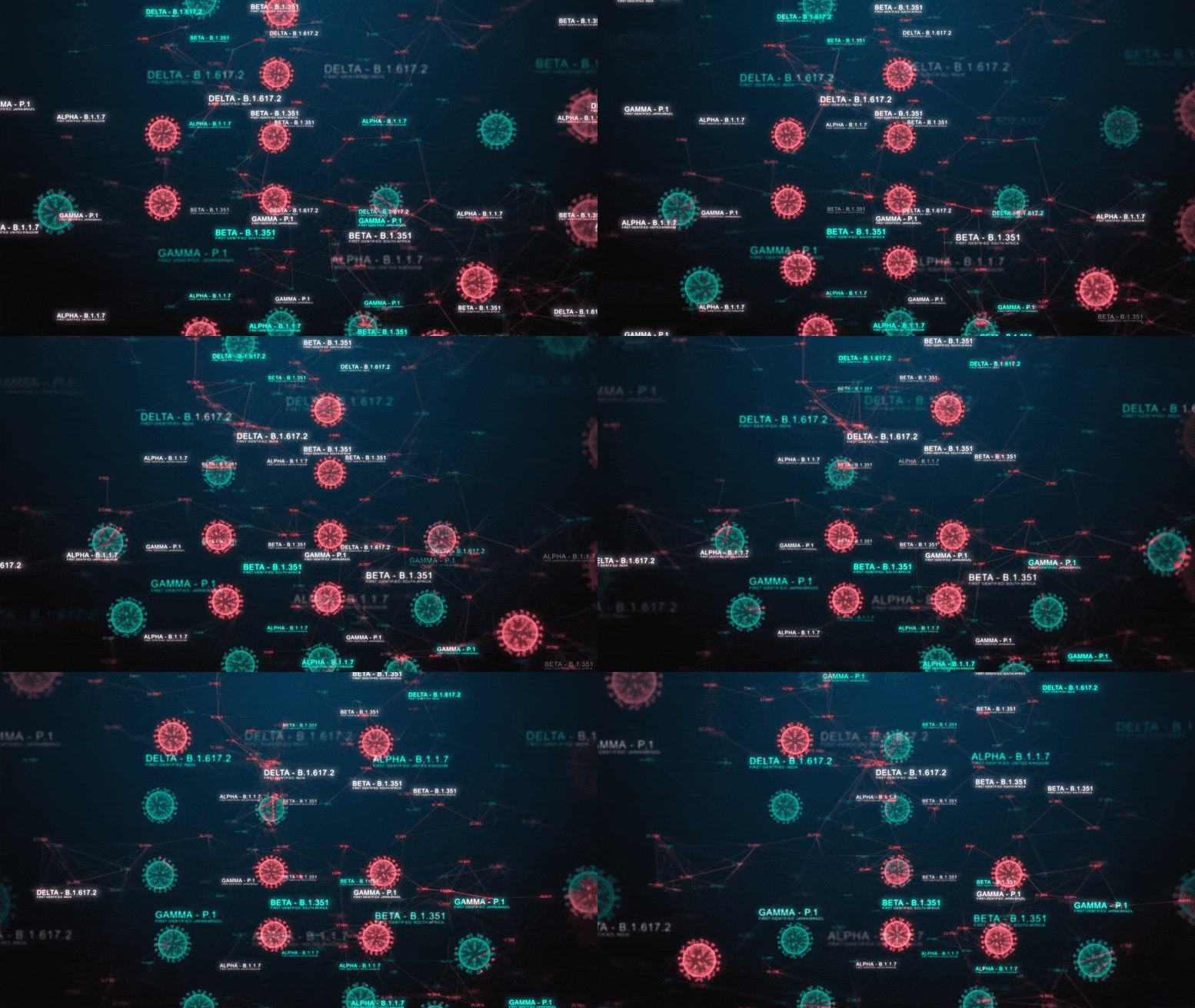
COVID-19 mutates quickly in pets—especially cats—sometimes mimicking human variants, though no cat-to-human transmission is known.
When animals catch COVID-19 from humans, new SARS-CoV-2 variants can arise. To evaluate this phenomenon, an interdisciplinary team at the College of Veterinary Medicine and Biomedical Sciences systematically analyzed mutation types occurring in the virus after infection of cats, dogs, ferrets, and hamsters.
Confirmed COVID-19 cases in a variety of wild, zoo, and household animals demonstrate cross-species transmission, which is a rare occurrence for most viruses.
“SARS-CoV-2, in the realm of coronaviruses, has a very broad species range,” said Laura Bashor, one of the first authors and a doctoral student in the Department of Microbiology, Immunology and Pathology. “Generally speaking, many types of viruses can’t infect other species of animals, they evolved to be very specific.”
“Humans have so much exposure to many different animals which permitted this virus to have the opportunity to expose a variety of different species,” said Erick Gagne, a first author and now an assistant professor of wildlife disease ecology at the University of Pennsylvania.
The global reach and spillover of the virus have given researchers a unique opportunity to investigate the viral evolution of SARS-CoV-2, including in University Distinguished Professor Sue VandeWoude’s laboratory at Colorado State University.
These specialists in disease transmission in wild and domestic cats applied their experience in sequence analysis and studying a collection of genomes to SARS-CoV-2. The study was recently published in PNAS, the official journal of the National Academy of Sciences.
Emerging Mutations
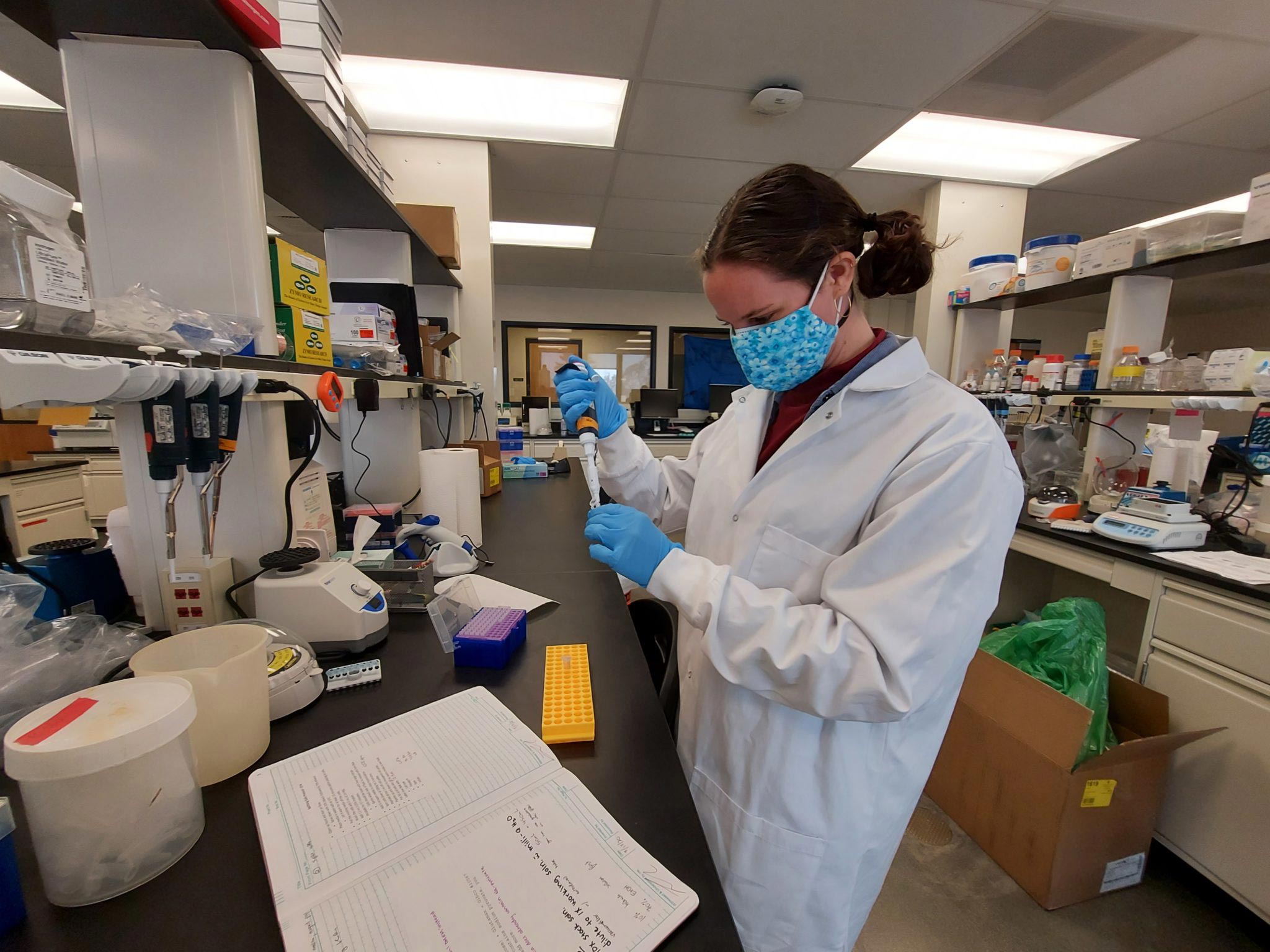
Researchers in the VandeWoude lab worked with Assistant Professor Angela Bosco-Lauth and Professor Dick Bowen in the Department of Biomedical Sciences, who used their animal modeling expertise to develop a test for SARS-CoV-2 susceptibility of animal species.
Also key to the findings was a newer sequencing technique of the virus at different stages of the study, now common to detect variants in the human population. Mark Stenglein, associate professor in the Department of Microbiology, Immunology, and Pathology, provided computational skills in analyzing biological molecule sequences, known as bioinformatics, to the study.
“We found there was evolution, we saw selection on the virus, and we saw a lot of variants emerge in the genome sequence of the virus,” said Bashor.
To provide ample viral material for the study, Bosco-Lauth and Bowen cultivated a SARS-CoV-2 human sample in cells grown in the lab. Bashor and Gagne determined that multiple mutations developed, and became a greater percentage of the genetic population, at each step of this process.
Then the virus was introduced to the four household species, and samples of the virus were collected from their nasal passages after infection.
“In the animals, the cell culture variants reverted back to the initial human type, which indicates that likely there is adaption occurring in that cell culture and environment that was selected for those variants,” said Gagne.
Not all these mutations within the cell culture SARS-CoV-2 variant transferred in the new hosts. Instead, different mutations emerged within the virus shed by the live animals.
The initial viral sample in the study was isolated in early 2020. The team observed mutations that have since formed wide-spread SARS-CoV-2 strains in the human population at an accelerated rate throughout the study.
“Among those were a number that we’ve since seen in humans in the alpha, beta, delta variants,” said Dr. Sue VandeWoude, senior author. “There were specific genetic code changes that mimicked what other scientists have reported in people.”
Contact exposure between two cats demonstrated the SARS-CoV-2 variant can be transmitted with the possibility of producing a new strain within the species.
“That’s what we’re seeing in people too,” said Bosco-Lauth. “Hosts that are really well adapted to support SARS-CoV-2 infection are also very good at allowing these mutations to stick and to be passed on.”
The Future
Bashor did not anticipate studying SARS-CoV-2 when she came to CSU to begin her doctoral studies during the pandemic. However, it provided a unique opportunity to hit the ground running as a graduate student on a “really cool and viable project” in disease ecology and evolution.
Gagne was completing his postdoctoral research on cross-species transmission of feline retroviruses in the VandeWoude lab when the team launched the SARS-CoV-2 study. Now an assistant professor, he has continued to investigate SARS-CoV-2 spillover with the Wildlife Futures Program at the University of Pennsylvania.
Graduate students and early career scientists like Bashor and Gagne, have made meaningful contributions to SARS-CoV-2 research, said VandeWoude.
The team has continued their investigations to focus on cats, as they have shown higher susceptibility for COVID-19 spillover from humans and can produce variants of the virus and spread to other cats.
Bashor began analyzing SARS-CoV-2 genome sequences from a large pool of cat species all over the world, including tigers, lions and snow leopards. The publicly available data of infected cats could provide additional insights on the adaptability and mutability of COVID-19 within and among cat species.
There is not evidence of transmission from cats to humans. But cats continue to be susceptible to all variants of COVID-19 in the human population.
By understanding viral evolution within cats, the research team may find answers to the question: what is the future of SARS-CoV-2 for humans and animals?
Reference: “SARS-CoV-2 evolution in animals suggests mechanisms for rapid variant selection” by Laura Bashor, Roderick B. Gagne, Angela M. Bosco-Lauth, Richard A. Bowen, Mark Stenglein and Sue VandeWoude, 29 October 2021, Proceedings of the National Academy of Sciences.
DOI: 10.1073/pnas.2105253118
Funding: Colorado State University College of Veterinary Medicine and Biomedical Sciences Research Council Award, NIH/National Center for Advancing Translational Science Colorado Clinical and Translational Science Awards
Never miss a breakthrough: Join the SciTechDaily newsletter.
Follow us on Google and Google News.