
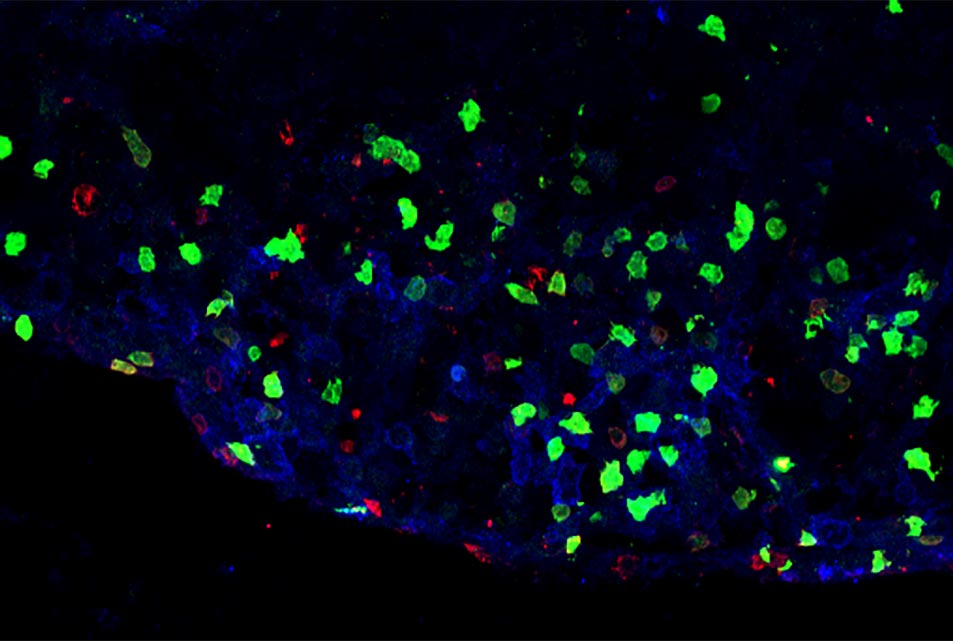
Researchers identified a unique subset of ILC3s immune cells can ignite brain inflammation in MS. Blocking their antigen presentation or programming gut ILC3s to induce tolerance prevented disease in mice.
A group of immune cells that normally protect against inflammation in the gastrointestinal tract may have the opposite effect in multiple sclerosis (MS) and other brain inflammation-related conditions, according to a new study by Weill Cornell Medicine and NewYork-Presbyterian researchers. The results suggest that countering the activity of these cells could be a new therapeutic approach for such conditions.
The researchers, who reported their findings on December 1, 2021, in the journal Nature, were studying a set of immune cells called group 3 innate lymphoid cells (ILC3s), which help the immune system tolerate beneficial microbes and suppress inflammation in the intestines and other organs throughout the body. They discovered a unique subset of these ILC3s that circulate in the bloodstream and can infiltrate the brain—and, to their surprise, do not quench inflammation but instead ignite it.
The scientists called this subset inflammatory ILC3s, and found them in the central nervous system of mice with a condition modeling MS. Instead of constraining the immune response, this subset of ILC3s spurred another group of immune cells called T cells to attack myelinated nerve fibers, leading to MS-like disease symptoms. The researchers detected similar inflammatory ILC3s in the peripheral blood and cerebrospinal fluid of MS patients.
“This work has the potential to inform our understanding of, and potential treatments for, a broad variety of conditions involving T-cell infiltration of the brain,” said senior author Dr. Gregory Sonnenberg, associate professor of microbiology and immunology in medicine in the Division of Gastroenterology and Hepatology and a member of the Jill Roberts Institute for Research in Inflammatory Bowel Disease at Weill Cornell Medicine.
MS affects more than two million people worldwide. Other conditions that feature chronic brain inflammation afflict tens of millions more and include Alzheimer’s and Parkinson’s diseases. There is also evidence that neuroinflammation develops naturally with aging and is a major factor in age-related cognitive decline, and more recently inflammatory T-cell responses in the brain have been linked to neurological symptoms associated with SARS-CoV-2 infection.
The researchers have shown in recent work that ILC3s residing in the gut act as sentinels and immune regulators, suppressing inflammation—including inflammatory T-cell activity—and warding off cancer. In the new study, they examined the roles of ILC3s in the brain, and found, contrary to their expectation, that ILC3s are not normally present in the brain under healthy conditions but can infiltrate the brain from the bloodstream during inflammation. When they do infiltrate the central nervous system, they have pro-inflammatory rather than anti-inflammatory effects.
How Inflammatory ILC3s Trigger Damage
The researchers showed with a mouse model of MS that these inflammatory ILC3s in the brain function as antigen-presenting cells: They display bits of myelin protein, the main ingredient in the insulating layer around nerve fibers, to T cells—prompting them to attack myelin, causing the nerve damage that gives rise to disease signs. They found the inflammatory ILC3s in close association with T cells in regions of active inflammation and nerve damage in the mouse brains.
“The infiltration of these inflammatory ILC3s to the brains and spinal cords of mice coincides with the onset and peak of disease,” said first author John Benji Grigg, a Weill Cornell Graduate School of Medical Sciences doctoral candidate in the Sonnenberg laboratory. “Further, our experimental data in mice demonstrate these immune cells play a key role in driving the pathogenesis of neuro-inflammation.”
The researchers discovered that they could prevent MS-like disease in the animals by removing from the ILC3s a key molecule called MHCII, which normally is used in the antigen-presenting process—the removal essentially blocks the cells’ ability to activate myelin-attacking T cells.
“Despite our very best disease-modifying therapies for MS, patients continue to progress, and since disease onset is early in life, they face the prospect of permanent physical and cognitive disability,” said co-author Dr. Tim Vartanian, professor of neuroscience in the Feil Family Brain and Mind Institute at Weill Cornell Medicine, chief of the division of multiple sclerosis and neuro-immunology and a professor of neurology in the Department of Neurology at Weill Cornell Medicine and NewYork-Presbyterian/Weill Cornell Medical Center. “Identification of inflammatory ILC3s with antigen presentation capabilities in the central nervous system of people with MS offers a new strategic target to prevent nervous system injury.”
Harnessing Gut ILC3s To Induce Tolerance
Finally, the researchers discovered that ILC3s that reside in other tissues in the body can be programmed, in effect, to counter the activity of brain-infiltrating T cells, preventing the MS-like condition disease in mice.
This work was completed in close collaboration with Dr. Ari Waisman, director of the Institute for Molecular Medicine at the University Medical Center of Johannes Gutenberg University Mainz, where the researchers built on prior research demonstrating that there are gut-resident ILC3s that display antigens to T cells in a slightly different way to promote T-cell inactivity, or “tolerance.” The researchers demonstrated that by experimentally exposing these tolerance-inducing intestinal ILC3s to myelin, they could block neuroinflammatory T-cell activity and the development of MS-like disease in the mice.
The work, therefore, points to the possibility that MS and potentially many other inflammatory conditions could someday be treated either by directly inhibiting the activity of inflammatory ILC3s that infiltrate the brain, or by targeting self-antigens to the intestinal ILC3s that promote tolerance in other tissues, Dr. Sonnenberg said.
Reference: “Antigen-presenting innate lymphoid cells orchestrate neuroinflammation” by John B. Grigg, Arthi Shanmugavadivu, Tommy Regen, Christopher N. Parkhurst, Anees Ahmed, Ann M. Joseph, Michael Mazzucco, Konrad Gronke, Andreas Diefenbach, Gerard Eberl, Timothy Vartanian, Ari Waisman and Gregory F. Sonnenberg, 1 December 2021, Nature.
DOI: 10.1038/s41586-021-04136-4
The Sonnenberg Laboratory is supported by the National Institutes of Health (R01AI143842, R01AI123368, R01AI145989, R01AI162936, R21CA249284 and U01AI095608), the NIAID Mucosal Immunology Studies Team (MIST), the Crohn’s and Colitis Foundation, the Searle Scholars Program, the American Asthma Foundation Scholar Award, Pilot Project Funding from the Center for Advanced Digestive Care (CADC), an Investigators in the Pathogenesis of Infectious Disease Award from the Burroughs Wellcome Fund, a Wade F.B. Thompson/Cancer Research Institute (CRI) CLIP Investigator grant, the Meyer Cancer Center Collaborative Research Initiative, the Dalton Family Foundation, Linda and Glenn Greenberg, and the Roberts Institute for Research in IBD. Gregory F. Sonnenberg is a CRI Lloyd J. Old STAR. John Benji Grigg is supported by the National Institute of Allergy and Infectious Diseases of the National Institutes of Health under Award Number F31AI138389-01A1. Support for human sample acquisition through the JRI IBD Live Cell Bank is provided by the JRI, Jill Roberts Center for IBD, Cure for IBD, the Rosanne H. Silbermann Foundation and Weill Cornell Medicine Division of Pediatric Gastroenterology and Nutrition.
Never miss a breakthrough: Join the SciTechDaily newsletter.
Follow us on Google and Google News.
2 Comments
I was diagnosed in 1996, before symptoms started. I am a pianist, suddenly unable to open my hands wide enough to get 8 keys. Nobody in my family had MS, nor my grandparents. Last year a cousin younger than me had MS, she is 40. I have primary progressive MS. I do not walk for the last 18 years, I was born in 1962. I have had 6 strokes and 1 heart attack.The Rebif (beta-1a) did very little to help me. The medical team did even less. After roughly five unending years of trauma in the family my MS developed into progressive. There have been many changes in the last 3 to 4 years. Many falls, many fractured bones, and three moves all in five years. I have gone downhill. Considerably. We tried every shot available but nothing was working. There has been little if any progress in finding a reliable treatment for Multiple Sclerosis, I started on MS Herbal Treatment from Kycuyu Health Clinic, the herbal treatment immensely helped my Multiple Sclerosis condition, i had huge improvements
Can you telle about the herbal treatments
My wife has MS for over 20 years. Treatments are no longer effective.