
Close Menu
    Facebook X (Twitter) Instagram
    SciTechDaily
    • Biology
    • Chemistry
    • Earth
    • Health
    • Physics
    • Science
    • Space
    • Technology
    Facebook X (Twitter) Pinterest YouTube RSS
    SciTechDaily
    Home»Space»ESA’s Mars Express View Remnants of Mega-Flood on Mars
    Space

    ESA’s Mars Express View Remnants of Mega-Flood on Mars

    By European Space AgencyMarch 3, 2017No Comments6 Mins Read
    Facebook Twitter Pinterest Telegram LinkedIn WhatsApp Email Reddit
    Share
    Facebook Twitter LinkedIn Pinterest Telegram Email Reddit
    Remnants of a Mega Flood on Mars
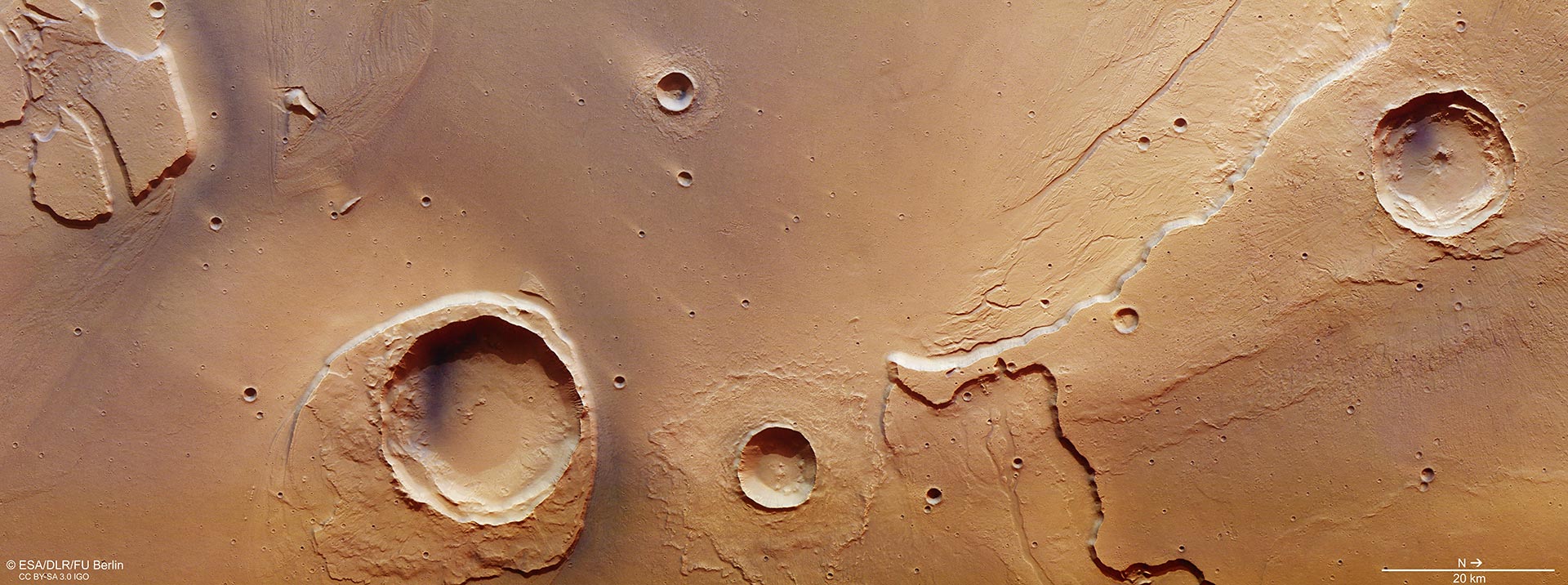
    This image focuses on the mouth of Kasei Valles, as it transitions into Chryse Planitia. The region experienced extreme flooding billions of years ago, which has left its mark in this scene. The region was imaged by the High Resolution Stereo Camera on ESA’s Mars Express on May 25, 2016, during orbit 15714. The image is centered on 309ºE/27ºN and the ground resolution is about 15 m per pixel. It was created using data from the nadir channel, the field of view which is aligned perpendicular to the surface of Mars, and the camera’s color channels. North is to the right. Credit: ESA/DLR/FU Berlin, CC BY-SA 3.0 IGO

    European Space Agency’s Mars Express has captured images of one of the largest outflow channel networks on Mars.

    The Kasei Valles channel system extends around 3,000 km(1,900 mi) from its source region in Echus Chasma – which lies east of the bulging volcanic region Tharsis and just north of the Valles Marineris canyon system – to its sink in the vast plains of Chryse Planitia.

    Worcester Crater in Context
    This context image shows a region of Mars where Kasei Vallis empties into the vast Chryse Planitia. The region outlined by the large white box indicates the area imaged during Mars Express orbit 15714, with the smaller inner box highlighted in an associated image release. In this context image, north is up. Credit: NASA MGS MOLA Science Team

    A combination of volcanism, tectonics, collapse, and subsidence in the Tharsis region led to several massive groundwater releases from Echus Chasma, which subsequently flooded the Kasei Valles region around 3.6–3.4 billion years ago. These ancient mega-floods have left their mark on the features seen today.

    Sections of Kasei Valles have already been imaged by Mars Express during its 14 years at the Red Planet, but this new image, taken on May 25, 2016, captures a portion right at its mouth.

    A 25 km-wide (16 mi-wide) impact crater – Worcester Crater – just left to the center of the main color image, has done its best to stand up to the erosive forces of the mega-floods.

    While much of the blanket of material surrounding the crater – which was originally thrown out from inside the crater during the impact – has been eroded, the section downstream of the flood has survived. Over time this has led to the overall appearance of a streamlined island, with its stepped topography downstream perhaps suggesting variations in water levels or different flood episodes.
    Topography at the Mouth of Kasei Valles
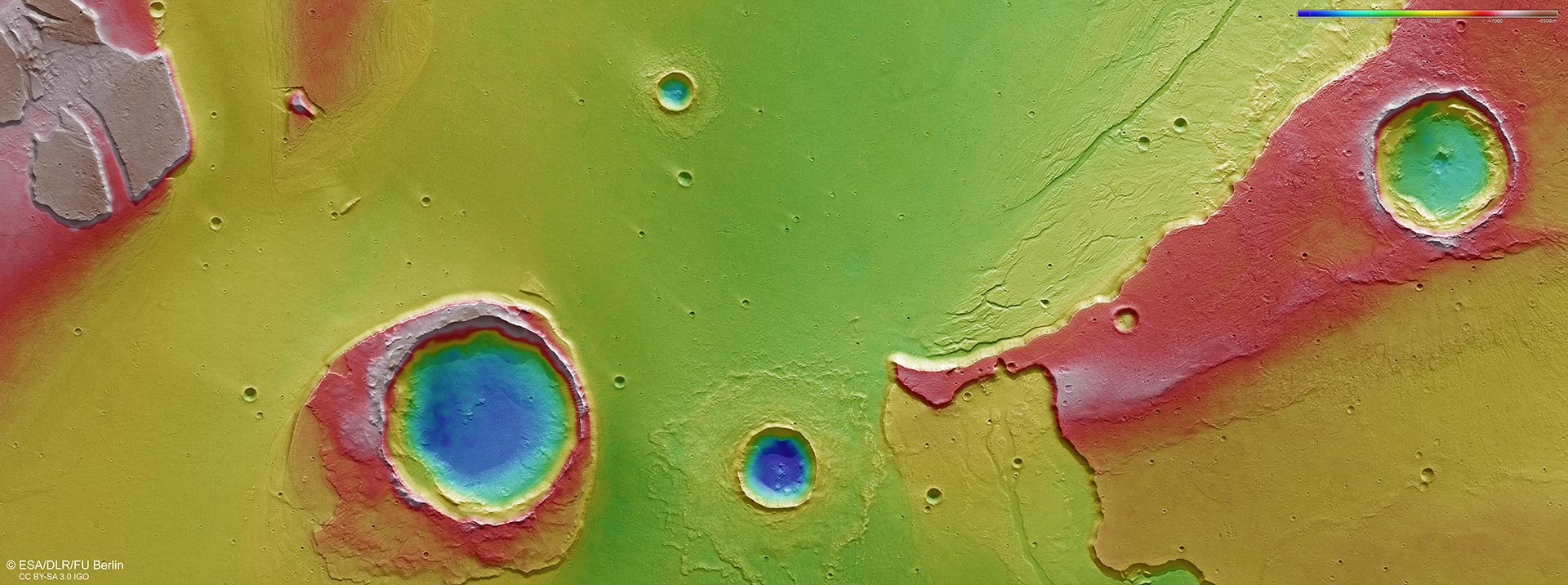
    The color-coded topographic view shows relative heights and depths of terrain in the region of Mars where Kasei Vallis reaches Chryse Planitia. As indicated in the key at top right, whites and reds represent the highest terrain, while blue is the lowest. The image is based on a digital terrain model of the region, from which the topography of the landscape can be derived. This region was imaged by the High Resolution Stereo Camera on ESA’s Mars Express on 25 May 2016 during orbit 15714. The image is centered on 309ºE/27ºN and the ground resolution is about 15 m per pixel. North is to the right. Credit: ESA/DLR/FU Berlin, CC BY-SA 3.0 IGO

    By contrast, the debris blanket surrounding the adjacent crater has remained intact. This suggests the impact producing that crater occurred after the major flooding.

    Moreover, the appearance of the debris blanket tells a story on the nature of the subsurface: in this case it points to the floodplain being rich in water or water-ice.

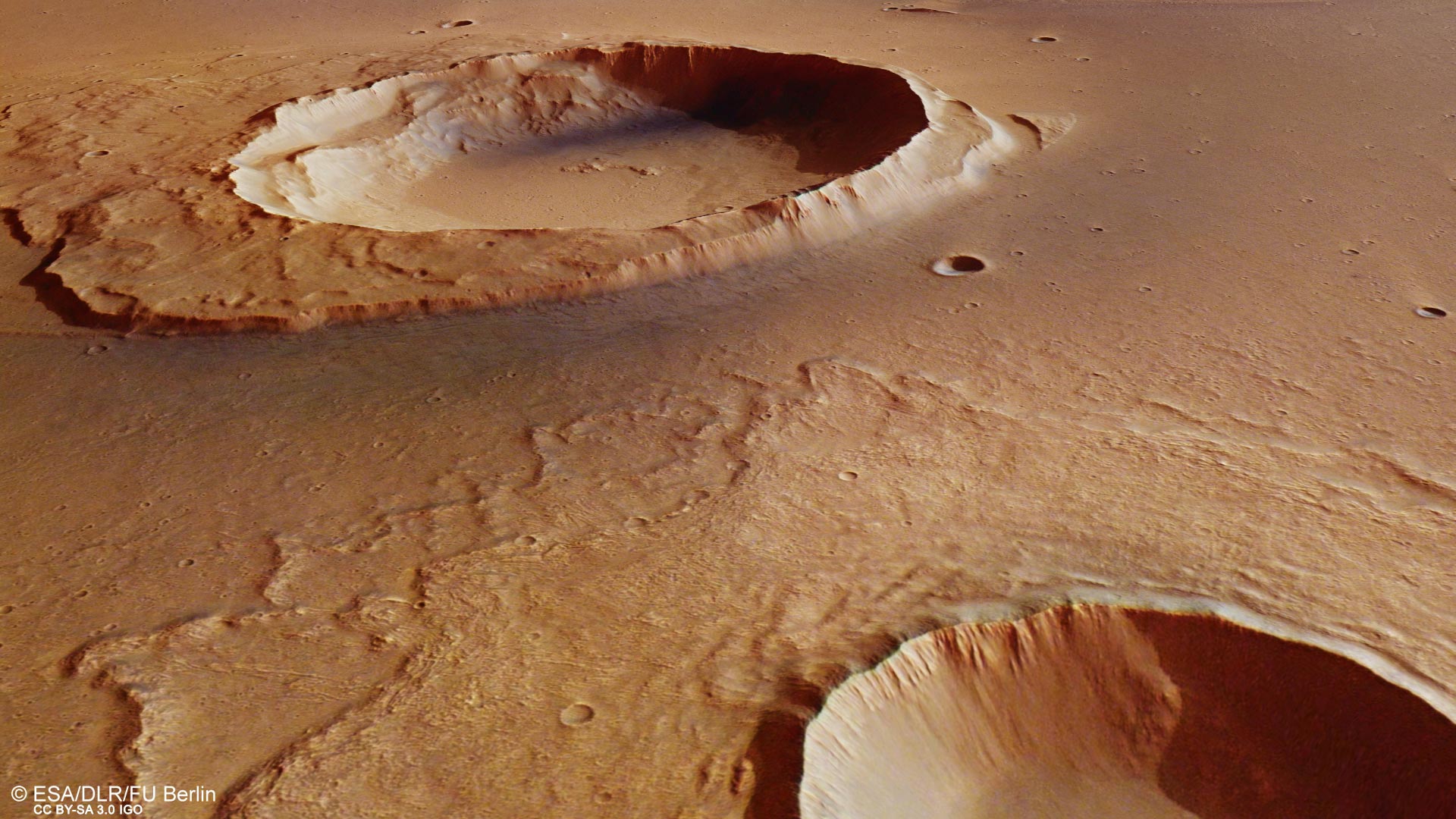
    Indeed, the pattern is reminiscent of a ‘splash’: the debris ejected from the crater was rich in water, allowing it to flow more easily. As it slowed, the debris behind it piled up, pushing up the material at its periphery into ramparts.
    Perspective View Towards Worcester Crater
    This perspective view looks from an unnamed crater at bottom right towards a 25 km-wide crater named Worcester Crater. The region sits at the mouth of Kasei Valles, where fierce floodwaters emptied into Chryse Planitia.
    The image was generated using data from the high-resolution stereo camera on ESA’s Mars Express. This scene is part of the region imaged on May 25, 2016, during orbit 15714. The main image is centered on 309ºE/27ºN and the ground resolution is about 15 m per pixel. The view is looking approximately to the south. Credit: ESA/DLR/FU Berlin, CC BY-SA 3.0 IGO

    The perspective view shows a close-up of this rampart feature and looks from the associated crater towards the eroded Worcester crater in the background.

    The large crater at the northernmost part (right, top) of the main image does not appear to have penetrated as deep as Worcester crater and its neighbor. Indeed, it is located on a plateau at least 1 km (0.6 mi) higher than the plains below.

    Nonetheless, there is a small depression in the center of the crater, which usually implies a weaker layer – such as ice – was buried underneath at the time of the impact.

    Close inspection also reveals the faint outline of the crater’s ejecta blanket, including a portion that spilled over onto the plains below.
    Anaglyph View at the Mouth of Kasei Vallis
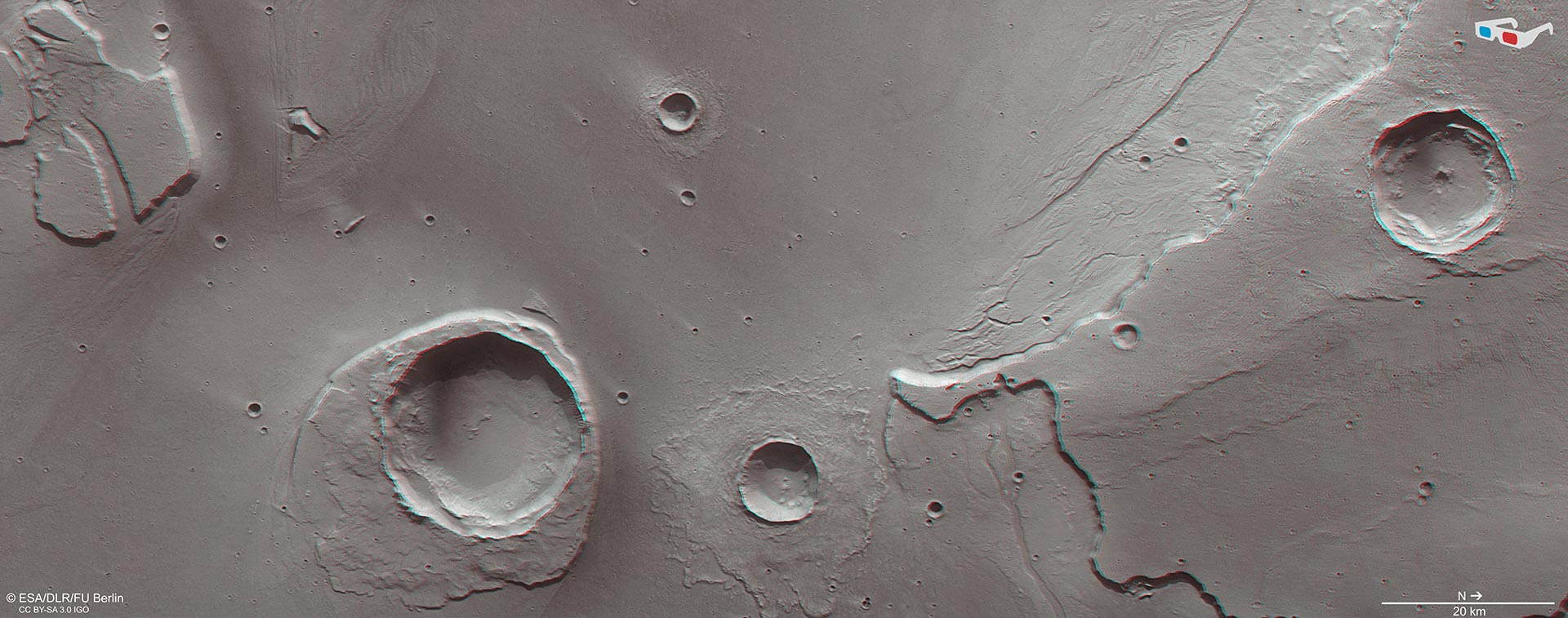
    This anaglyph view, showing a portion of terrain at the mouth of Kasei Vallis, provides a 3D view of the landscape when viewed using red–green or red–blue glasses. The image is based on data acquired by the nadir channel and one stereo channel of the High Resolution Stereo Camera on Mars Express on May 25, 2016 during orbit 15714. The image is centered on 309ºE/27ºN and the ground resolution is about 15 m per pixel. North is to the right. Credit: ESA/DLR/FU Berlin, CC BY-SA 3.0 IGO

    The ejecta shows an interesting grooved pattern that the other craters in this view seem to be lacking. This suggests a difference in the nature of the impact itself, perhaps either with the energy imparted during the impact, the way in which the ejecta was emplaced from the crater, or in the composition of the plateau material.

    Small dendritic channels can be seen all around the plateau, which perhaps hint at the varying flood magnitudes during numerous episodes of flooding.

    A number of smaller craters in the flat plains can also be found. These appear to have lighter-colored ‘tails’ pointing in the opposite direction to the flow of water coming from Kasei Valles.

    These craters were formed by impacts that took place after the catastrophic flooding, their delicate tails created by winds blowing in a westwards direction ‘up’ valley. Their raised rims influence wind flow over the crater such that the dust immediately ‘behind’ the crater remains undisturbed in comparison to the surrounding, more exposed, plains.

    This scene therefore preserves a record of geological activity spanning billions of years of the Red Planet’s history.

    Never miss a breakthrough: Join the SciTechDaily newsletter.
    Follow us on Google and Google News.

    Astronomy European Space Agency Mars Mars Express Planetary Science
    Share. Facebook Twitter Pinterest LinkedIn Email Reddit

    Related Articles

    Mars Express Provides a Window to a Watery Past on Mars

    New Mosaic Shows Off the Red Planet’s North Polar Ice Cap

    Mars Express Image of the Rim of the Schiaparelli Crater

    ESA’s Mars Express Sheds New Light on the Red Planet’s Rare Aurora

    New ESA Image of Craters within the Hellas Basin on Mars

    New Fly-Through Video of the Ancient Flood Plain Kasei Valles

    Mars Express Captures a Radar View of the Southern Highlands of Mars

    ESA’s Mars Express Captures New Images of Sulci Gordii

    ESA’s Mars Express MARSIS Radar Explores Martian Oceans

    Leave A Reply Cancel Reply

    • Facebook
    • Twitter
    • Pinterest
    • YouTube

    Don't Miss a Discovery

    Subscribe for the Latest in Science & Tech!

    Trending News

    The Universe Is Expanding Too Fast and Scientists Can’t Explain Why

    “Like Liquid Metal”: Scientists Create Strange Shape-Shifting Material

    Early Warning Signals of Esophageal Cancer May Be Hiding in Plain Sight

    Common Blood Pressure Drug Shows Surprising Power Against Deadly Antibiotic-Resistant Superbug

    Scientists Uncover Dangerous Connection Between Serotonin and Heart Valve Disease

    Scientists Discover a “Protector” Protein That Could Help Reverse Hair Loss

    Bone-Strengthening Discovery Could Reverse Osteoporosis

    Scientists Uncover Hidden Trigger Behind Stem Cell Aging

    Follow SciTechDaily
    • Facebook
    • Twitter
    • YouTube
    • Pinterest
    • Newsletter
    • RSS
    SciTech News
    • Biology News
    • Chemistry News
    • Earth News
    • Health News
    • Physics News
    • Science News
    • Space News
    • Technology News
    Recent Posts
    • A Common Diabetes Drug May Hold the Key to Stopping HIV From Coming Back
    • Ancient “Syphilis-Like” Disease in Vietnam Challenges Key Scientific Assumptions
    • Drinking Alcohol To Cope in Your 20s Could Damage Your Brain for Life
    • Scientists Crack Alfalfa’s Chromosome Mystery After Decades of Debate
    • Ancient Ant-Plant Alliance Collapses As Predatory Wasps Move In
    Copyright © 1998 - 2026 SciTechDaily. All Rights Reserved.
    • Science News
    • About
    • Contact
    • Editorial Board
    • Privacy Policy
    • Terms of Use

    Type above and press Enter to search. Press Esc to cancel.