
Close Menu
    Facebook X (Twitter) Instagram
    SciTechDaily
    • Biology
    • Chemistry
    • Earth
    • Health
    • Physics
    • Science
    • Space
    • Technology
    Facebook X (Twitter) Pinterest YouTube RSS
    SciTechDaily
    Home»Space»Mars Express Image of the Rim of the Schiaparelli Crater
    Space

    Mars Express Image of the Rim of the Schiaparelli Crater

    By ESA/DLR/FU Berlin, CC BY-SA 3.0 IGONovember 23, 20151 Comment3 Mins Read
    Facebook Twitter Pinterest Telegram LinkedIn WhatsApp Email Reddit
    Share
    Facebook Twitter LinkedIn Pinterest Telegram Email Reddit
    ESA’s Mars Express Views Schiaparelli Basin
    New image of Schiaparelli Basin from Mars Express

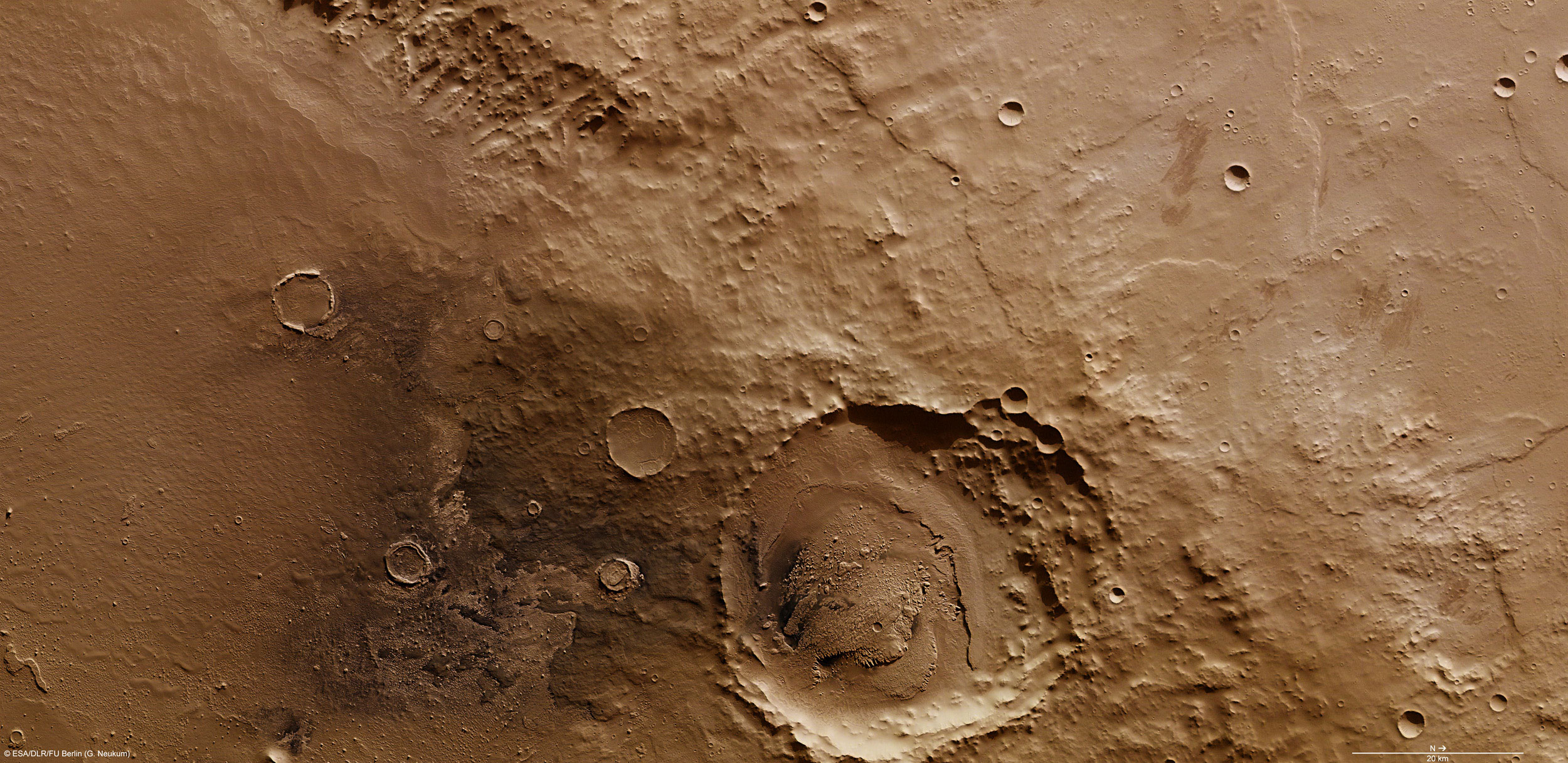
    This image from ESA’s Mars Express features the small crater embedded in the northwestern rim of the Schiaparelli impact basin. All around is evidence for past water and the great Martian winds that periodically blow.

    A 42 km (26 mi)-wide impact crater and numerous smaller craters straddle the northwestern rim of the 460 km (290 mi)-diameter Schiaparelli basin in this image taken by ESA’s Mars Express on 15 July 2010.

    The large basin is named for Italian astronomer Giovanni Schiaparelli (1835–1910). The entry, descent, and landing demonstrator module of the joint ESA–Roscosmos ExoMars 2016 mission also honors the astronomer with the name Schiaparelli.

    Giovanni Schiaparelli is famous for observing straight-line features on Mars that he called ‘canali’. This term was mistakenly translated into English as ‘canal’ instead of ‘channel’, conjuring up images of vast irrigation networks constructed by intelligent beings.

    We now know that Schiaparelli’s canali were illusions created by the comparatively poor telescopes of the time and that there are no water-filled channels on Mars today – but there is plenty of evidence that water was once present in Mars’ past. The Schiaparelli basin may be one such location: layers in its walls and deposits on its floor suggest it once hosted a lake. The scene shown here has also been modified by lava flows and wind erosion.

    Meanwhile, the ‘other’ Schiaparelli, that of the ExoMars 2016 mission, is getting ready – along with the Trace Gas Orbiter – to leave Europe for its launch site in Kazakhstan. They are due for launch on a Russian Proton rocket in March 2016, arriving at the Red Planet in October.

    While Schiaparelli will demonstrate technologies for Europe to land on Mars, the orbiter will take a detailed inventory of Mars’ trace gases. Although present in the atmosphere only in very small quantities, these gases, including methane, imply a current source and therefore could be linked to present-day geological or biological activity.
    Schiaparelli Impact Basin
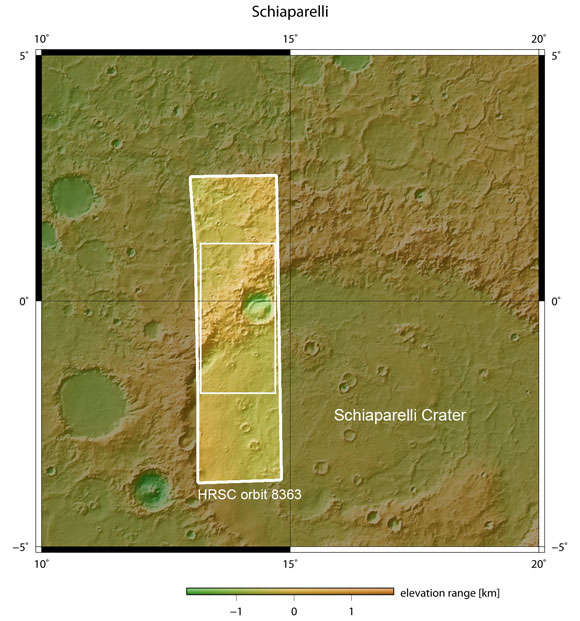
    Schiaparelli is a large impact basin about 460 km (290 mi) across, located in the eastern Terra Meridiani region of the planet’s equator. This image is centered on the equator of Mars, at a longitude of about 14°E. The new Mars Express image shows just a small part of the basin’s northwestern rim and a smaller 42-km-diameter crater in its rim.

    More Information

    Schiaparelli is a large impact basin about 460 km (290 mi) in diameter located in the eastern Terra Meridiani region of the equator of Mars. The center of the basin lies at about 3°S/17°E and is named after the Italian astronomer Giovanni Schiaparelli (1835–1910). Although he also studied Mercury and Venus, he is best known for his observations of the Red Planet.
    Schiaparelli in context

    During the ‘Great Opposition’ of 1877, when Mars passed close to Earth, Schiaparelli mapped the planet, perceiving a number of straight dark lines across the red surface. He assumed that these were natural water-filled channels and used the equivalent Italian word, ‘canali’.

    However, other astronomers thought he meant canals, meaning artificial irrigation and transportation routes, which led to a few astronomers, and a large number of the general public, believing that they had been created by intelligent Martians.

    Now we know that Schiaparelli’s ‘canali’ were illusions created by the comparatively poor telescopes of the time and there are no water-filled channels on Mars today. Nevertheless, there is evidence in this new picture that water was once present in this region of the planet, perhaps in the form of a lake.

    Never miss a breakthrough: Join the SciTechDaily newsletter.
    Follow us on Google and Google News.

    Astronomy European Space Agency Mars Mars Express Planetary Science
    Share. Facebook Twitter Pinterest LinkedIn Email Reddit

    Related Articles

    Mars Express Provides a Window to a Watery Past on Mars

    ESA’s Mars Express View Remnants of Mega-Flood on Mars

    New Mosaic Shows Off the Red Planet’s North Polar Ice Cap

    ESA’s Mars Express Sheds New Light on the Red Planet’s Rare Aurora

    New ESA Image of Craters within the Hellas Basin on Mars

    New Fly-Through Video of the Ancient Flood Plain Kasei Valles

    Mars Express Captures a Radar View of the Southern Highlands of Mars

    ESA’s Mars Express Captures New Images of Sulci Gordii

    ESA’s Mars Express MARSIS Radar Explores Martian Oceans

    1 Comment

    1. Mark Watney on June 1, 2021 2:23 pm

      Also known as “Entrance Crater” and, beside it, “Entrance Ramp” into Schiaparelli..

      Reply
    Leave A Reply Cancel Reply

    • Facebook
    • Twitter
    • Pinterest
    • YouTube

    Don't Miss a Discovery

    Subscribe for the Latest in Science & Tech!

    Trending News

    Artificial Sweeteners May Harm Future Generations, Study Suggests

    Splashdown! NASA Artemis II Returns From Record-Breaking Moon Mission

    What If Consciousness Exists Beyond Your Brain

    Scientists Finally Crack the 100-Million-Year Evolutionary Mystery of Squid and Cuttlefish

    Beyond “Safe Levels”: Study Challenges What We Know About Pesticides and Cancer

    Researchers Have Found a Dietary Compound That Increases Longevity

    Scientists Baffled by Bizarre “Living Fossil” From 275 Million Years Ago

    Your IQ at 23 Could Predict Your Wealth at 27, Study Finds

    Follow SciTechDaily
    • Facebook
    • Twitter
    • YouTube
    • Pinterest
    • Newsletter
    • RSS
    SciTech News
    • Biology News
    • Chemistry News
    • Earth News
    • Health News
    • Physics News
    • Science News
    • Space News
    • Technology News
    Recent Posts
    • AI Could Detect Early Signs of Alzheimer’s in Under a Minute – Far Before Traditional Tests
    • What if Dark Matter Has Two Forms? Bold New Hypothesis Could Explain a Cosmic Mystery
    • Researchers Expose Hidden Chemistry of “Ore-Forming” Elements in Biology
    • Geologists Reveal the Americas Collided Earlier Than We Thought
    • 20x Difference: Study Reveals True Source of Airborne Microplastics
    Copyright © 1998 - 2026 SciTechDaily. All Rights Reserved.
    • Science News
    • About
    • Contact
    • Editorial Board
    • Privacy Policy
    • Terms of Use

    Type above and press Enter to search. Press Esc to cancel.