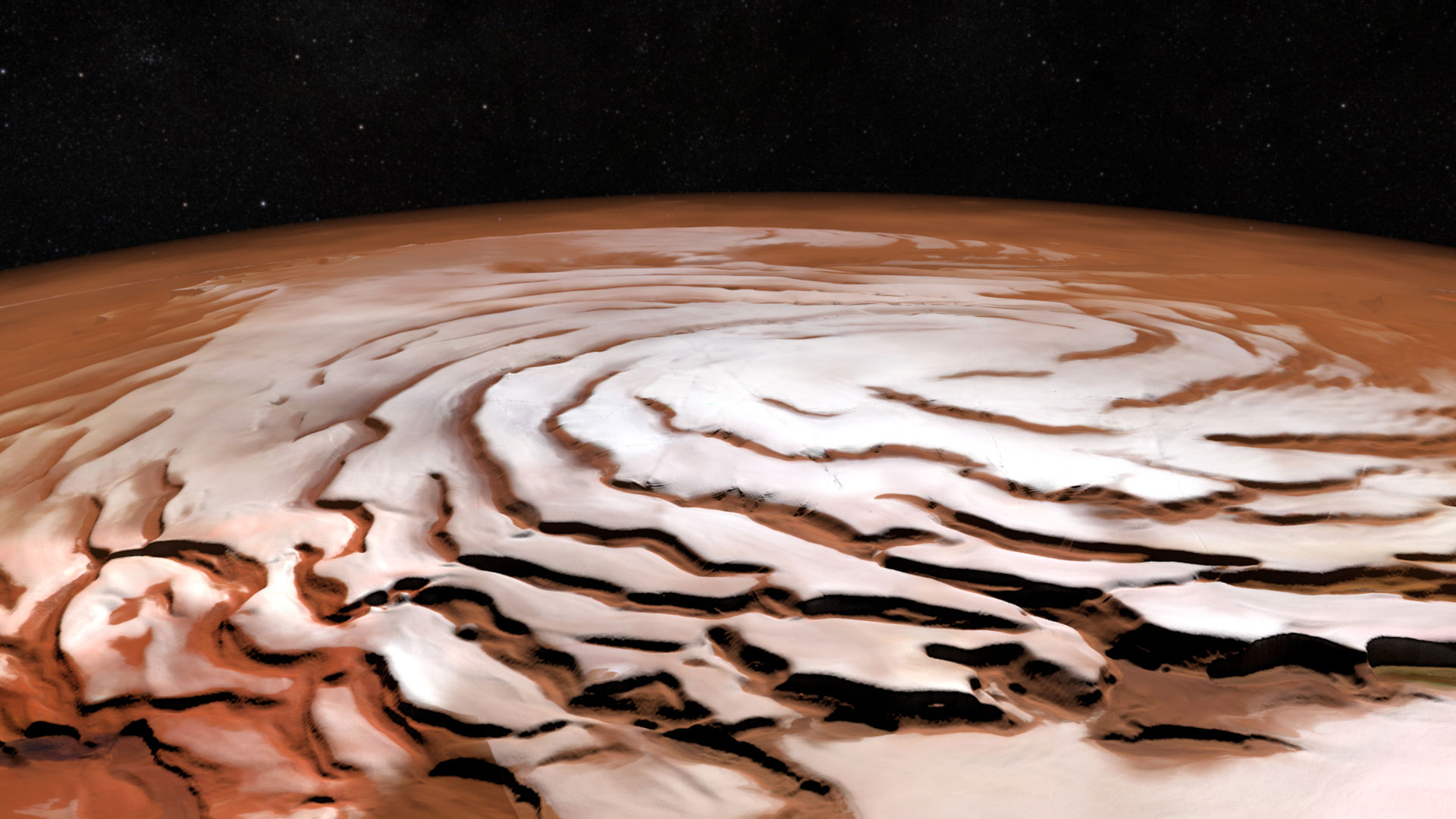
Perspective view of the Mars north polar ice cap and its distinctive dark troughs forming a spiral-like pattern. The view is based on images taken by ESA’s Mars Express and generated using elevation data from the Mars Orbiter Laser Altimeter (MOLA) on board the NASA Mars Global Surveyor mission. Credit: ESA/DLR/FU Berlin; NASA MGS MOLA Science Team
ESA’s Mars Express provides a new mosaic of Mars.
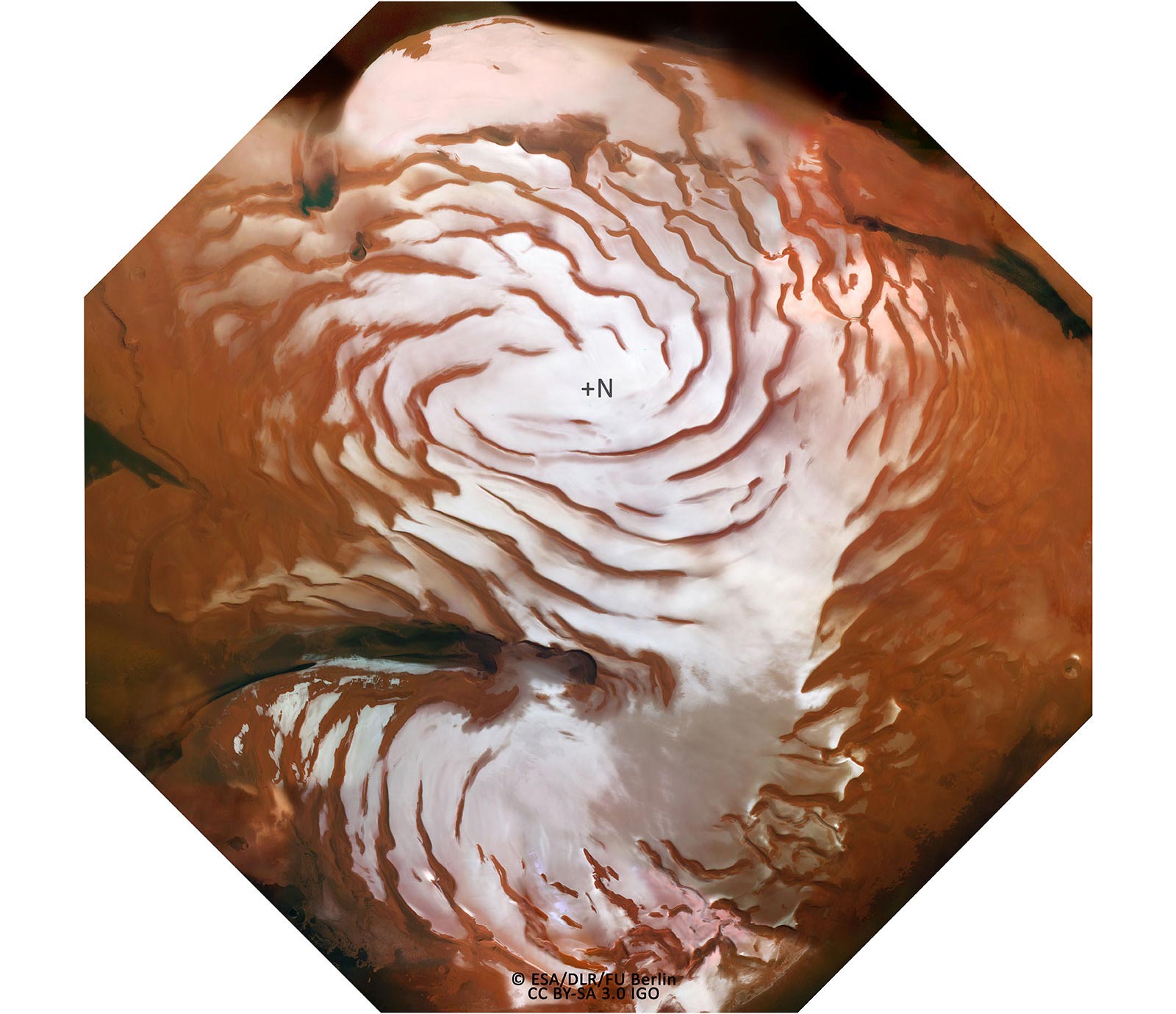
A new mosaic from ESA’s Mars Express shows off the Red Planet’s north polar ice cap and its distinctive dark spiraling troughs. The mosaic was generated from 32 individual orbit ‘strips’ captured between 2004 and 2010, and covers an area of around a million square kilometers.
The ice cap is a permanent fixture, but in the winter season – as it is now in early 2017 – temperatures are cold enough for around 30 percent of the carbon dioxide in the planet’s atmosphere to precipitate onto the cap, adding a seasonal layer up to a meter thick.
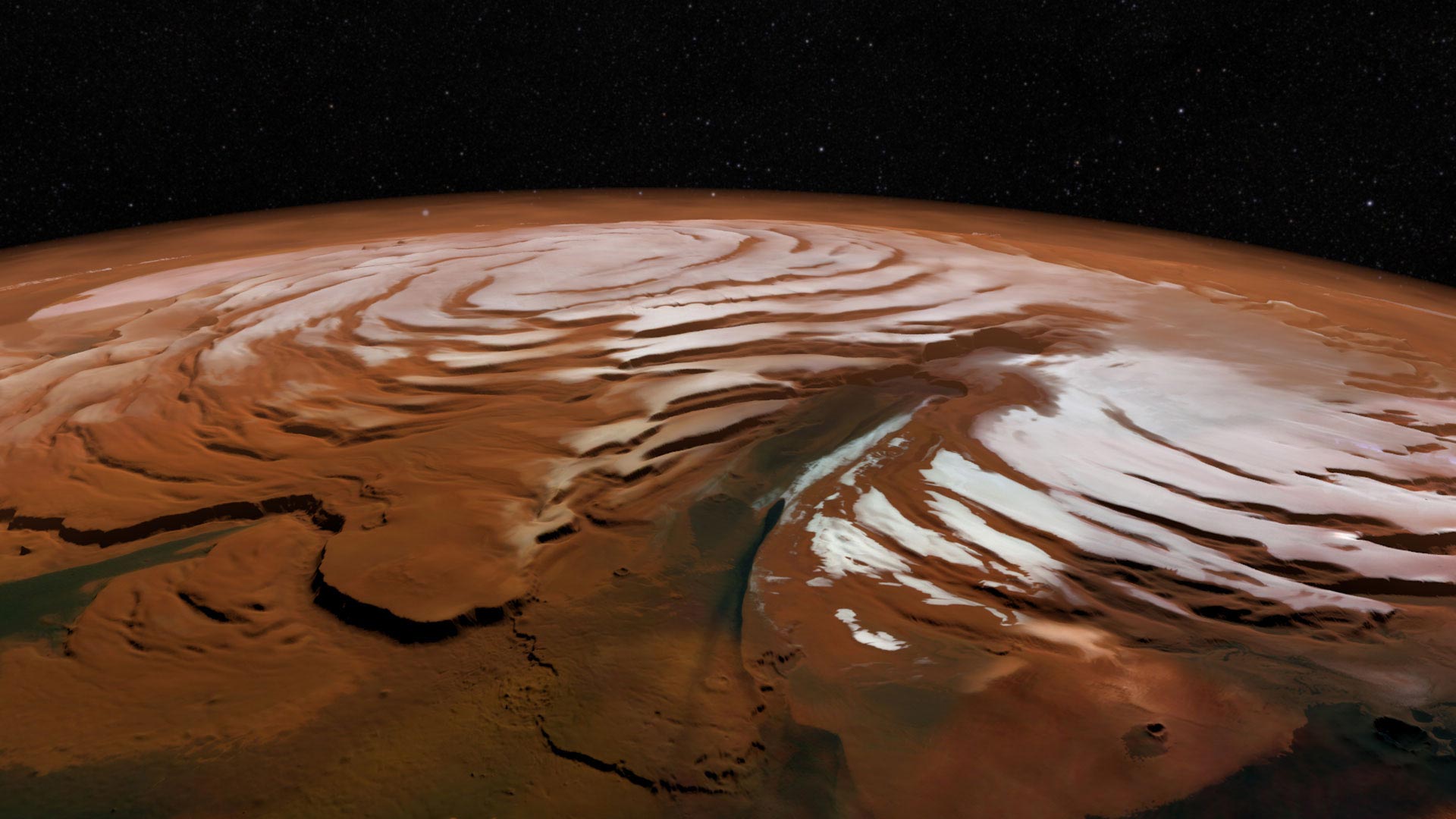
This perspective view of Mars’s north polar cap focuses on the ~500 km long, 100 km wide, and 2 km-deep canyon known as Chasma Boreale. The giant trough, which gives the appearance of almost cutting the ice cap in two, is thought to have been present before the iconic spiraling ice cap formed, seemingly growing deeper as new ice deposits built up around it. The view is based on images taken by ESA’s Mars Express and generated using elevation data from the Mars Orbiter Laser Altimeter (MOLA) on board the NASA Mars Global Surveyor mission.
During the warmer summer months, most of the carbon dioxide ice turns directly into gas and escapes into the atmosphere, leaving behind the water-ice layers.
Strong winds are thought to have played an important role in shaping the ice cap over time, blowing from the elevated center towards its lower edges and twisted by the same Coriolis force that causes hurricanes to spiral on Earth.
This color mosaic was generated from 32 individual orbit ‘strips’ captured between 2004 and 2010 by the High Resolution Stereo Camera onboard ESA’s Mars Express. The position of the north pole is marked. The ice cap covers an area of around one million square kilometers and has a volume equivalent to almost half the size of the Greenland ice sheet on Earth. It has a persistent water-ice cap about 2 km (1.3 mi) deep, with an additional thin layer of carbon dioxide ice in cold winter months. Dark trenches etched into the ice form a spiral-like pattern.
The plunging canyon, known as Chasma Boreale, is thought to be a relatively old feature, forming before the ice–dust spiral features, and seemingly growing deeper as new ice deposits built up around it.
Subsurface investigations by radar instruments onboard Mars Express and NASA’s Mars Reconnaissance Orbiter revealed that the ice cap is made up of many individual layers of ice and dust extending to a depth of around 2 km (1.3 mi).
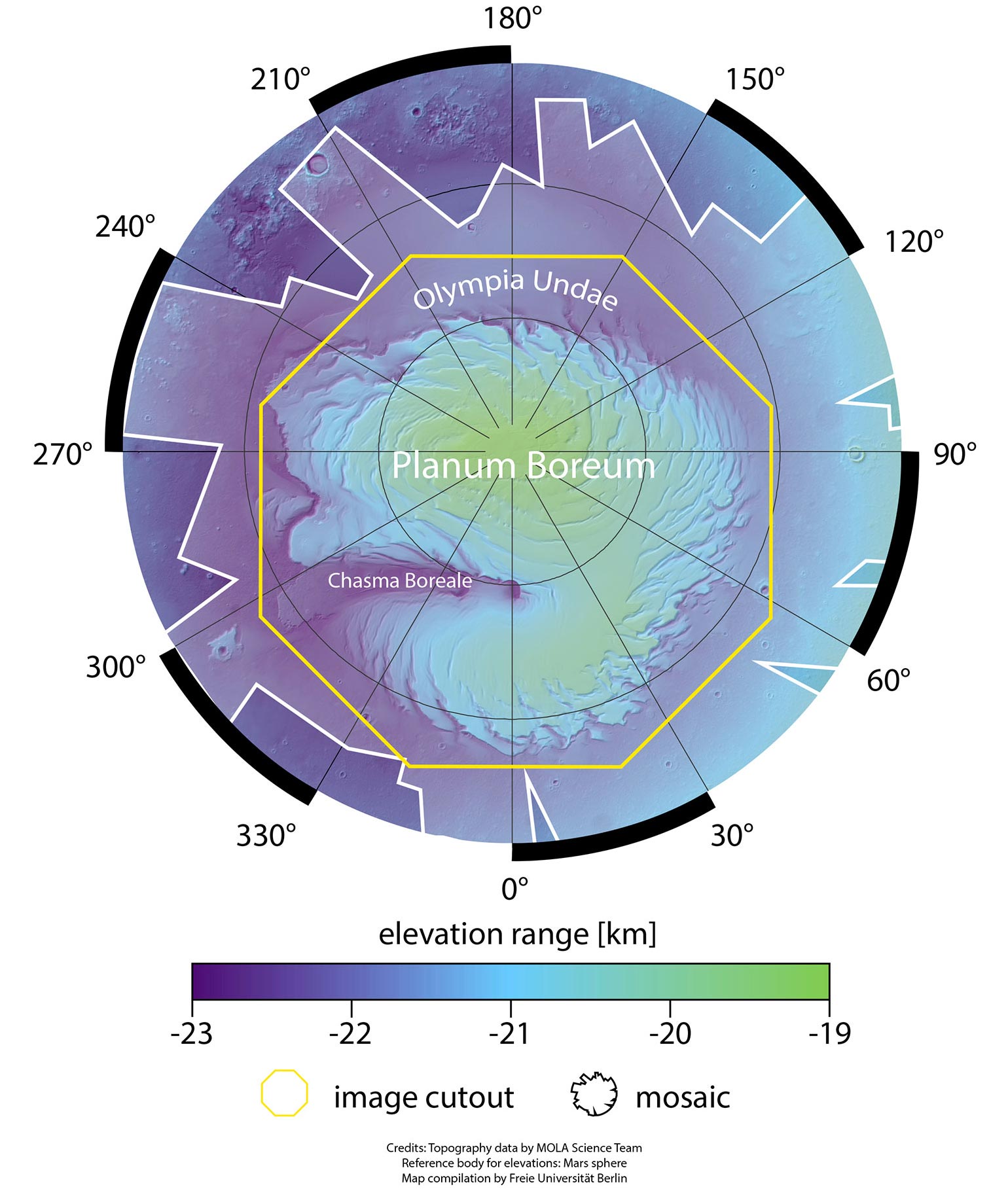
Context image showing the extent of the north polar ice cap in the northern hemisphere of Mars. It covers a region 0°–360°E and approximately 78°–90° N. The yellow outline indicates the area featured in the corresponding main color image release, while the white outlines show the area covered by the 32 individual image strips compiled to make the mosaic. The mosaic was created from images acquired during the following orbits: 1154, 1177, 1219, 1291, 1394, 1745, 3663, 3681, 3685, 3695, 5483, 5775, 5784, 5796, 5808, 5810, 5818, 5824, 5827, 5838, 5853, 5864, 5867, 5900, 5904, 5963, 6007, 6229, 8042, 8080, 8153 and 8160, which cover a time span from December 11, 2004, to May 17, 2010. The context map is in stereographic projection and uses a Mars sphere as a reference body for elevation values.
This presents a valuable record for the nature of how the planet’s climate has changed as its tilt and orbit varied over hundreds of thousands of years.

1 Comment
Keep it up – I try not to miss a post – Leon