
Close Menu
    Facebook X (Twitter) Instagram
    SciTechDaily
    • Biology
    • Chemistry
    • Earth
    • Health
    • Physics
    • Science
    • Space
    • Technology
    Facebook X (Twitter) Pinterest YouTube RSS
    SciTechDaily
    Home»Space»Astronomers Obtain Sensitive Measurements of a Massive and Luminous Elliptical Galaxy
    Space

    Astronomers Obtain Sensitive Measurements of a Massive and Luminous Elliptical Galaxy

    By Harvard-Smithsonian Center for AstrophysicsFebruary 3, 20171 Comment3 Mins Read
    Facebook Twitter Pinterest Telegram LinkedIn WhatsApp Email Reddit
    Share
    Facebook Twitter LinkedIn Pinterest Telegram Email Reddit
    A Massive Galaxy Long Ago and Far Away
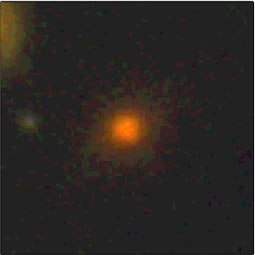
    An extremely massive elliptical galaxy at about three billion years after the big bang, as seen in an optical/near-infrared image. The galaxy is about ten times more massive than the Milky Way. Today the galaxy is not actively producing new stars, but its population of old, red stars appears to be the result of earlier episodes during which the galaxy was one of the most active star-forming examples known.

    Using the spectrometer on the Keck telescope, astronomers from the Harvard-Smithsonian Center for Astrophysics obtained very sensitive magnesium measurements in one of the most massive and luminous elliptical galaxies known.

    Galaxies today fall roughly into two categories: elliptically-shaped collections of reddish, old stars that formed predominantly during a period early in the history of the universe, and spiral-shaped objects dominated by blue, young stars. The Milky Way is an example of the latter, a spiral galaxy actively making new stars. In order to understand the growth of galaxies over cosmic time and the past star formation history of the universe, astronomers study the population of old stars in distant ellipticals from earlier epochs, stars which in turn formed at an even early time. Star formation produces supernovae which enrich their environments with elements, including the diagnostic element magnesium. Measuring the amount of magnesium (relative to iron) in a galaxy thus helps to fix the strength and duration of prior episodes of star formation.

    CfA astronomers Charlie Conroy and Jieun Choi and eight colleagues used the spectrometer on the Keck telescope (along with some secondary datasets) to obtain very sensitive magnesium measurements in one of the most massive and luminous elliptical galaxies known. The galaxy, seen at an epoch only three billion years after the big bang, has a stellar mass of about three hundred billion solar-masses (the Milky Way’s stellar mass is about ten times less) but is currently making stars at a rate only about half that of the Milky Way. However, its magnesium-to-iron ratio indicates that earlier in its life it was making stars at a phenomenally high rate, perhaps as many as several thousand solar-masses each year, making it one of the most vigorous examples of star formation known.

    The scientists conclude that the bursts of star formation in this galaxy must have been due to mergers with other galaxies. In fact, they estimate that the object probably doubled in size as a consequence of accreting smaller galaxies. Unfortunately, this particular elliptical is so unusual that it cannot be considered a typical progenitor for any local elliptical galaxy. The team argues that additional observations of more, less extreme ellipticals in the early universe are now needed to fill in the rest of the story. The instruments on the James Webb Space Telescope, to be launched next year, should be capable of doing so.

    Reference: “A Massive, Quiescent, Population II Galaxy at a Redshift of 2.1” by Mariska Kriek, Charlie Conroy, Pieter G. van Dokkum, Alice E. Shapley, Jieun, Naveen A. Reddy, Brian Siana, Freeke van de Voort, Alison L. Coil and Bahram Mobasher, 7 December 2016, Nature.
    DOI: 10.1038/nature20570

    Never miss a breakthrough: Join the SciTechDaily newsletter.
    Follow us on Google and Google News.

    Astronomy Cosmology Harvard-Smithsonian Center for Astrophysics W. M. Keck Observatory
    Share. Facebook Twitter Pinterest LinkedIn Email Reddit

    Related Articles

    Astronomers Just Reconstructed a Galaxy’s 12-Billion-Year History

    Webb’s Mysterious “Little Red Dots” May Be the Cradle of the First Black Holes

    Mysterious Radio Signals Reveal What’s Hiding Between Galaxies

    Cosmic Mystery Solved: Astronomers Have Discovered the Universe’s “Missing” Matter

    Invisible Storm Lights Up Galaxy Cluster With Record-Breaking Radio Glow

    Astronomers View Distant Galaxy Powered by Primordial Hydrogen

    Keck Observatory Measures Segue 2: The Least Massive Galaxy

    New Study Challenges Planck Results

    Calculations Show the Ideal Time to Study the Cosmos

    1 Comment

    1. Valeriy on February 4, 2017 8:31 am

      There are some very complicated issues of galaxy formation. Unfortunately, here is the same problem as with the stars. The origin of galaxies remains unclear, in spite of huge activity in the field. What the “formation” means? It means that we have the material that is assembling into galaxies.

      Reply
    Leave A Reply Cancel Reply

    • Facebook
    • Twitter
    • Pinterest
    • YouTube

    Don't Miss a Discovery

    Subscribe for the Latest in Science & Tech!

    Trending News

    Scientists Warn That This Common Pet Fish Can Wreck Entire Ecosystems

    Scientists Make Breakthrough in Turning Plastic Trash Into Clean Fuel Using Sunlight

    This Popular Supplement May Interfere With Cancer Treatment, Scientists Warn

    Scientists Finally Solved One of Water’s Biggest Mysteries

    Could This New Weight-Loss Pill Disrupt the Entire Market? Here’s What You Should Know About Orforglipron

    Earth’s Crust Is Tearing Open in Africa, and It Could Form a New Ocean

    Breakthrough Bowel Cancer Trial Leaves Patients Cancer-Free for Nearly 3 Years

    Natural Compound Shows Powerful Potential Against Rheumatoid Arthritis

    Follow SciTechDaily
    • Facebook
    • Twitter
    • YouTube
    • Pinterest
    • Newsletter
    • RSS
    SciTech News
    • Biology News
    • Chemistry News
    • Earth News
    • Health News
    • Physics News
    • Science News
    • Space News
    • Technology News
    Recent Posts
    • The Most Effective Knee Arthritis Treatments Aren’t What You Expect
    • Scientists Develop Bioengineered Chewing Gum That Could Help Fight Oral Cancer
    • Popular Weight-Loss Drugs Found To Cut Heart Attack and Stroke Risk
    • After 37 Years, the World’s Longest-Running Soil Warming Experiment Uncovers a Startling Climate Secret
    • NASA Satellite Captures First-Ever High-Res View of Massive Pacific Tsunami
    Copyright © 1998 - 2026 SciTechDaily. All Rights Reserved.
    • Science News
    • About
    • Contact
    • Editorial Board
    • Privacy Policy
    • Terms of Use

    Type above and press Enter to search. Press Esc to cancel.