
Close Menu
    Facebook X (Twitter) Instagram
    SciTechDaily
    • Biology
    • Chemistry
    • Earth
    • Health
    • Physics
    • Science
    • Space
    • Technology
    Facebook X (Twitter) Pinterest YouTube RSS
    SciTechDaily
    Home»Space»Astronomers Discover Dead Disk Galaxy, Challenges Theories of Galaxy Evolution
    Space

    Astronomers Discover Dead Disk Galaxy, Challenges Theories of Galaxy Evolution

    By Ann Jenkins / Ray Villard, Space Telescope Science InstituteJune 22, 2017No Comments5 Mins Read
    Facebook Twitter Pinterest Telegram LinkedIn WhatsApp Email Reddit
    Share
    Facebook Twitter LinkedIn Pinterest Telegram Email Reddit
    Hubble Spots Massive Dead Disk Galaxy that Challenges Theories of Galaxy Evolution
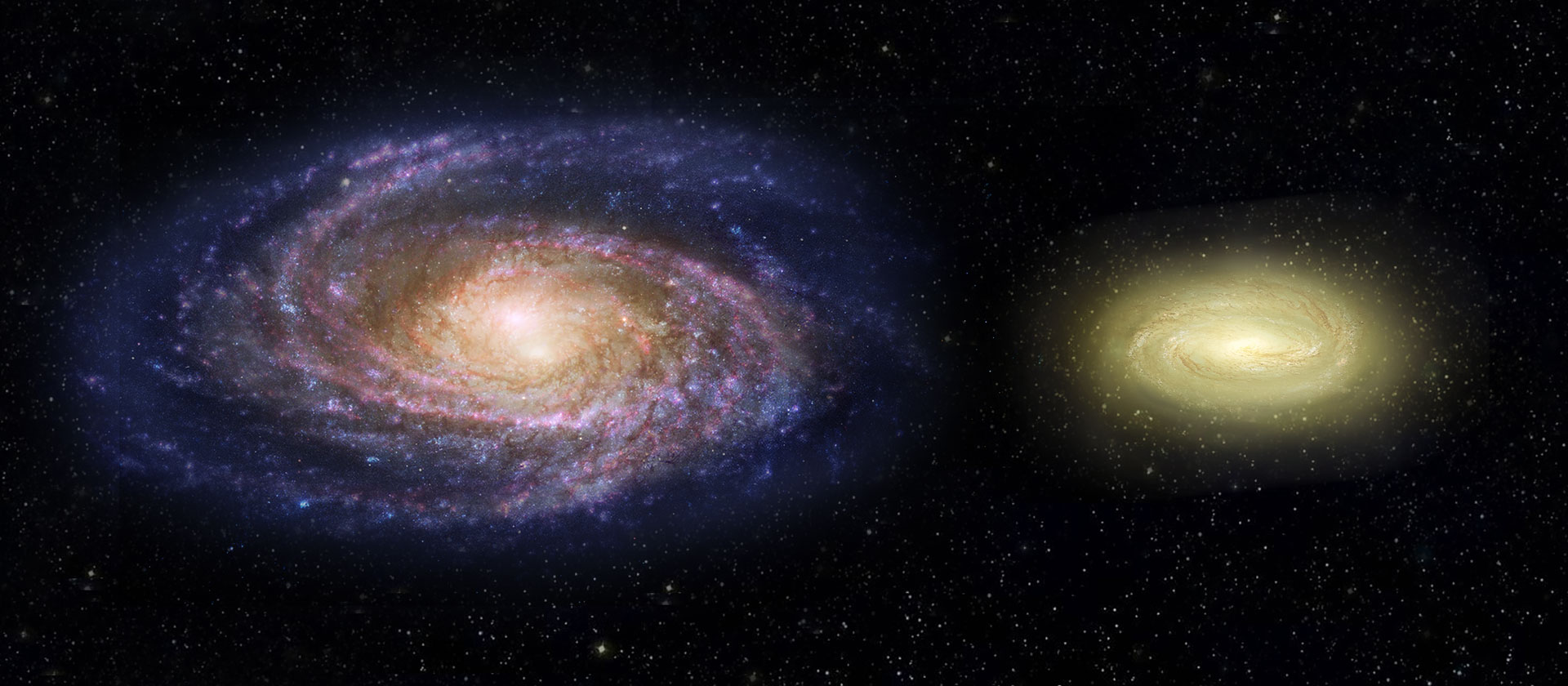
    This artist’s concept shows what the young, dead, disk galaxy MACS2129-1, right, would look like when compared with the Milky Way galaxy, left. Although three times as massive as the Milky Way, it is only half the size. MACS2129-1 is also spinning more than twice as fast as the Milky Way. Note that regions of Milky Way are blue from bursts of star formation, while the young, dead galaxy is yellow, signifying an older star population and no new star birth. Credit: NASA, ESA, and Z. Levy (STScI)

    Using the Hubble Space Telescope, a team of astronomers has discovered the first example of a compact yet massive, fast-spinning, disk-shaped galaxy that stopped making stars only a few billion years after the big bang.

    Finding such a galaxy early in the history of the universe challenges the current understanding of how massive galaxies form and evolve, say researchers.

    When Hubble photographed the galaxy, astronomers expected to see a chaotic ball of stars formed through galaxies merging together. Instead, they saw evidence that the stars were born in a pancake-shaped disk.
    Dead Disk Galaxy that Challenges Theories of Galaxy Evolution
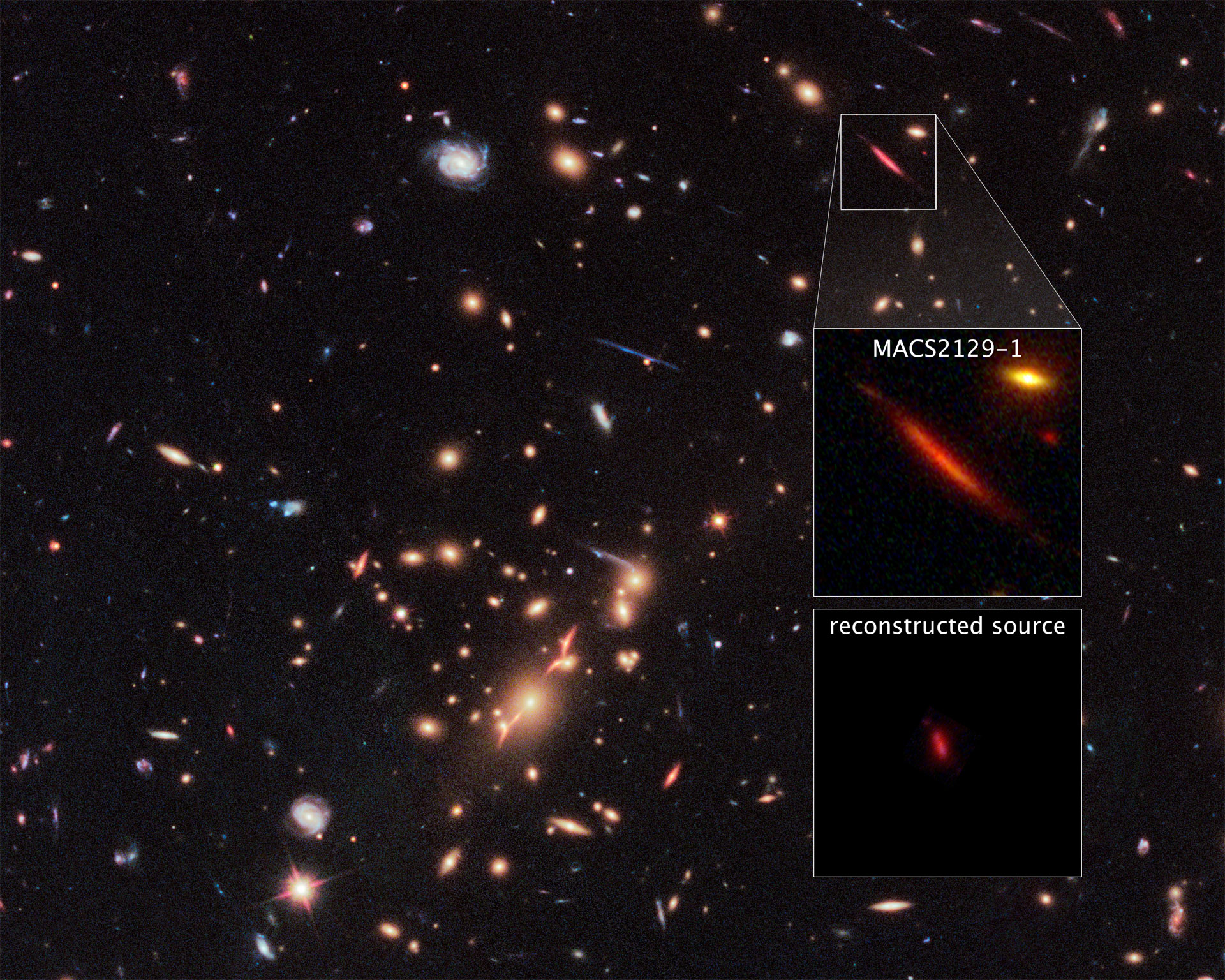
    Acting as a “natural telescope” in space, the gravity of the extremely massive foreground galaxy cluster MACS J2129-0741 magnifies, brightens, and distorts the far-distant background galaxy MACS2129-1, shown in the top box. The middle box is a blown-up view of the gravitationally lensed galaxy. In the bottom box is a reconstructed image, based on modeling that shows what the galaxy would look like if the galaxy cluster were not present. The galaxy appears red because it is so distant that its light is shifted into the red part of the spectrum. Credit: NASA, ESA, S. Toft (University of Copenhagen), M. Postman (STScI), and the CLASH team

    This is the first direct observational evidence that at least some of the earliest so-called “dead” galaxies — where star formation stopped — somehow evolved from a Milky Way-shaped disk into the giant elliptical galaxies we see today.

    This is a surprise because elliptical galaxies contain older stars, while spiral galaxies typically contain younger blue stars. At least some of these early “dead” disk galaxies must have gone through major makeovers. They not only changed their structure, but also the motions of their stars to make a shape of an elliptical galaxy.

    “This new insight may force us to rethink the whole cosmological context of how galaxies burn out early on and evolve into local elliptical-shaped galaxies,” said study leader Sune Toft of the Dark Cosmology Center at the Niels Bohr Institute, University of Copenhagen, Denmark. “Perhaps we have been blind to the fact that early “dead” galaxies could in fact be disks, simply because we haven’t been able to resolve them.”

    Previous studies of distant dead galaxies have assumed that their structure is similar to the local elliptical galaxies they will evolve into. Confirming this assumption in principle requires more powerful space telescopes than are currently available. However, through the phenomenon known as “gravitational lensing,” a massive, foreground cluster of galaxies acts as a natural “zoom lens” in space by magnifying and stretching images of far more distant background galaxies. By joining this natural lens with the resolving power of Hubble, scientists were able to see into the center of the dead galaxy.

    The remote galaxy is three times as massive as the Milky Way but only half the size. Rotational velocity measurements made with the European Southern Observatory’s Very Large Telescope (VLT) showed that the disk galaxy is spinning more than twice as fast as the Milky Way.

    Using archival data from the Cluster Lensing And Supernova survey with Hubble (CLASH), Toft and his team were able to determine the stellar mass, star-formation rate, and ages of the stars.

    Why this galaxy stopped forming stars is still unknown. It may be the result of an active galactic nucleus, where energy is gushing from a supermassive black hole. This energy inhibits star formation by heating the gas or expelling it from the galaxy. Or it may be the result of the cold gas streaming onto the galaxy being rapidly compressed and heated up, preventing it from cooling down into star-forming clouds in the galaxy’s center.

    But how do these young, massive, compact disks evolve into the elliptical galaxies we see in the present-day universe? “Probably through mergers,” Toft said. “If these galaxies grow through merging with minor companions, and these minor companions come in large numbers and from all sorts of different angles onto the galaxy, this would eventually randomize the orbits of stars in the galaxies. You could also imagine major mergers. This would definitely also destroy the ordered motion of the stars.”

    The findings are published in the June 22 issue of the journal Nature. Toft and his team hope to use NASA’s upcoming James Webb Space Telescope to look for a larger sample of such galaxies.

    The Very Large Telescope is a telescope facility operated by the European Southern Observatory on Cerro Paranal in the Atacama Desert of Northern Chile.

    Reference: “A massive, dead disk galaxy in the early Universe” by Sune Toft, Johannes Zabl, Johan Richard, Anna Gallazzi, Stefano Zibetti, Moire Prescott, Claudio Grillo, Allison W. S. Man, Nicholas Y. Lee, Carlos Gómez-Guijarro, Mikkel Stockmann, Georgios Magdis and Charles L. Steinhardt, 22 June 2017, Nature.
    DOI: 10.1038/nature22388
    arXiv

    Never miss a breakthrough: Join the SciTechDaily newsletter.
    Follow us on Google and Google News.

    Astronomy Astrophysics Cosmology Galaxy Evolution Hubble Space Telescope
    Share. Facebook Twitter Pinterest LinkedIn Email Reddit

    Related Articles

    Astronomers See Evidence of Something Unexpected in the Universe

    Simulations Shed Light on the Formation of Stars in the Earliest Galaxies

    Uniform Heavy Element Distribution Points to Early Cosmic ‘Seeding’

    Hubble Data Reveals Galaxies Had ‘Mature’ Shapes 11.5 Billion Years Ago

    Study Suggest Spiral Galaxies Are Larger Than Previously Thought

    New Planck Data Challenges Our Understanding of the Universe

    Evidence That Local Starbursts Impact the Bulk of the Gas Around Their Host Galaxy

    One of the Most Efficient Star Making Galaxies Ever Observed

    Sideways Motions of Distant Stars Shed New Light on Milky Way Evolution

    Leave A Reply Cancel Reply

    • Facebook
    • Twitter
    • Pinterest
    • YouTube

    Don't Miss a Discovery

    Subscribe for the Latest in Science & Tech!

    Trending News

    Scientists May Have Found the Key to Jupiter and Saturn’s Moon Mystery

    Scientists Uncover Brain Changes That Link Pain to Depression

    Saunas May Do More Than Raise Body Temperature – They Activate Your Immune System

    Exercise in a Pill? Metformin Shows Surprising Effects in Cancer Patients

    Hidden Oceans of Magma Could Be Protecting Alien Life

    New Study Challenges Alzheimer’s Theories: It’s Not Just About Plaques

    Artificial Sweeteners May Harm Future Generations, Study Suggests

    Splashdown! NASA Artemis II Returns From Record-Breaking Moon Mission

    Follow SciTechDaily
    • Facebook
    • Twitter
    • YouTube
    • Pinterest
    • Newsletter
    • RSS
    SciTech News
    • Biology News
    • Chemistry News
    • Earth News
    • Health News
    • Physics News
    • Science News
    • Space News
    • Technology News
    Recent Posts
    • Ancient DNA Reveals Irish Goats Have a 3,000-Year-Old Lineage Still Alive Today
    • Historians Reveal Secrets of the Strange Hat Wars That Shook Early Modern England
    • “A Plague Is Upon Us”: The Mass Death That Changed an Ancient City Forever
    • This Strange Material Can Turn Superconductivity on and off Like a Switch
    • Scientists Discover Game-Changing New Way To Treat High Cholesterol
    Copyright © 1998 - 2026 SciTechDaily. All Rights Reserved.
    • Science News
    • About
    • Contact
    • Editorial Board
    • Privacy Policy
    • Terms of Use

    Type above and press Enter to search. Press Esc to cancel.