
Close Menu
    Facebook X (Twitter) Instagram
    SciTechDaily
    • Biology
    • Chemistry
    • Earth
    • Health
    • Physics
    • Science
    • Space
    • Technology
    Facebook X (Twitter) Pinterest YouTube RSS
    SciTechDaily
    Home»Space»New ESA Image of Craters within the Hellas Basin on Mars
    Space

    New ESA Image of Craters within the Hellas Basin on Mars

    By European Space AgencyAugust 18, 2014No Comments2 Mins Read
    Facebook Twitter Pinterest Telegram LinkedIn WhatsApp Email Reddit
    Share
    Facebook Twitter LinkedIn Pinterest Telegram Email Reddit
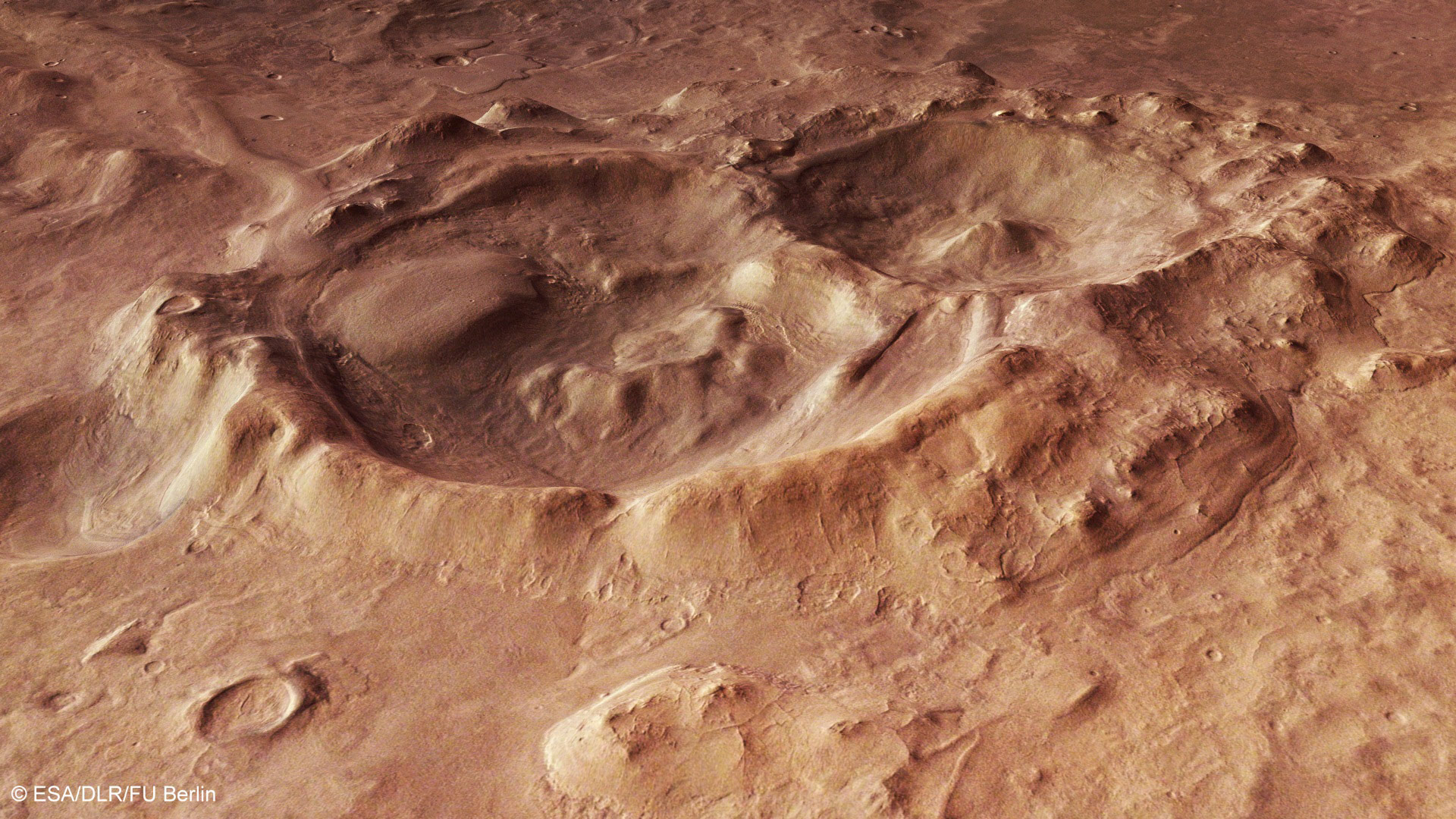
    Craters within the Hellas Basin of Mars
    Craters within the Hellas Basin. Credit: ESA/DLR/FU Berlin

    This newly released Mars Express image shows craters within the Hellas Basin in the southern highlands of Mars.

    Scarring the southern highlands of Mars is one of the Solar System’s largest impact basins: Hellas, with a diameter of 2,300 km (1,400 mi) and a depth of over 7 km (4 mi).

    Hellas is thought to have formed between 3.8 and 4.1 billion years ago, when a large asteroid hit the surface of Mars. Since its formation, Hellas has been subject to modification by the action of wind, ice, water, and volcanic activity.

    Impact craters have also since pock-marked this vast basin floor, two of which are the focus of this image, taken by the High Resolution Stereo Camera on ESA’s Mars Express on 17 December 2013. The ground resolution is about 15 meters (49 feet) per pixel.

    These craters lie in the deepest, western portion of Hellas, and such a clear view is unusual because dust clouds typically obscure the basin floor. Indeed, this region seems to be covered by a thick blanket of dust.

    The larger of the two craters is about 25 km (16 mi) across. A flow of material appears to have been transported from the top left of the scene and into the crater. Zooming in to the smooth mound and the area immediately around it reveals interesting textures that likely resulted from this flow.

    Flow features are also seen outside of the craters, and in particular, at the center left of the image near the top of the frame. Material also seems to have cascaded from the larger crater’s rim and into a neighboring smaller crater, at the far left of the image.

    The morphology of many features in the Hellas Basin and its surroundings strongly suggests the presence of ice and glaciers.

    For example, in the foreground and around the crater rim, polygons of patterned ground are visible which indicates the presence of water – this pattern occurs when fine-grained and porous wet soil freezes.

    Indeed, in the deepest parts of the basin, the atmospheric pressure is about 89% higher than at the surface, which may even offer conditions suitable for water. Radar images from NASA’s Mars Reconnaissance Orbiter suggest that some craters in Hellas might contain water-ice glaciers several hundred meters thick, buried under layers of dust.


    Never miss a breakthrough: Join the SciTechDaily newsletter.
    Follow us on Google and Google News.

    Astronomy European Space Agency Mars Planetary Science
    Share. Facebook Twitter Pinterest LinkedIn Email Reddit

    Related Articles

    Mars Express Provides a Window to a Watery Past on Mars

    First Images from ExoMars Mission

    ESA’s Mars Express View Remnants of Mega-Flood on Mars

    New Mosaic Shows Off the Red Planet’s North Polar Ice Cap

    Mars Express Image of the Rim of the Schiaparelli Crater

    ESA’s Mars Express Sheds New Light on the Red Planet’s Rare Aurora

    New Fly-Through Video of the Ancient Flood Plain Kasei Valles

    Mars Express Captures a Radar View of the Southern Highlands of Mars

    ESA’s Mars Express Captures New Images of Sulci Gordii

    Leave A Reply Cancel Reply

    • Facebook
    • Twitter
    • Pinterest
    • YouTube

    Don't Miss a Discovery

    Subscribe for the Latest in Science & Tech!

    Trending News

    First-of-Its-Kind Discovery: Homer’s Iliad Found Embedded in a 1,600-Year-Old Egyptian Mummy

    Beyond Inflammation: Scientists Uncover New Cause of Persistent Rheumatoid Arthritis

    A Simple Molecule Could Unlock Safer, Easier Weight Loss

    Scientists Just Built a Quantum Battery That Charges Almost Instantly

    Researchers Unveil Groundbreaking Sustainable Solution to Vitamin B12 Deficiency

    Millions of People Have Osteopenia Without Realizing It – Here’s What You Need To Know

    Researchers Discover Boosting a Single Protein Helps the Brain Fight Alzheimer’s

    World-First Study Reveals Human Hearts Can Regenerate After a Heart Attack

    Follow SciTechDaily
    • Facebook
    • Twitter
    • YouTube
    • Pinterest
    • Newsletter
    • RSS
    SciTech News
    • Biology News
    • Chemistry News
    • Earth News
    • Health News
    • Physics News
    • Science News
    • Space News
    • Technology News
    Recent Posts
    • After Decades, MIT Researchers Capture the First 3D Atomic View of a Mysterious Material
    • Your Favorite Fishing Spot Is Turning Brown – and the Fish Are Changing
    • 380-Million-Year-Old Fish Fossil Reveals Secrets of Life’s First Steps Onto Land
    • Mezcal “Worm” in a Bottle Mystery: DNA Testing Reveals a Surprise
    • Scientists Turn Red Lettuce Green, Unlocking Hidden Nutrients
    Copyright © 1998 - 2026 SciTechDaily. All Rights Reserved.
    • Science News
    • About
    • Contact
    • Editorial Board
    • Privacy Policy
    • Terms of Use

    Type above and press Enter to search. Press Esc to cancel.