
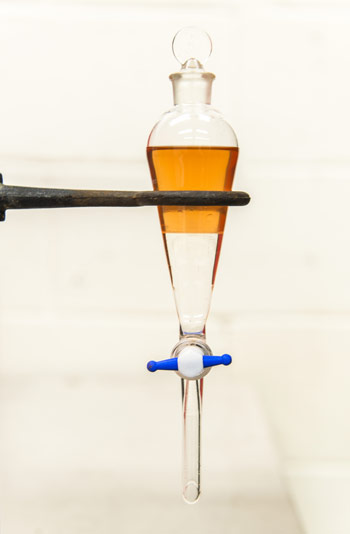
Researchers have developed “bionic liquids” from lignin and hemicellulose, two by-products of biofuel production from biorefineries, paving the way closed loop biofuel refineries.
While the powerful solvents known as ionic liquids show great promise for liberating fermentable sugars from lignocellulose and improving the economics of advanced biofuels, an even more promising candidate is on the horizon – bionic liquids.
Researchers at the U.S. Department of Energy’s Joint BioEnergy Institute (JBEI) have developed “bionic liquids” from lignin and hemicellulose, two by-products of biofuel production from biorefineries. JBEI is a multi-institutional partnership led by Lawrence Berkeley National Laboratory (Berkeley Lab) that was established by the DOE Office of Science to accelerate the development of advanced, next-generation biofuels.
“What if we could turn what is now a bane to the bioenergy industry into a boon?” says Blake Simmons, a chemical engineer who is JBEI’s Chief Science and Technology Officer and heads JBEI’s Deconstruction Division. “Lignin is viewed as a waste stream that is typically burned to generate heat and electricity for the biorefinery, but if other uses for lignin could be found with higher economic value it would significantly improve the refinery’s overall economics. Our concept of bionic liquids opens the door to realizing a closed-loop process for future lignocellulosic biorefineries, and has far-reaching economic impacts for other ionic liquid-based process technologies that currently use ionic liquids synthesized from petroleum sources.”
Simmons and Seema Singh, who directs JBEI’s biomass pretreatment program, are the corresponding authors of a paper describing this research in the Proceedings of the National Academy of Sciences (PNAS). The paper is titled “Efficient biomass pretreatment using ionic liquids derived from lignin and hemicellulose.” The lead author is Aaron Socha. Other co-authors are Ramakrishnan Parthasarathi, Jian Shi, Sivakumar Pattathil, Dorian Whyte, Maxime Bergeron, Anthe George, Kim Tran, Vitalie Stavila, Sivasankari Venkatachalam and Michael Hahn.
The cellulosic sugars stored in the biomass of grasses and other non-food crops, and in agricultural waste, can be used to make advanced biofuels that could substantially reduce the use of the fossil fuels responsible for the release of nearly 9 billion metric tons of excess carbon into the atmosphere each year. More than a billion tons of biomass are produced annually in the United States alone and fuels from this biomass could be clean, green, and renewable substitutes for gasoline, diesel, and jet fuel on a gallon-for-gallon basis. Unlike ethanol, “drop-in” transportation fuels derived from biomass have the potential to be directly dropped into today’s engines and infrastructures at high levels – greater than 50 percent – without negatively impacting performance.
However, if biofuels, including cellulosic ethanol, are to be a commercial success, they must be cost-competitive with fossil fuels. This means economic technologies must be developed for extracting fermentable sugars from cellulosic biomass and synthesizing them into fuels and other valuable chemical products. A major challenge has been that, unlike the simple sugars in corn grain, the complex polysaccharides in biomass are deeply embedded within a tough woody material called lignin. Researchers at JBEI have been cost-effectively deconstructing biomass into fuel sugars by pre-treating the biomass with ionic liquids – salts that are composed entirely of paired ions and are liquid at room temperature. The ionic liquids that have emerged from this JBEI effort as a benchmark for biomass processing are imidazolium-based molten salts, which are made from nonrenewable sources such as petroleum or natural gas.
“Imidazolium-based ionic liquids effectively and efficiently dissolve biomass, and represent a remarkable platform for biomass pretreatment, but imidazolium cations are expensive and thus limited in their large-scale industrial deployment,” says Singh. “To replace them with a renewable product, we synthesized a series of tertiary amine-based ionic liquids from aromatic aldehydes in lignin and hemicellulose.”
The JBEI researchers tested the effectiveness of their bionic liquids as a pre-treatment for biomass deconstruction on switchgrass, one of the leading potential crops for making liquid transportation fuels. After 73 hours of incubation with these new bionic liquids, sugar yields were between 90 and 95 percent for glucose, and between 70 and 75 percent for xylose. These yields are comparable to the yields obtained after pre-treatment with the best-performing imidazolium-based ionic liquids.
“Lignin and hemicellulose are byproducts from the agricultural industry, biofuel plants, and pulp mills, which not only makes these abundant polymers inexpensive, but also allows for a closed-loop bio-refinery, in which the lignin in the waste stream can be up-cycled and reused to make more bionic liquid,” says lead author Socha, who is now the Director of the Center for Sustainable Energy at the Bronx Community College in New York City.
The current batch of bionic liquids was made using reductive amination and phosphoric acid, but Socha says the research team is now investigating the use of alternative reducing agents and acids that would be less expensive and even more environmentally benign.
“Our results have established an important foundation for the further study of bionic liquids in biofuels as well as other industrial applications,” he says.
This research was supported by the DOE Office of Science.
Reference: “Efficient biomass pretreatment using ionic liquids derived from lignin and hemicellulose” by Aaron M. Socha, Ramakrishnan Parthasarathi, Jian Shi, Sivakumar Pattathil, Dorian Whyte, Maxime Bergeron, Anthe George, Kim Tran, Vitalie Stavila, Sivasankari Venkatachalam, Michael G. Hahn, Blake A. Simmons and Seema Singh, 18 August 2014, PNAS.
DOI: 10.1073/pnas.1405685111
Never miss a breakthrough: Join the SciTechDaily newsletter.
Follow us on Google and Google News.