
Close Menu
    Facebook X (Twitter) Instagram
    SciTechDaily
    • Biology
    • Chemistry
    • Earth
    • Health
    • Physics
    • Science
    • Space
    • Technology
    Facebook X (Twitter) Pinterest YouTube RSS
    SciTechDaily
    Home»Space»ESO Image of the Week: A Wide View of the Crab Nebula
    Space

    ESO Image of the Week: A Wide View of the Crab Nebula

    By European Southern ObservatoryJune 8, 2015No Comments2 Mins Read
    Facebook Twitter Pinterest Telegram LinkedIn WhatsApp Email Reddit
    Share
    Facebook Twitter LinkedIn Pinterest Telegram Email Reddit
    Wide View of the Crab Nebula
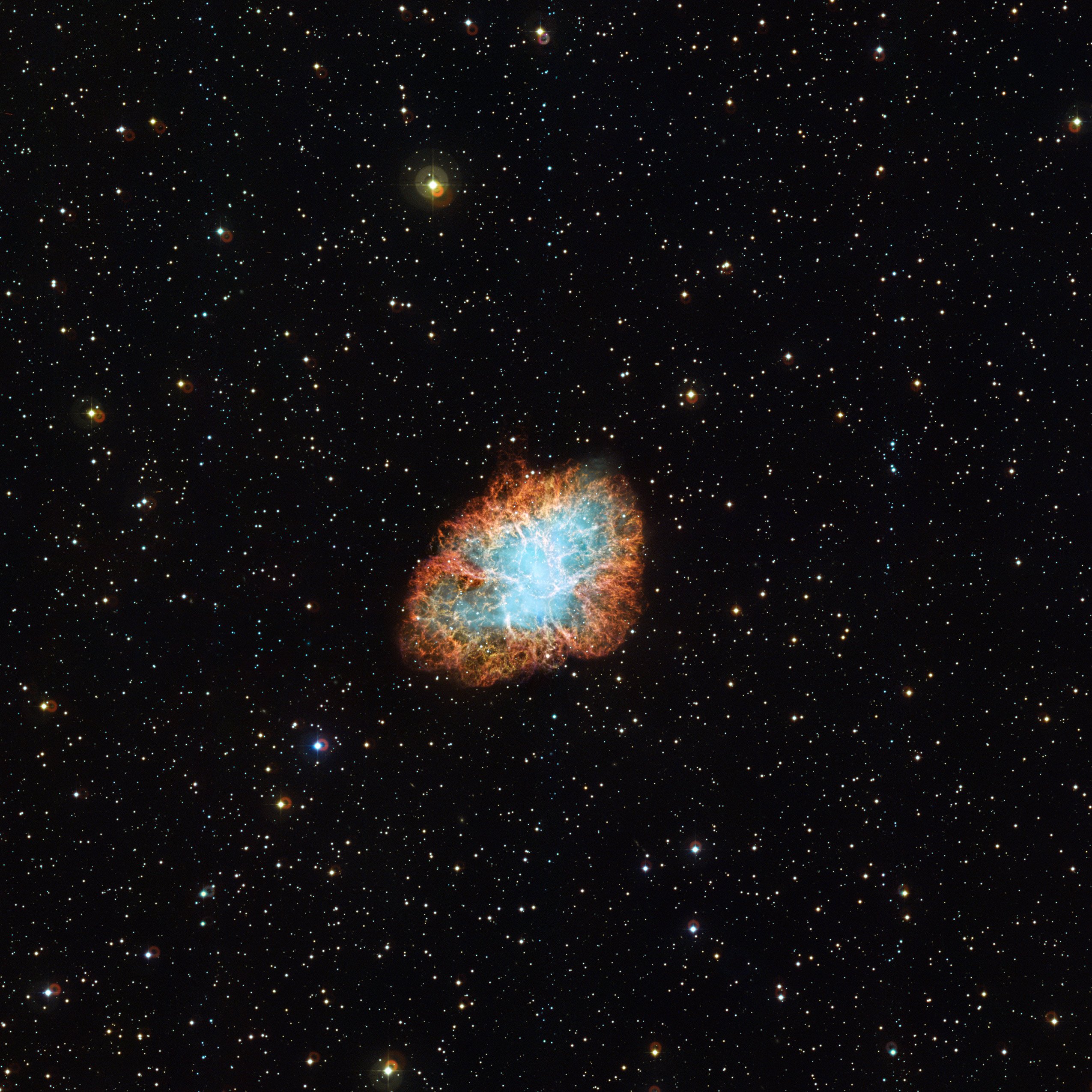
    ESO’s La Silla Observatory in Chile captured this image of the Crab Nebula using the Wide Field Imager on the MPG/ESO 2.2-meter (7.2-foot) telescope. Credit: ESO / Manu Mejias

    This newly released image from the European Southern Observatory (ESO) shows a wide view of the Crab Nebula.

    The Crab Nebula, which also goes by the names Messier 1, NGC 1952, and Taurus A, is one of the best studied astronomical objects in the sky. It is the remnant of a supernova explosion which was observed by Chinese astronomers in 1054. The tangled filaments visible in this image are the remains of the exploded star, which are still expanding outwards at about 1500 kilometers per second (~930 miles per second).

    Although not visible to the naked eye due to foreground filaments of helium and hydrogen the heart of the nebula hosts two faint stars. It is one of these that is responsible for the nebula that we see today — a star that is known as the Crab Pulsar, or CM Tau. This is the small, dense, corpse of the original star that caused the supernova. It is now only about 20 kilometers in diameter and rotates around its axis 30 times every second!

    The star emits pulses of radiation in all wavelengths, ranging from gamma rays — for which it is one of the brightest sources in the sky — to radio waves. The radiation from the star is so strong that it is creating a wave of material that is deforming the inner parts of the nebula. The appearance of these structures changes so fast that astronomers can actually observe how they reshape. This provides a rare opportunity as cosmic timescales are usually much too long for change to be observed to this extent.

    The data from the Wide Field Imager on the MPG/ESO 2.2-meter (7.2-foot) telescope at ESO’s La Silla Observatory in Chile used to make this image were selected from the ESO archive by Manu Mejias as part of the Hidden Treasures competition.

    Never miss a breakthrough: Join the SciTechDaily newsletter.
    Follow us on Google and Google News.

    Astronomy European Southern Observatory Popular
    Share. Facebook Twitter Pinterest LinkedIn Email Reddit

    Related Articles

    Stunning Galactic Fireworks: New ESO Images Reveal Spectacular Features of Nearby Galaxies

    Astronomers Were Puzzled by “Great Dimming” of Betelgeuse – Now the Mystery Is Solved

    “Big Surprise!” – Heavy Metal Vapors Unexpectedly Found in Comets Throughout Our Solar System – and Beyond

    Mysterious Interstellar Visitor May Be the Most Pristine Comet Ever Found

    Event Horizon Telescope Images Magnetic Fields at the Edge of M87’s Supermassive Black Hole

    “Meteorological Beast in Our Solar System” – Powerful Stratospheric Winds Measured on Jupiter for the First Time

    Astronomers Have Discovered the Most Distant Source of Radio Emission Ever Known – 13 Billion Light-Years Away

    Distant Colliding Galaxy Dying Out As It Loses the Ability to Form Stars – Ejecting 10,000 Suns-Worth of Gas a Year

    Puzzling Six-Exoplanet System Discovered With Resonant Rhythmic Movement

    Leave A Reply Cancel Reply

    • Facebook
    • Twitter
    • Pinterest
    • YouTube

    Don't Miss a Discovery

    Subscribe for the Latest in Science & Tech!

    Trending News

    5 Simple Ways To Remember More and Forget Less

    The Atomic Gap That Could Cost the Semiconductor Industry Billions

    Researchers Finally Solve 50-Year-Old Blood Group Mystery

    Scientists Discover “Molecular Switch” That Fuels Alzheimer’s Brain Inflammation

    Trees Emit Tiny Lightning Flashes During Storms and Scientists Finally Prove It

    Pomegranate Compound Could Help Protect Against Heart Disease

    Your Blood Test Might Already Show Alzheimer’s Risk

    Scientists Were Wrong About This Strange “Rule-Breaking” Particle

    Follow SciTechDaily
    • Facebook
    • Twitter
    • YouTube
    • Pinterest
    • Newsletter
    • RSS
    SciTech News
    • Biology News
    • Chemistry News
    • Earth News
    • Health News
    • Physics News
    • Science News
    • Space News
    • Technology News
    Recent Posts
    • Hidden Parasite Found in Popular Portuguese Lake Raises Health Concerns
    • This Simple Trick Can Boost Your Workout Endurance by 20%
    • This Popular Supplement May Interfere With Cancer Treatment, Scientists Warn
    • Scientists Propose Radical New Way To Detect Alien Life – Without Traditional Biosignatures
    • Scientists Just Discovered Light Can Actually Slow Plant Growth
    Copyright © 1998 - 2026 SciTechDaily. All Rights Reserved.
    • Science News
    • About
    • Contact
    • Editorial Board
    • Privacy Policy
    • Terms of Use

    Type above and press Enter to search. Press Esc to cancel.