
Close Menu
    Facebook X (Twitter) Instagram
    SciTechDaily
    • Biology
    • Chemistry
    • Earth
    • Health
    • Physics
    • Science
    • Space
    • Technology
    Facebook X (Twitter) Pinterest YouTube RSS
    SciTechDaily
    Home»Space»Hubble Image of the Week – Crab Nebula in Bright Neon Colors
    Space

    Hubble Image of the Week – Crab Nebula in Bright Neon Colors

    By SciTechDailyMay 15, 2017No Comments2 Mins Read
    Facebook Twitter Pinterest Telegram LinkedIn WhatsApp Email Reddit
    Share
    Facebook Twitter LinkedIn Pinterest Telegram Email Reddit
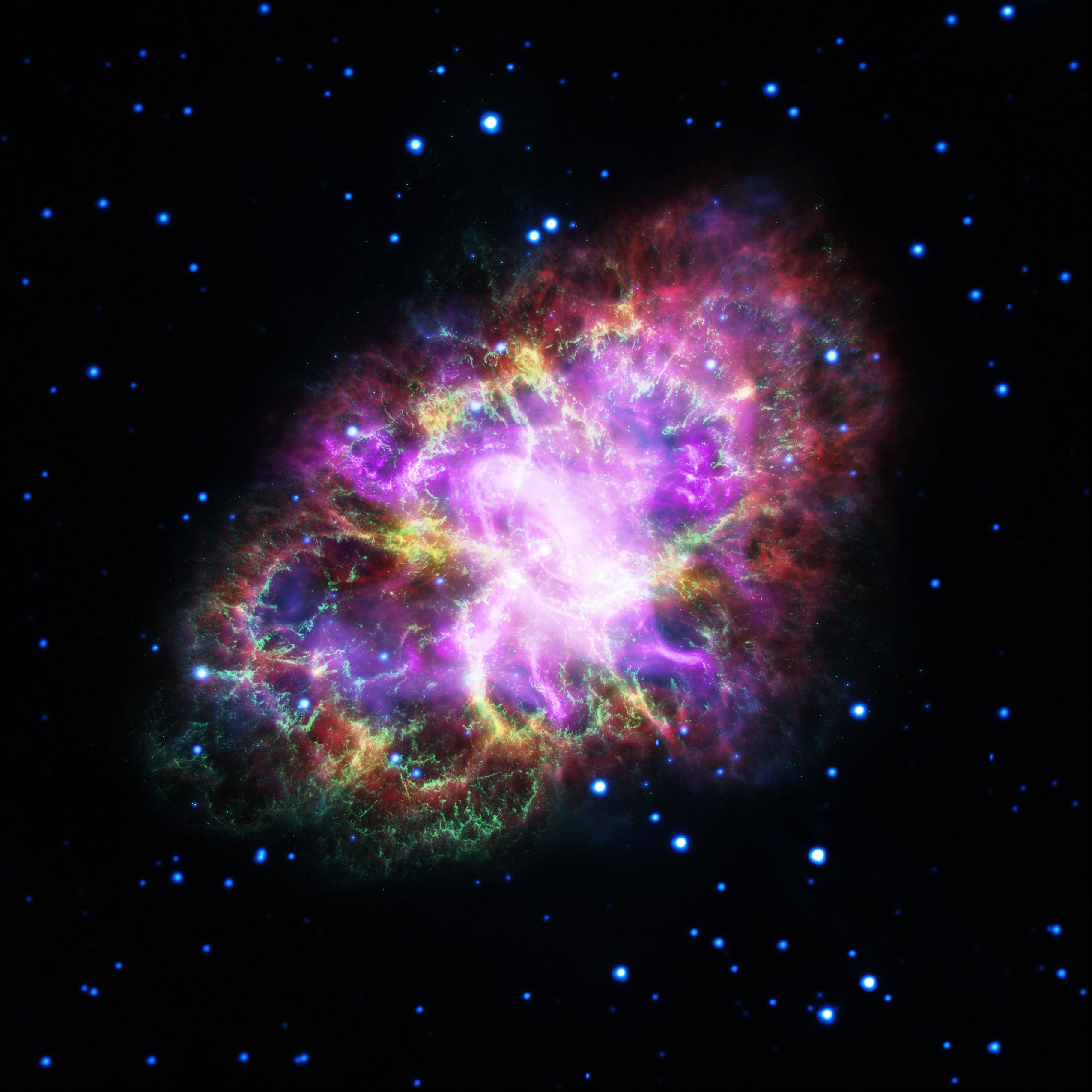
    New Telescope Image of the Crab Nebula
    The Crab Nebula, located 6500 light-years from Earth in the constellation of Taurus (The Bull), is the result of a supernova explosion which was observed by Chinese and other astronomers in 1054. Credit: NASA, ESA, G. Dubner (IAFE, CONICET-University of Buenos Aires) et al.; A. Loll et al.; T. Temim et al.; F. Seward et al.; VLA/NRAO/AUI/NSF; Chandra/CXC; Spitzer/JPL-Caltech; XMM-Newton/ESA; and Hubble/STScI

    By combining data from several telescopes, astronomers created this captivating new image of the Crab Nebula.

    The unusual image was produced by combining data from telescopes spanning nearly the entire electromagnetic spectrum, from radio waves to X-rays. The Karl G. Jansky Very Large Array (VLA) provided information about the nebula gathered in the radio regime (colored in red). NASA’s Spitzer Space Telescope took images in the infrared (yellow). The NASA/ESA Hubble Space Telescope provided the images made in optical wavelengths (colored in green). ESA’s XMM-Newton telescope observed the Crab Nebula in the ultraviolet (blue) and NASA’s Chandra X-ray Observatory provided the data for X-ray radiation (purple).

    The Crab Nebula, located 6500 light-years from Earth in the constellation of Taurus (The Bull), is the result of a supernova explosion which was observed by Chinese and other astronomers in 1054. At its center is a pulsar: a super-dense neutron star, spinning once every 33 milliseconds, shooting out rotating lighthouse-like beams of radio waves and visible light.

    Surrounding the pulsar lies a mix of material; some of it was originally expelled from the star before it went supernova, and the rest was ejected during the explosion itself. Fast-moving winds of particles fly off from the neutron star, energizing the dust and gas around it. These different layers and intricacies of the nebula can be observed in all of the different wavelengths of light.


    Never miss a breakthrough: Join the SciTechDaily newsletter.
    Follow us on Google and Google News.

    Astronomy Hubble Space Telescope Karl G. Jansky Very Large Array Nebula Spitzer Space Telescope
    Share. Facebook Twitter Pinterest LinkedIn Email Reddit

    Related Articles

    Astronomers Build Incredible 3D Visualization of Exploded Star Using NASA’s Great Observatories [Video]

    Chandra Reveals a New Composite Image of NGC 4258

    New Study Revives Doubted Exoplanet Fomalhaut b

    Images of the Necklace Nebula

    New Image of the Helix Nebula Unraveling Into Space

    NASA Telescopes Spot Ultra-Distant Galaxy, MACS 1149-JD

    Hubble’s Close-Up View of the Tarantula Nebula

    Hubble Spots Extremely Rare Gravitational Arc

    Infant Galaxy Showcases Star Systems in the Early Universe

    Leave A Reply Cancel Reply

    • Facebook
    • Twitter
    • Pinterest
    • YouTube

    Don't Miss a Discovery

    Subscribe for the Latest in Science & Tech!

    Trending News

    Mezcal “Worm” in a Bottle Mystery: DNA Testing Reveals a Surprise

    New Research Reveals That Your Morning Coffee Activates an Ancient Longevity Switch

    This Is What Makes You Irresistible to Mosquitoes

    Shockingly Powerful Giant Octopuses Ruled the Seas 100 Million Years Ago

    Scientists Stunned by New Organic Molecules Found on Mars

    Rewriting Dinosaur Evolution: Scientists Unearth Remarkable 150-Million-Year-Old Stegosaur Skull

    Omega-3 Supplements Linked to Cognitive Decline in Surprising New Study

    First-of-Its-Kind Discovery: Homer’s Iliad Found Embedded in a 1,600-Year-Old Egyptian Mummy

    Follow SciTechDaily
    • Facebook
    • Twitter
    • YouTube
    • Pinterest
    • Newsletter
    • RSS
    SciTech News
    • Biology News
    • Chemistry News
    • Earth News
    • Health News
    • Physics News
    • Science News
    • Space News
    • Technology News
    Recent Posts
    • These Simple Daily Habits Can Quickly Improve Blood Pressure and Heart Risk Factors
    • A Common Nutrient May Play a Surprising Role in Anxiety
    • Doing This After 9 p.m. Could Double Your Risk of Gut Issues
    • New Research Challenges Long-Held Beliefs About How the Brain Makes Decisions
    • Breakthrough Technology Reveals New Treatment Targets for Cancer
    Copyright © 1998 - 2026 SciTechDaily. All Rights Reserved.
    • Science News
    • About
    • Contact
    • Editorial Board
    • Privacy Policy
    • Terms of Use

    Type above and press Enter to search. Press Esc to cancel.