
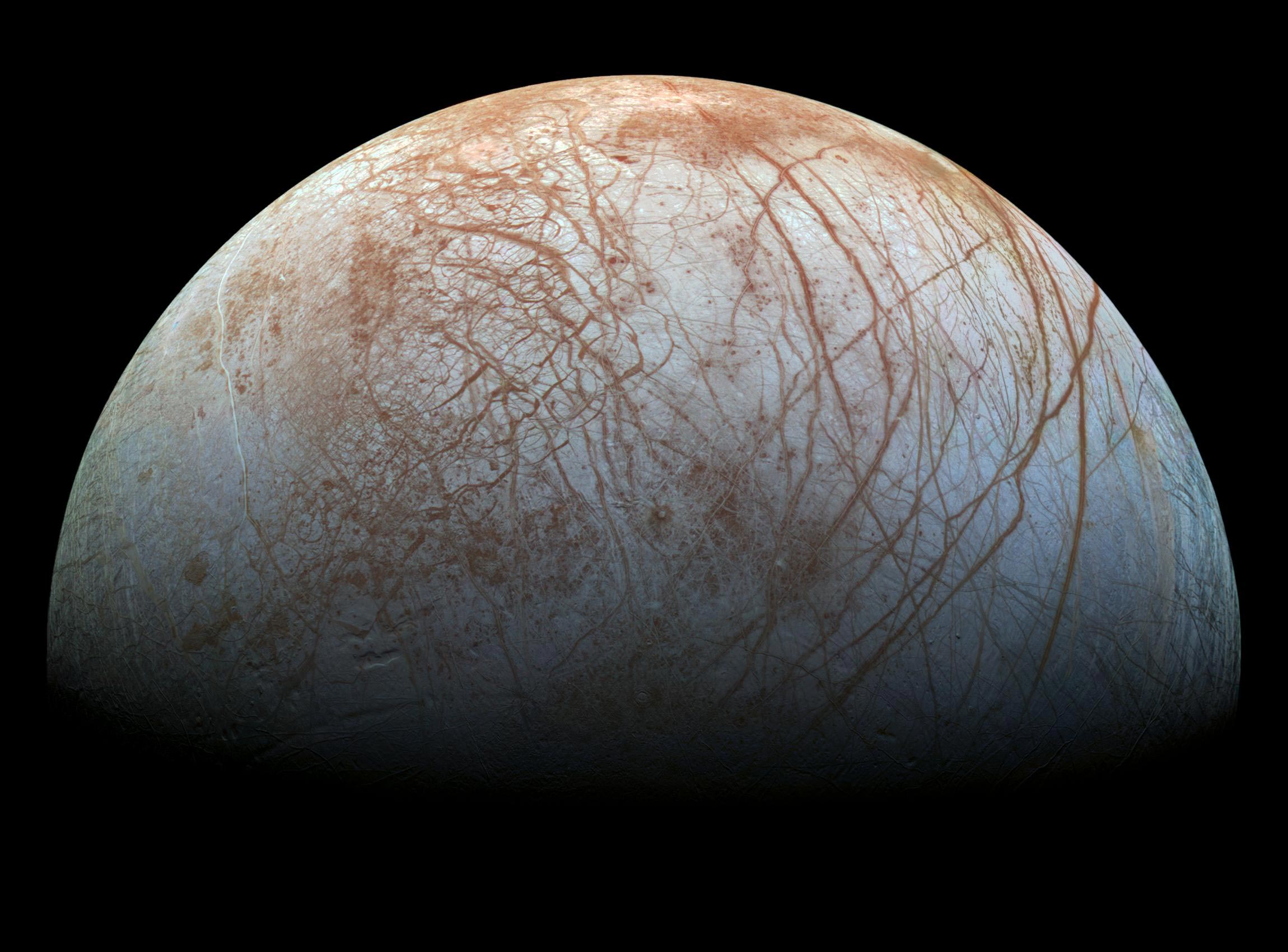
New simulations suggest Europa’s massive ice shell may seal its hidden ocean off far more completely than scientists ever realized.
Europa may contain more liquid water than Earth, yet reaching that water could be far more difficult than scientists hoped.
New simulations suggest that Europa’s ice shell may not be a cracked doorway into its hidden ocean, but an imposing barrier that rapidly freezes water trying to escape.
The discovery complicates one of the most attractive ideas in planetary exploration: that material from Europa’s buried ocean might rise through fractures and collect in shallow pockets just beneath the surface. Those reservoirs would give spacecraft a much easier way to investigate the ocean without drilling through miles of ice.
Research led by Rutgers scientist Lujendra Ojha, however, indicates that the journey upward may be nearly impossible under realistic conditions. Water rushing through the ice would lose heat so quickly that the fractures could become clogged with ice before much liquid traveled toward the surface.

Simulations Challenge a Promising Shortcut
In a study published in Nature Astronomy, Ojha and his colleagues modeled how ocean water might move through narrow fractures in Europa’s ice shell. Their simulations included turbulence, a chaotic form of fluid motion that earlier models often overlooked. The results suggest that direct exchange between the deep ocean and shallow regions of the ice is probably minimal.
“The mystery we wanted to solve was whether this journey is actually possible,” said Ojha, an associate professor in the Department of Earth and Planetary Sciences at the Rutgers School of Arts and Sciences. “Can liquid water rise from Europa’s deep ocean toward the surface without freezing along the way?”
The answer, according to the new calculations, is that such a journey would be far more difficult than commonly assumed.
“There’s an icy shell, there’s water underneath, and there’s all this speculation about how that water can come from deep underground and make its way all the way up without freezing en route,” Ojha said. “That’s really what we think we disproved.”
Why Europa Matters in the Search for Life
Europa is considered one of the solar system’s leading candidates for a potentially habitable environment. Evidence suggests a salty global ocean lies beneath its frozen exterior, kept liquid in part by heat generated as Jupiter’s gravity repeatedly flexes the moon’s interior.
That combination of water, chemical ingredients, and energy makes Europa a major target in the search for environments where life could exist. Scientists are not necessarily expecting spacecraft to find living organisms. Instead, they want to determine whether the moon provides the basic conditions that biology requires.
A shallow pocket of water would be especially valuable because it could be detected, studied, or perhaps eventually sampled more easily than the global ocean buried deep below. But the new research shows that finding liquid water near the surface would not prove that scientists had gained access to the ocean.
Such reservoirs may instead form locally when heat melts portions of the ice shell. If so, their chemistry and history could be very different from those of the ocean beneath them.
Water that recently rose from the ocean might carry salts, minerals, or organic compounds from Europa’s interior. Water created by local melting would reveal more about processes inside the ice itself and might provide a less complete picture of the moon’s potential habitability.
Earth’s Volcanic Analogy Breaks Down
The study examined structures called dikes, narrow, water-filled fractures that could theoretically extend upward through the shell. On Earth, magma can force open cracks in rock and travel toward the surface, sometimes supplying volcanic eruptions. A similar process involving water and ice on frozen worlds is known as cryovolcanism.
Ojha said that analogy can be misleading because liquid water moving through ice behaves very differently from magma moving through rock.
“Ice and liquid water are fundamentally different than lava and the volcanoes that we see here on Earth,” he said. “I think there’s some fundamental physics that’s missing here, and so I wanted to explore that.”
Turbulence Rapidly Drains the Water’s Heat
One of the most important missing factors was turbulence. Earlier models often treated the rising water as a relatively smooth flow. Under that assumption, water might retain enough heat to travel a considerable distance before freezing.
The new simulations produced a much more violent picture. Water moving quickly through a fracture would surge, swirl, and repeatedly mix against its intensely cold walls. That contact would draw heat out of the water and transfer it into the surrounding ice.
“This water that’s going to come up, it’s going to be turbulent,” Ojha said. “It’s going to be left and right, it’s going to be up and down, it’s going to have a swirling motion. And when that happens, that liquid water is going to cool very, very fast as it approaches the surface.”
Ice Crystals Could Seal the Fractures
The rapidly cooling water could become supercooled, remaining liquid even after its temperature falls below the usual freezing point. Tiny suspended crystals called frazil ice would then begin to form.
Similar crystals can appear in turbulent, frigid waters on Earth. Inside Europa, they could accumulate along a fracture, restrict the flow, and eventually seal the passage.
According to the simulations, narrow fractures could freeze shut within hours. Larger openings could transport more water in simplified scenarios, but turbulence makes even those routes much less effective. To deliver enough water to explain certain features on Europa’s surface, the fractures would need to be implausibly long, unusually abundant, or both.
Localized heating may offer a more likely explanation. Tidal flexing, friction, or other sources of warmth could melt ice within the shell, creating isolated pockets of liquid without opening a continuous path to the ocean.
Europa Clipper and JUICE Will Test the Theory
The question of where Europa’s shallow water comes from will soon be tested by spacecraft equipped to examine the moon in unprecedented detail.
NASA’s Europa Clipper launched on October 14, 2024, and is expected to reach Jupiter in April 2030 after traveling about 1.8 billion miles (2.9 billion kilometers). The spacecraft will orbit Jupiter and make 49 close flybys of Europa, using nine scientific instruments and a gravity investigation to study the moon’s ice, composition, geology, and interior.
The European Space Agency’s Jupiter Icy Moons Explorer, known as JUICE, launched in April 2023 and is scheduled to arrive at Jupiter in July 2031. It will investigate Europa, Callisto, and Ganymede before eventually entering orbit around Ganymede.
Future Missions Must Interpret Water Carefully
Europa Clipper’s ice-penetrating radar could help researchers identify shallow reservoirs and examine their shape, depth, and possible connections to deeper layers. Other instruments will map the surface, analyze its chemistry, and look for clues about the thickness and structure of the ice shell.
A radar signal consistent with liquid water would be an important discovery, but it would not automatically represent a sample of Europa’s global ocean.
“Our work suggests that Europa’s ice shell may be a stronger barrier between the ocean and the surface than previously assumed,” Ojha said. “This helps future missions interpret what they find and better understand where to look for signs of habitability.”
Reference: “Limited direct fluid exchange between the deep subsurface ocean and the shallow subsurface environment of Europa” by Lujendra Ojha, Ankit Barik and Jacob Buffo, 23 July 2026, Nature Astronomy.
DOI: 10.1038/s41550-026-02918-2
Never miss a breakthrough: Join the SciTechDaily newsletter.
Follow us on Google and Google News.
3 Comments
It is possible to have an orbiting space craft waiting for an asteroid to make a hole in the ice shell, then take advantage of it to plunge into the ocean.
You’ll have to wait a long time – or guide an appropriately massive asteroid – and an entire craft is ill suited to prevent both sample and biosphere contamination. Nuclear melt or thermo-mechanical drills are studied.
That also explains why they don’t see any venting.
Europe is a problematic target anyway, estimates for free energies translates to a thin biofilm at the water/ice interface if it is inhabited.
Despite being situated further away and makes for long science turn around times, Enceladus is likely better suited as target. Lots of free energies for a biosphere and either direct ocean ejecta or at least the intermediate transport that was hoped for Europe.