
Close Menu
    Facebook X (Twitter) Instagram
    SciTechDaily
    • Biology
    • Chemistry
    • Earth
    • Health
    • Physics
    • Science
    • Space
    • Technology
    Facebook X (Twitter) Pinterest YouTube RSS
    SciTechDaily
    Home»Space»NASA Mission to Jupiter’s Icy Moon Confirmed
    Space

    NASA Mission to Jupiter’s Icy Moon Confirmed

    By Jet Propulsion LaboratoryAugust 21, 20191 Comment2 Mins Read
    Facebook Twitter Pinterest Telegram LinkedIn WhatsApp Email Reddit
    Share
    Facebook Twitter LinkedIn Pinterest Telegram Email Reddit
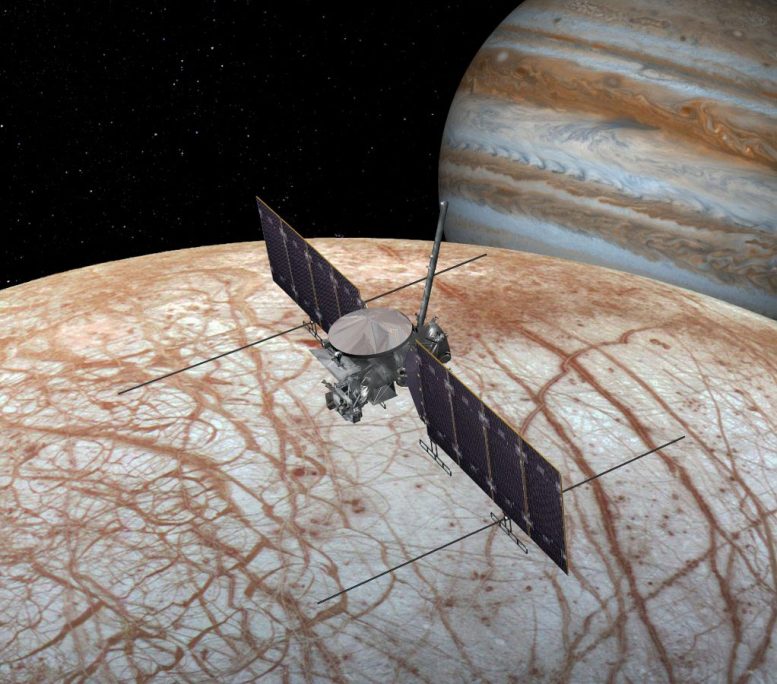
    Europa Clipper Spacecraft
    A 2016 artist’s concept of the Europa Clipper spacecraft. The design is changing as the spacecraft is developed. Credit: NASA/JPL-Caltech

    An icy ocean world in our solar system that could tell us more about the potential for life on other worlds is coming into focus with the confirmation of the Europa Clipper mission’s next phase. The decision allows the mission to progress to the completion of the final design, followed by the construction and testing of the entire spacecraft and science payload.

    “We are all excited about the decision that moves the Europa Clipper mission one key step closer to unlocking the mysteries of this ocean world,” said Thomas Zurbuchen, associate administrator for the Science Mission Directorate at NASA Headquarters in Washington. “We are building upon the scientific insights received from the flagship Galileo and Cassini spacecraft and working to advance our understanding of our cosmic origin, and even life elsewhere.”

    The mission will conduct an in-depth exploration of Jupiter’s moon Europa and investigate whether the icy moon could harbor conditions suitable for life, honing our insights into astrobiology. To develop this mission in the most cost-effective fashion, NASA is targeting to have the Europa Clipper spacecraft complete and ready for launch as early as 2023. The agency baseline commitment, however, supports a launch readiness date by 2025.

    NASA’s Jet Propulsion Laboratory (JPL) in Pasadena, California, leads the development of the Europa Clipper mission in partnership with the Johns Hopkins University Applied Physics Laboratory (APL) for the Science Mission Directorate. Europa Clipper is managed by the Planetary Missions Program Office at NASA’s Marshall Space Flight Center in Huntsville, Alabama.

    Never miss a breakthrough: Join the SciTechDaily newsletter.
    Follow us on Google and Google News.

    Europa Europa Clipper JPL Jupiter Moons NASA Spacecraft
    Share. Facebook Twitter Pinterest LinkedIn Email Reddit

    Related Articles

    Europa Clipper: 8 Things to Know About NASA’s $5 Billion Mission to an Ocean Moon of Jupiter

    Enhance! Citizen Scientists’ Awe-Inspiring New Europa Images From NASA’s Juno

    Parallel Ice Ridges Increase the Odds That Jupiter’s Moon Europa Harbors Alien Life

    NASA’s Juno Spacecraft Captures Stunning View of Jupiter’s Moons Io and Europa – And a Crater on Ganymede

    NASA Begins Assembly of Europa Clipper Spacecraft – Will Search for Alien Life on Jupiter’s Icy Moon Europa

    A Few Steps Closer to Jupiter’s Moon Europa: Spacecraft Hardware Makes Headway

    Jupiter’s Moon Europa May Have an Interior Hot Enough to Fuel Seafloor Volcanoes

    Europa Clipper – NASA’s Mission to Search for Life on Jupiter’s Moon Europa – Just Hit a Significant Milestone

    Jupiter’s Icy Moon Europa Glows in the Dark

    1 Comment

    1. james carter on August 21, 2019 1:56 pm

      The clipper will search for conditions of life in Europa’s ocean.
      I think that Europa has more of chance of life than Mars.

      Reply
    Leave A Reply Cancel Reply

    • Facebook
    • Twitter
    • Pinterest
    • YouTube

    Don't Miss a Discovery

    Subscribe for the Latest in Science & Tech!

    Trending News

    AI Could Detect Early Signs of Alzheimer’s in Under a Minute – Far Before Traditional Tests

    What if Dark Matter Has Two Forms? Bold New Hypothesis Could Explain a Cosmic Mystery

    This Metal Melts in Your Hand – and Scientists Just Discovered Something Strange

    Beef vs. Chicken: Surprising Results From New Prediabetes Study

    Alzheimer’s Breakthrough: Scientists Discover Key Protein May Prevent Toxic Protein Clumps in the Brain

    Quantum Reality Gets Stranger: Physicists Put a Lump of Metal in Two Places at Once

    Scientists May Have Found the Key to Jupiter and Saturn’s Moon Mystery

    Scientists Uncover Brain Changes That Link Pain to Depression

    Follow SciTechDaily
    • Facebook
    • Twitter
    • YouTube
    • Pinterest
    • Newsletter
    • RSS
    SciTech News
    • Biology News
    • Chemistry News
    • Earth News
    • Health News
    • Physics News
    • Science News
    • Space News
    • Technology News
    Recent Posts
    • 250-Million-Year-Old Egg Solves One of Evolution’s Biggest Mysteries
    • Living With Roommates Might Be Changing Your Gut Microbiome Without You Knowing
    • Simple and Cheap Blood Test Could Detect Cancer and Other Diseases Before Symptoms Appear
    • Century-Old Cleaning Chemical Linked to 500% Increased Risk of Parkinson’s Disease
    • What if Your Memories Never Happened? Physicists Take a New Look at the Boltzmann Brain Paradox
    Copyright © 1998 - 2026 SciTechDaily. All Rights Reserved.
    • Science News
    • About
    • Contact
    • Editorial Board
    • Privacy Policy
    • Terms of Use

    Type above and press Enter to search. Press Esc to cancel.