

Long-term exposure to fine particle pollution quietly scars heart muscle, MRI scans reveal, laying the groundwork for future heart failure.
Canadian researchers found even “safe” levels of PM2.5 boosted myocardial fibrosis in both healthy volunteers and cardiomyopathy patients, especially women, smokers, and people with hypertension.
Air Pollution’s Hidden Cardiac Scars
Breathing polluted air could be doing more harm to your heart than you realize—even if you’re healthy. A new study using advanced cardiac MRI imaging has found that long-term exposure to air pollution is linked to early signs of heart damage, specifically a condition known as myocardial fibrosis. This type of scarring in the heart muscle can develop silently and may set the stage for heart failure later in life.
Heart disease remains the leading cause of death around the world, and poor air quality has long been linked to increased cardiovascular risk. But what exactly happens inside the heart when we breathe polluted air has been less clear—until now.
“We know that if you’re exposed to air pollution, you’re at higher risk of cardiac disease, including higher risk of having a heart attack,” said the study’s senior author Kate Hanneman, M.D., M.P.H., from the Department of Medical Imaging at the Temerty Faculty of Medicine, University of Toronto and University Health Network in Toronto. “We wanted to understand what drives this increased risk at the tissue level.”
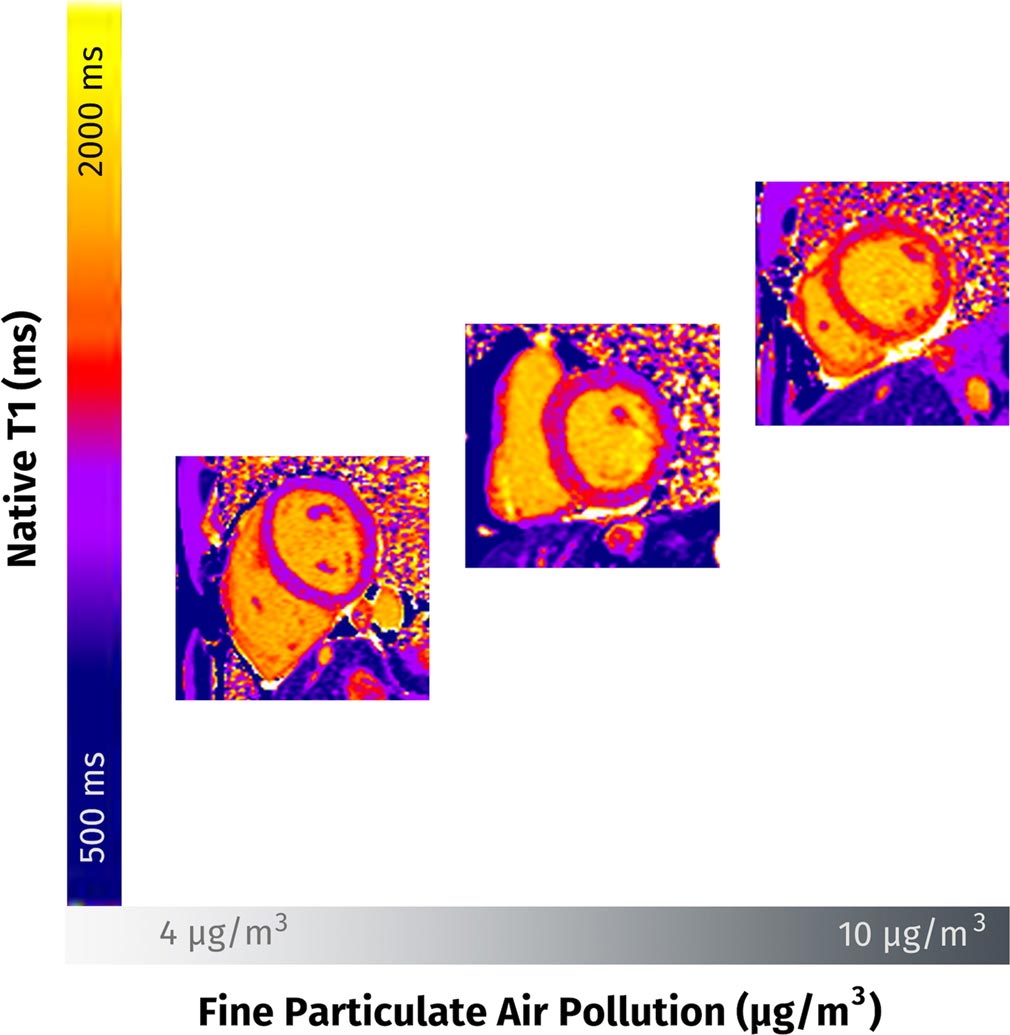
MRI Reveals Fibrosis Triggered by PM2.5
To investigate, researchers used cardiac MRI—a powerful, noninvasive imaging tool—to look for signs of damage in the heart tissue. They focused on PM2.5, a type of fine particulate matter found in vehicle exhaust, industrial emissions, and wildfire smoke. These particles are tiny, about 30 times smaller than the width of a human hair, and can travel deep into the lungs and enter the bloodstream.
The study examined 694 people, including 201 healthy individuals and 493 patients with dilated cardiomyopathy, a condition that weakens the heart’s ability to pump blood. The results were striking: higher long-term exposure to PM2.5 was consistently linked with higher levels of myocardial fibrosis in both groups. This suggests that even people without existing heart disease may be at risk.
Notably, the strongest effects were seen in women, smokers, and people with high blood pressure—groups that may be especially vulnerable to pollution’s impact on the heart.
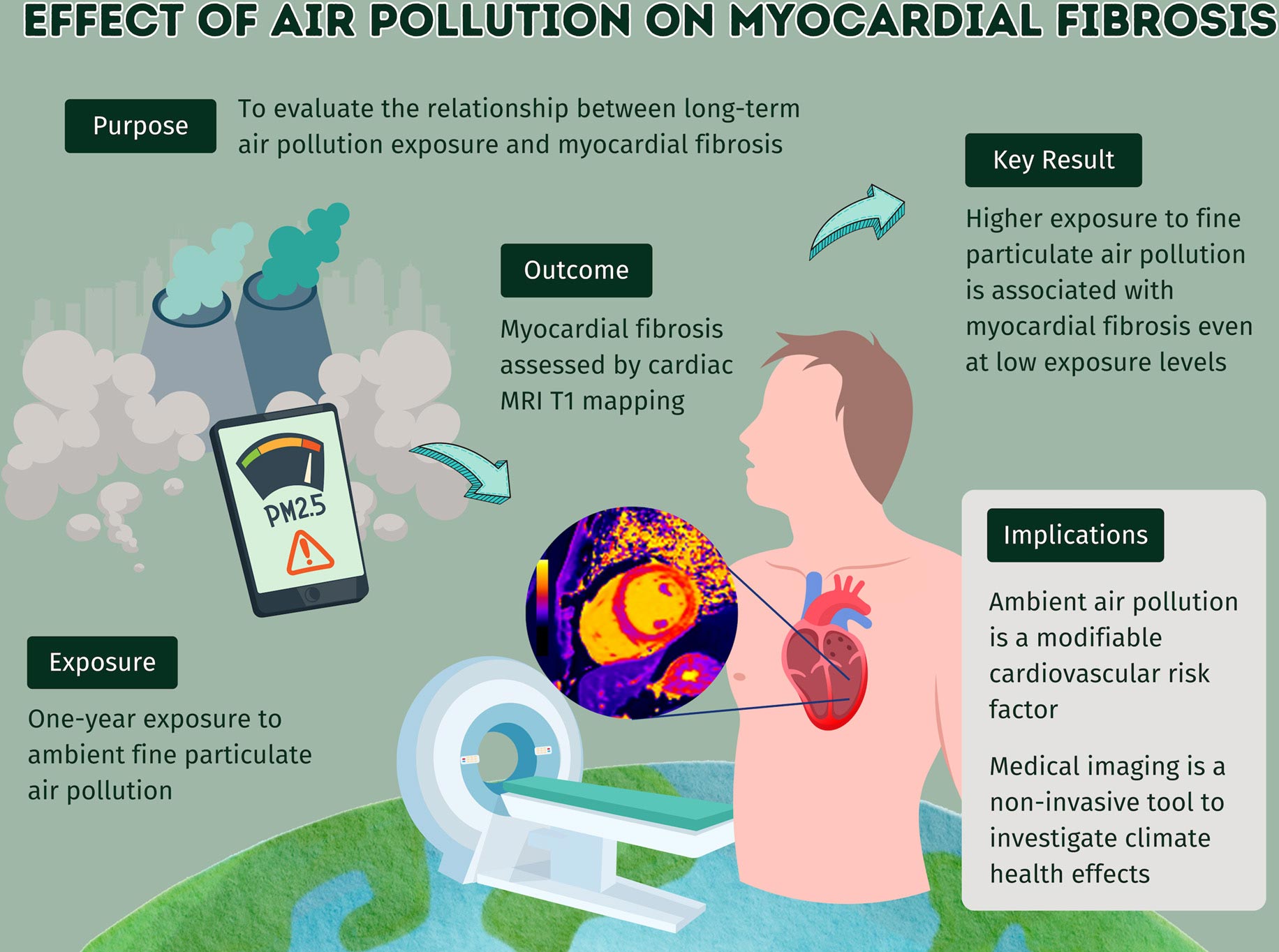
Unmasking High-Risk Groups
The study adds to growing evidence that air pollution is a cardiovascular risk factor, contributing to residual risk not accounted for by conventional clinical predictors such as smoking or hypertension.
“Even modest increases in air pollution levels appear to have measurable effects on the heart,” Dr. Hanneman said. “Our study suggests that air quality may play a significant role in changes to heart structure, potentially setting the stage for future cardiovascular disease.”
Knowing a patient’s long-term air pollution exposure history could help refine heart disease risk assessment and address the health inequities that air pollution contributes to both in level of exposure and effect. For instance, Dr. Hanneman said, if an individual works outside in an area with poor air quality, healthcare providers could incorporate that exposure history into heart disease risk assessment.
Rethinking Risk and Policy
The air pollution exposure levels of the patients in the study were below many of the global air quality guidelines, reinforcing that there are no safe exposure limits.
“Public health measures are needed to further reduce long-term air pollution exposure,” Dr. Hanneman said. “There have been improvements in air quality over the past decade, both in Canada and the United States, but we still have a long way to go.”
Imaging the Future of Environmental Health
In addition to illuminating the links between air pollution and myocardial fibrosis, the study highlights the important role that radiologists will play in research and clinical developments going forward.
“Medical imaging can be used as a tool to understand environmental effects on a patient’s health,” Dr. Hanneman said. “As radiologists, we have a tremendous opportunity to use imaging to identify and quantify some of the health effects of environmental exposures in various organ systems.”
Reference: “Association between Long-term Exposure to Ambient Air Pollution and Myocardial Fibrosis Assessed with Cardiac MRI” by Jacques Du Plessis, Chloe DesRoche, Scott Delaney, Rachel C. Nethery, Rachel Hong, Paaladinesh Thavendiranathan, Heather Ross, Felipe Castillo and Kate Hanneman, 1 July 2025, Radiology.
DOI: 10.1148/radiol.250331
Collaborating with Dr. Hanneman were Jacques du Plessis, M.D., Chloe DesRoche, M.D., M.Sc., Scott Delaney, Sc.D., J.D., M.P.H., Rachel C. Nethery, Ph.D., Rachel Hong, B.Sc., Paaladinesh Thavendiranathan, M.D., S.M., Heather Ross, M.D., M.H.Sc., and Felipe Castillo, M.D.
Never miss a breakthrough: Join the SciTechDaily newsletter.
Follow us on Google and Google News.
1 Comment
Fine airborne particles indeed. Let’s acknowledge nano plastic particles, too.
Now, I can’t believe it’s been fifty years since the good citizens of Brookline, MA gathered themselves to battle the Harvard Corporation’s plans to provide electrical power to the Hospital area in Boston’s Longwood Avenue and Mission Hill neighborhoods by building a gigantic diesel powered generator and say goodbye to Boston Edison.
During the legal fighting it became clear that diesel engines produce soot in prodigious quantities. Some of the soot is so small the particles can be inhaled directly into the lungs. Those bits of soot are carcinogenic and immediately alter the DNA of lung tissue.
The Harvard Corporation prevailed and for 50 years the Hospitals have been powered by soot belching diesel; an oxymoron for ya.