
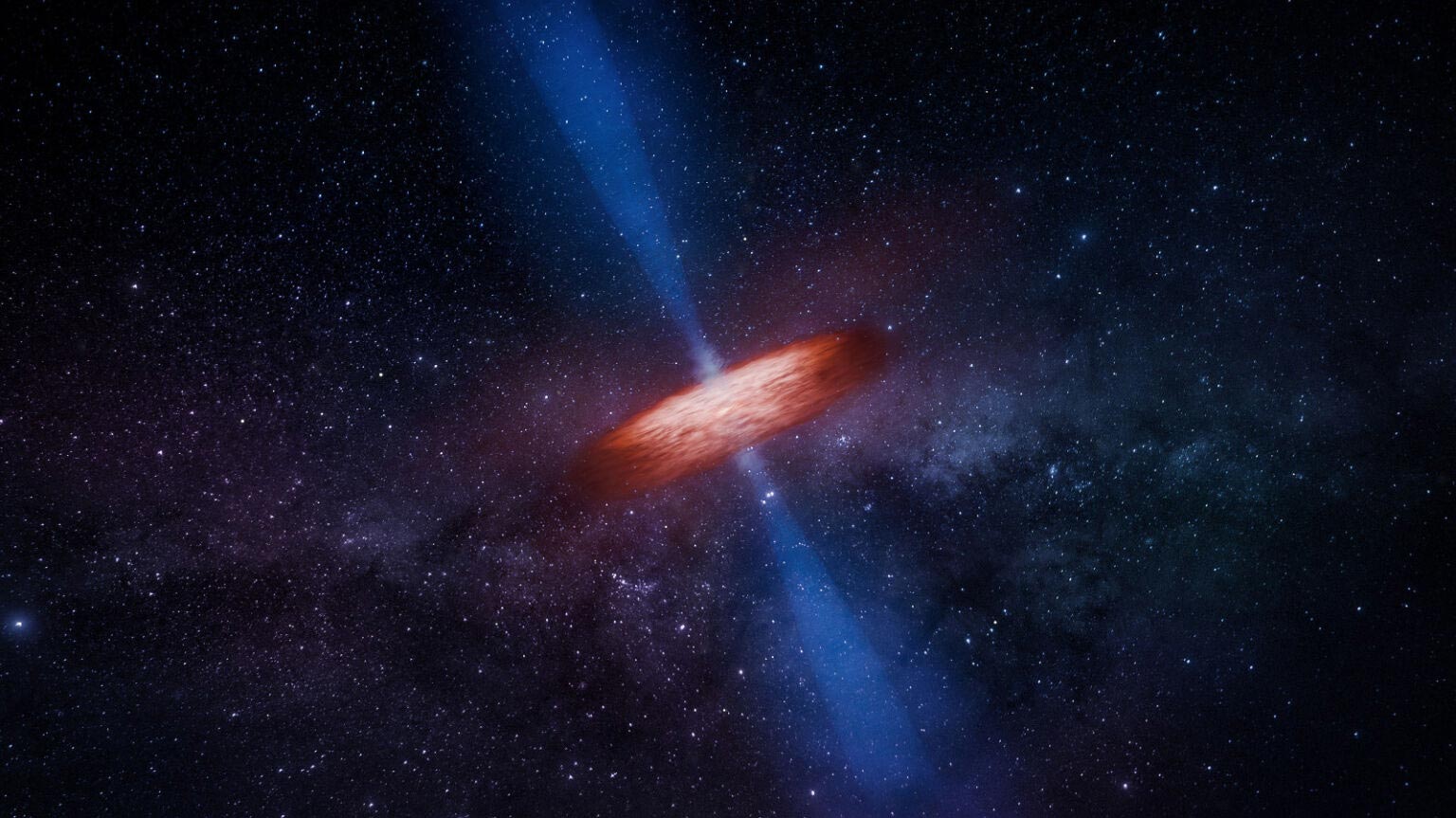
The Event Horizon Telescope (EHT), famous for capturing the first images of black holes, is now set to unlock another cosmic mystery: how black holes launch powerful jets into space.
A research team led by Anne-Kathrin Baczko from Chalmers University of Technology in Sweden has demonstrated that the EHT can capture detailed images of a supermassive black hole and its jets in the galaxy NGC 1052. Their measurements, made with interconnected radio telescopes, also confirmed the presence of strong magnetic fields near the black hole’s edge.
Breakthroughs in Black Hole Imaging
The central question driving this research is how supermassive black holes eject enormous streams of high-energy particles—called jets—into space at nearly the speed of light. Scientists have moved closer to answering this with detailed observations of the core of NGC 1052, located 60 million light-years from Earth.
By coordinating data from several radio telescopes, the researchers gained new insights into the inner workings of this galaxy and its supermassive black hole. Their findings were published today (December 17, 2024) in the scientific journal Astronomy & Astrophysics.

Challenges and Advances in Astronomical Observation
The work has been led by Anne-Kathrin Baczko, astronomer at Onsala Space Observatory, Chalmers University of Technology.
“The center of this galaxy, NGC 1052, is a promising target for imaging with the Event Horizon Telescope, but it’s faint, complex, and more challenging than all other sources we’ve attempted so far,” says Anne-Kathrin Baczko.
The galaxy has a supermassive black hole that is the source of two powerful jets that stretch thousands of light years outwards through space.

“We want to investigate not just the black hole itself, but also the origins of the jets which stream out from the east and west sides of the black hole as seen from Earth,” says Eduardo Ros, team member and astronomer at the Max Planck Institute for Radio Astronomy in Bonn, Germany.
The team made measurements using just five of the telescopes in the EHT’s global network – including ALMA (the Atacama Large Millimeter/submillimeter Array) in Chile, in a configuration that would allow the best possible estimate of its potential for future observations, and supplemented with measurements from other telescopes.
“For such a faint and unknown target, we were not sure if we would get any data at all. But the strategy worked, thanks in particular to the sensitivity of ALMA and complementary data from many other telescopes,” says Anne-Kathrin Baczko.
Measurements Show Successful Imaging Is Possible in the Future
- The scientists are now convinced that successful imaging will be possible in the future, thanks to two new key pieces of information: The black hole’s surroundings shine brightly at just the right frequency of radio waves to be sure that they can be measured by the EHT.
- The size of the region where the jets are formed is similar in size to the ring of M 87* – easily big enough to be imaged with the EHT at full strength.

From their measurements, the scientists have also estimated the strength of the magnetic field close to the black hole’s event horizon. The field strength, 2.6 tesla, is about 400 times stronger than the Earth’s magnetic field. That’s consistent with previous estimates for this galaxy.
“This is such a powerful magnetic field that we think it can probably stop material from falling into the black hole. That in turn can help to launch the galaxy’s two jets,” says Matthias Kadler.
Even though the source is as challenging as this, the future looks bright as radio astronomers prepare for new generations of telescope networks, like the NRAO’s ngVLA (next generation Very Large Array) and the ngEHT (The next generation Event Horizon Telescope).
“Our measurements give us a clearer idea of how the innermost center of the galaxy shines at different wavelengths. Its spectrum is bright at wavelengths around one millimeter, where we can make the very sharpest images today. It’s even brighter at slightly longer wavelengths, which makes it a prime target for the next generation of radio telescopes,” says team member Matthias Kadler, astronomer at the University of Würzburg in Germany.
The research paper, “The putative center in NGC 1052,” by Anne-Kathrin Baczko (Chalmers University of Technolgy, Sweden) and 286 co-authors, is published today (December 17) in the journal Astronomy & Astrophysics.
Reference: “The putative center in NGC 1052” by Anne-Kathrin Baczko, Matthias Kadler, Eduardo Ros, Christian M. Fromm, Maciek Wielgus, Manel Perucho, Thomas P. Krichbaum, Mislav Baloković, Lindy Blackburn, Chi-kwan Chan, Sara Issaoun, Michael Janssen, Luca Ricci, Kazunori Akiyama, Ezequiel Albentosa-Ruíz, Antxon Alberdi, Walter Alef, Juan Carlos Algaba, Richard Anantua, Keiichi Asada, Rebecca Azulay, Uwe Bach, David Ball, Bidisha Bandyopadhyay, John Barrett, Michi Bauböck, Bradford A. Benson, Dan Bintley, Raymond Blundell, Katherine L. Bouman, Geoffrey C. Bower, Hope Boyce, Michael Bremer, Christiaan D. Brinkerink, Roger Brissenden, Silke Britzen, Avery E. Broderick, Dominique Broguiere, Thomas Bronzwaer, Sandra Bustamante, Do-Young Byun, John E. Carlstrom, Chiara Ceccobello, Andrew Chael, Dominic O. Chang, Koushik Chatterjee, Shami Chatterjee, Ming-Tang Chen, Yongjun Chen, Xiaopeng Cheng, Ilje Cho, Pierre Christian, Nicholas S. Conroy, John E. Conway, James M. Cordes, Thomas M. Crawford, Geoffrey B. Crew, Alejandro Cruz-Osorio, Yuzhu Cui, Rohan Dahale, Jordy Davelaar, Mariafelicia De Laurentis, Roger Deane, Jessica Dempsey, Gregory Desvignes, Jason Dexter, Vedant Dhruv, Indu K. Dihingia, Sheperd S. Doeleman, Sean Taylor Dougall, Sergio A. Dzib, Ralph P. Eatough, Razieh Emami, Heino Falcke, Joseph Farah, Vincent L. Fish, Edward Fomalont, H. Alyson Ford, Marianna Foschi, Raquel Fraga-Encinas, William T. Freeman, Per Friberg, Antonio Fuentes, Peter Galison, Charles F. Gammie, Roberto García, Olivier Gentaz, Boris Georgiev, Ciriaco Goddi, Roman Gold, Arturo I. Gómez-Ruiz, José L. Gómez, Minfeng Gu, Mark Gurwell, Kazuhiro Hada, Daryl Haggard, Kari Haworth, Michael H. Hecht, Ronald Hesper, Dirk Heumann, Luis C. Ho, Paul Ho, Mareki Honma, Chih-Wei L. Huang, Lei Huang, David H. Hughes, C. M. Violette Impellizzeri, Makoto Inoue, David J. James, Buell T. Jannuzi, Britton Jeter, Wu Jiang, Alejandra Jiménez-Rosales, Michael D. Johnson, Svetlana Jorstad, Abhishek V. Joshi, Taehyun Jung, Mansour Karami, Ramesh Karuppusamy, Tomohisa Kawashima, Garrett K. Keating, Mark Kettenis, Dong-Jin Kim, Jae-Young Kim, Jongsoo Kim, Junhan Kim, Motoki Kino, Jun Yi Koay, Prashant Kocherlakota, Yutaro Kofuji, Shoko Koyama, Carsten Kramer, Joana A. Kramer, Michael Kramer, Cheng-Yu Kuo, Noemi La Bella, Tod R. Lauer, Daeyoung Lee, Sang-Sung Lee, Po Kin Leung, Aviad Levis, Zhiyuan Li, Rocco Lico, Greg Lindahl, Michael Lindqvist, Mikhail Lisakov, Jun Liu, Kuo Liu, Elisabetta Liuzzo, Wen-Ping Lo, Andrei P. Lobanov, Laurent Loinard, Colin J. Lonsdale, Amy E. Lowitz, Ru-Sen Lu, Nicholas R. MacDonald, Jirong Mao, Nicola Marchili, Sera Markoff, Daniel P. Marrone, Alan P. Marscher, Iván Martí-Vidal, Satoki Matsushita, Lynn D. Matthews, Lia Medeiros, Karl M. Menten, Daniel Michalik, Izumi Mizuno, Yosuke Mizuno, James M. Moran, Kotaro Moriyama, Monika Moscibrodzka, Wanga Mulaudzi, Cornelia Müller, Hendrik Müller, Alejandro Mus, Gibwa Musoke, Ioannis Myserlis, Andrew Nadolski, Hiroshi Nagai, Neil M. Nagar, Dhanya G. Nair, Masanori Nakamura, Gopal Narayanan, Iniyan Natarajan, Antonios Nathanail, Santiago Navarro Fuentes, Joey Neilsen, Roberto Neri, Chunchong Ni, Aristeidis Noutsos, Michael A. Nowak, Junghwan Oh, Hiroki Okino, Héctor Raúl Olivares Sánchez, Gisela N. Ortiz-León, Tomoaki Oyama, Feryal Özel, Daniel C. M. Palumbo, Georgios Filippos Paraschos, Jongho Park, Harriet Parsons, Nimesh Patel, Ue-Li Pen, Dominic W. Pesce, Vincent Piétu, Richard Plambeck, Aleksandar PopStefanija, Oliver Porth, Felix M. Pötzl, Ben Prather, Jorge A. Preciado-López, Giacomo Principe, Dimitrios Psaltis, Hung-Yi Pu, Venkatessh Ramakrishnan, Ramprasad Rao, Mark G. Rawlings, Alexander W. Raymond, Angelo Ricarte, Bart Ripperda, Freek Roelofs, Alan Rogers, Cristina Romero-Cañizales, Arash Roshanineshat, Helge Rottmann, Alan L. Roy, Ignacio Ruiz, Chet Ruszczyk, Kazi L. J. Rygl, Salvador Sánchez, David Sánchez-Argüelles, Miguel Sánchez-Portal, Mahito Sasada, Kaushik Satapathy, Tuomas Savolainen, F. Peter Schloerb, Jonathan Schonfeld, Karl-Friedrich Schuster, Lijing Shao, Zhiqiang Shen, Des Small, Bong Won Sohn, Jason SooHoo, León David Sosapanta Salas, Kamal Souccar, Joshua S. Stanway, He Sun, Fumie Tazaki, Alexandra J. Tetarenko, Paul Tiede, Remo P. J. Tilanus, Michael Titus, Pablo Torne, Teresa Toscano, Efthalia Traianou, Tyler Trent, Sascha Trippe, Matthew Turk, Ilse van Bemmel, Huib Jan van Langevelde, Daniel R. van Rossum, Jesse Vos, Jan Wagner, Derek Ward-Thompson, John Wardle, Jasmin E. Washington, Jonathan Weintroub, Robert Wharton, Kaj Wiik, Gunther Witzel, Michael F. Wondrak, George N. Wong, Qingwen Wu, Nitika Yadlapalli, Paul Yamaguchi, Aristomenis Yfantis, Doosoo Yoon, André Young, Ken Young, Ziri Younsi, Wei Yu, Feng Yuan, Ye-Fei Yuan, J. Anton Zensus, Shuo Zhang and Guang-Yao Zhao, 17 December 2024, Astronomy & Astrophysics.
DOI: 10.1051/0004-6361/202450898
The measurements were made by five telescopes in the EHT network: ALMA (the Atacama Large Millimeter/submillimeter Array) in Chile, the IRAM 30-metre telescope in Spain; the James Clerk Maxwell Telescope (JCMT) and the Submillimeter Array (SMA) in Hawaii; and the South Pole Telescope (SPT) in Antarctica. These were supplemented with measurements from 14 other radio telescopes in the GMVA network (Global Millimetre VLBI Array), in Spain, Finland and Germany, including the 20-metre telescope at Onsala Space Observatory, Sweden, and the telescopes of the VLBA (Very Long Baseline Array) in the US.
The research team also includes Chalmers scientists John Conway and Michael Lindqvist (both Onsala Space Observatory) and Chiara Ceccobello (now at AI Sweden).
The EHT Collaboration involves more than 400 researchers from Africa, Asia, Europe, North and South America. The international collaboration aims to capture the most detailed black hole images ever obtained by creating a virtual Earth-sized telescope.
Never miss a breakthrough: Join the SciTechDaily newsletter.
Follow us on Google and Google News.