
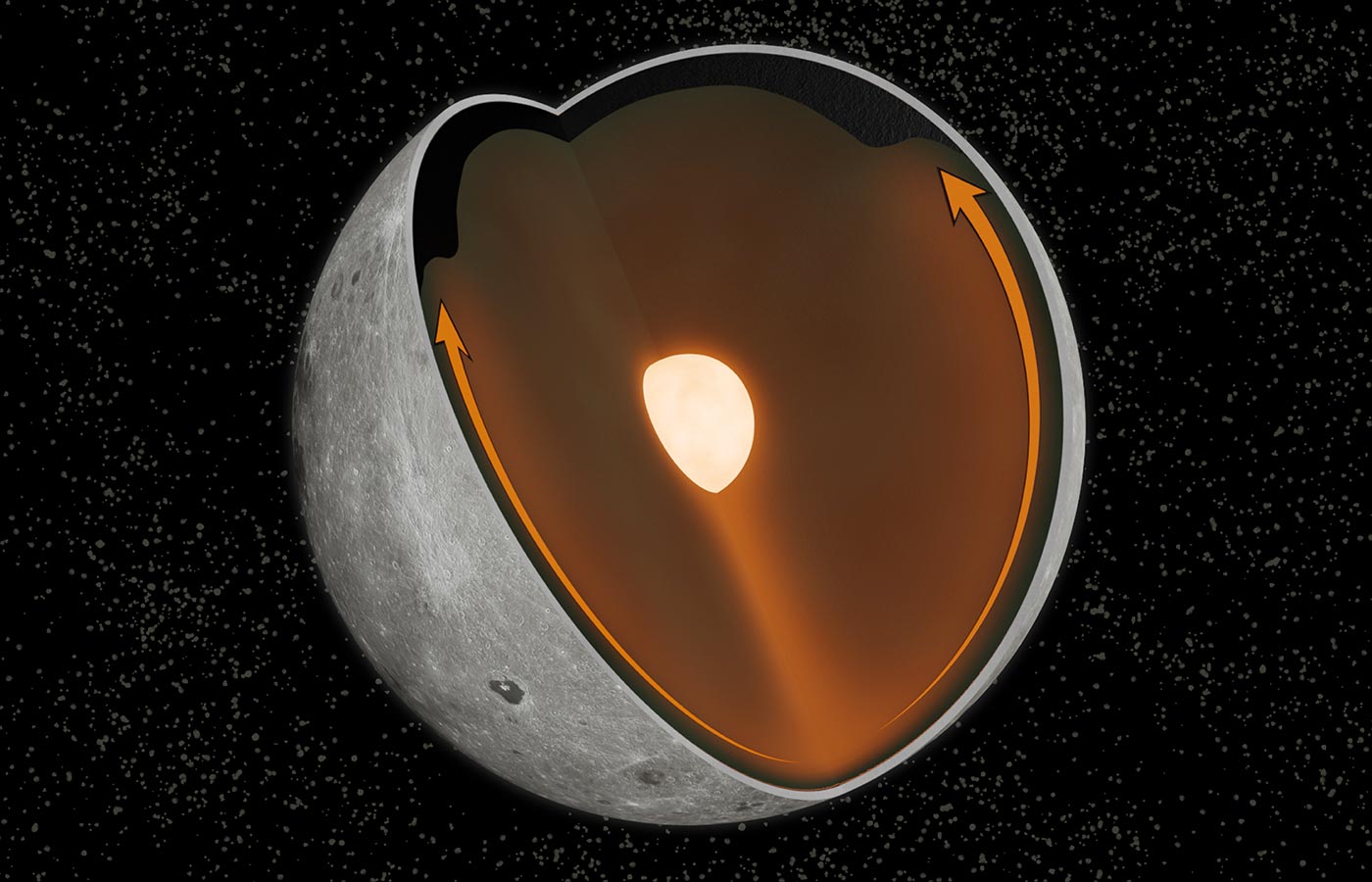
New research shows how the impact that created the Moon’s South Pole–Aitken basin is linked to the stark contrast in composition and appearance between the two sides of the Moon.
The face that the Moon shows to Earth looks far different from the one it hides on its far side. The nearside is dominated by the lunar mare — the vast, dark-colored remnants of ancient lava flows. The crater-pocked far side, on the other hand, is virtually devoid of large-scale mare features. Why the two sides are so different is one of the Moon’s most enduring mysteries.
Now, researchers have a new explanation for the two-faced Moon — one that relates to a giant impact billions of years ago near the Moon’s south pole.
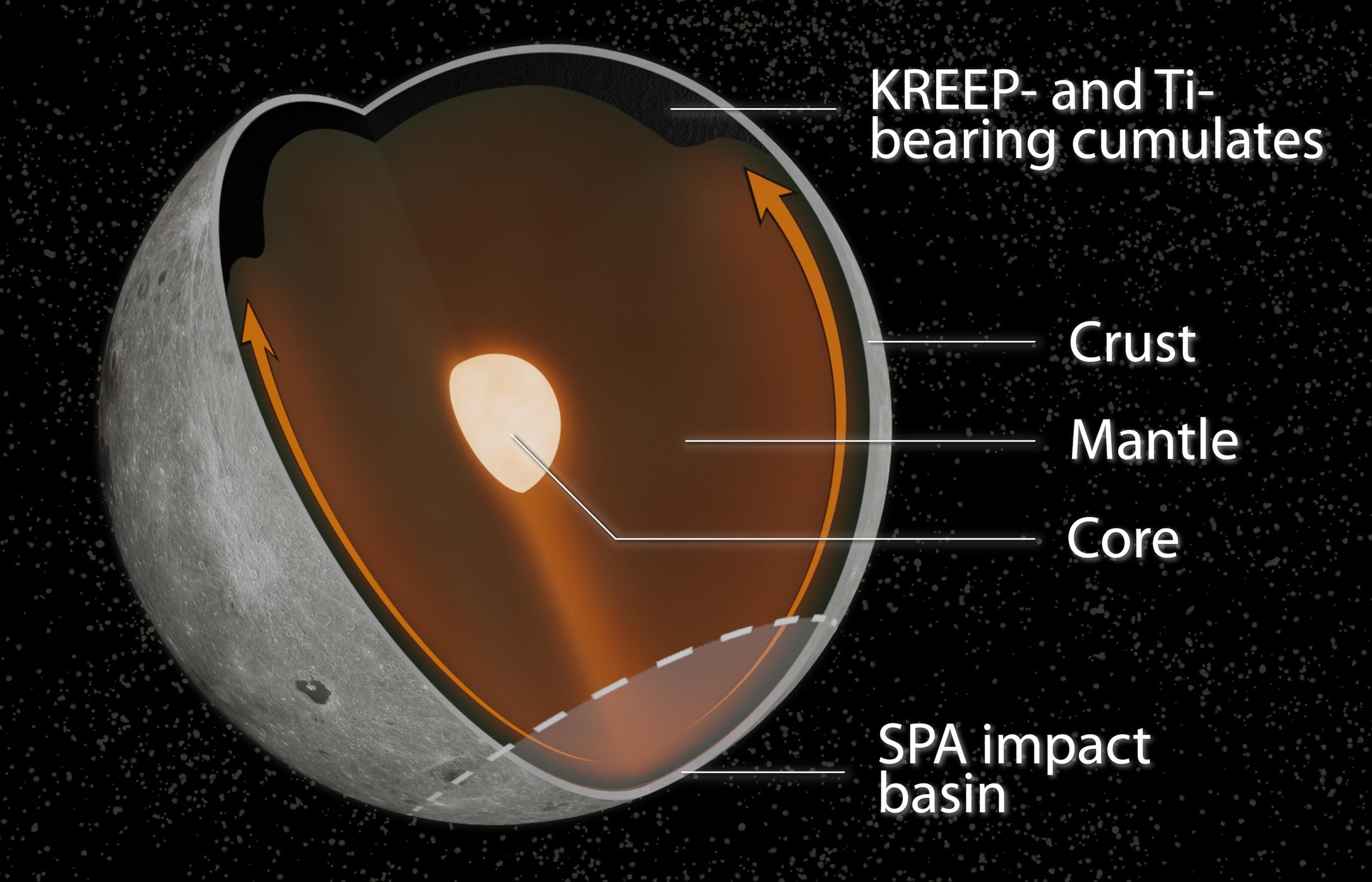
A new study published in the journal Science Advances shows that the impact that formed the Moon’s giant South Pole–Aitken (SPA) basin would have created a massive plume of heat that propagated through the lunar interior. That plume would have carried certain materials — a suite of rare-Earth and heat-producing elements — to the Moon’s nearside. That concentration of elements would have contributed to the volcanism that created the nearside volcanic plains.

“We know that big impacts like the one that formed SPA would create a lot of heat,” said Matt Jones, a Ph.D. candidate at Brown University and the study’s lead author. “The question is how that heat affects the Moon’s interior dynamics. What we show is that under any plausible conditions at the time that SPA formed, it ends up concentrating these heat-producing elements on the nearside. We expect that this contributed to the mantle melting that produced the lava flows we see on the surface.”
The study was a collaboration between Jones and his advisor Alexander Evans, an assistant professor at Brown, along with researchers from Purdue University, the Lunar and Planetary Science Laboratory in Arizona, Stanford University and NASA’s Jet Propulsion Laboratory.
The Nearside’s Composition: KREEP and Lava Flows
The differences between the near and far sides of the Moon were first revealed in the 1960s by the Soviet Luna missions and the U.S. Apollo program. While the differences in volcanic deposits are plain to see, future missions would reveal differences in the geochemical composition as well. The nearside is home to a compositional anomaly known as the Procellarum KREEP terrane (PKT) — a concentration of potassium (K), rare earth elements (REE), phosphorus (P), along with heat-producing elements like thorium. KREEP seems to be concentrated in and around Oceanus Procellarum, the largest of the nearside volcanic plains, but is sparse elsewhere on the Moon.
Some scientists have suspected a connection between the PKT and the nearside lava flows, but the question of why that suite of elements was concentrated on the nearside remained. This new study provides an explanation that is connected to the South Pole–Aitken basin, the second largest known impact crater in the solar system.
For the study, the researchers conducted computer simulations of how heat generated by a giant impact would alter patterns of convection in the Moon’s interior, and how that might redistribute KREEP material in the lunar mantle. KREEP is thought to represent the last part of the mantle to solidify after the Moon’s formation. As such, it likely formed the outermost layer of mantle, just beneath the lunar crust. Models of the lunar interior suggest that it should have been more or less evenly distributed beneath the surface. But this new model shows that the uniform distribution would be disrupted by the heat plume from the SPA impact.
Explaining the Procellarum KREEP Terrane
According to the model, the KREEP material would have ridden the wave of heat emanating from the SPA impact zone like a surfer. As the heat plume spread beneath the Moon’s crust, that material was eventually delivered en masse to the nearside. The team ran simulations for a number of different impact scenarios, from dead-on hit to a glancing blow. While each produced differing heat patterns and mobilized KREEP to varying degrees, all created KREEP concentrations on the nearside, consistent with the PKT anomaly.
The researchers say the work provides a credible explanation for one of the Moon’s most enduring mysteries.
“How the PKT formed is arguably the most significant open question in lunar science,” Jones said. “And the South Pole–Aitken impact is one of the most significant events in lunar history. This work brings those two things together, and I think our results are really exciting.”
Reference: “A South Pole–Aitken impact origin of the lunar compositional asymmetry” by Matt J. Jones, Alexander J. Evans, Brandon C. Johnson, Matthew B. Weller, Jeffrey C. Andrews-Hanna, Sonia M. Tikoo and James T. Kean, 8 April 2022, Science Advances.
DOI: 10.1126/sciadv.abm8475
Never miss a breakthrough: Join the SciTechDaily newsletter.
Follow us on Google and Google News.
3 Comments
… yeah, but still it is mystery on the night sky, though…
THEORY is, by definition SPECULATION:
1.) Take the the unexplained
2.) Develop a THEORY based on Theories which
3.) Fit and PROJECT the OBSERVED events/attributes into
4.) A SEEMINGLY LOGICAL FRAMEWORK
5.) Wait a Millennium (or two) and
6.) VOILÀ:
7.) God and Seven Days IN the Week… OR: The CELESTIAL BATTLES described in the BHAGAVAD-GITA… OR: Why (in the Western World) the MAN in The Moon has a crooked smile and a DIMPLE in his CHIN.
PAREIDOLIA… by any other name… Is ENTIRELY HUMAN:
SOMETIMES it is a MATTER of what ONE NEEDS to believe with “Certainty” which SKEWS Reason toward an Overwhelming Conclusion…
🎶 Give me that Old-time RELIGION… 🎶
ALTERNATE SCENARIO: A massive cometary/meteoric body emerged from the Öpik-Oort Cloud in company with a SWARM of smaller bodies dislodged from the Cloud, and set on a collision course with Earth. The Moon was (by design or chance) interposed between Earth and the approaching swarm. The Bodies pushed ahead of the massive projectile impacted first. The Moon absorbed many, but not all, of these smaller bodies. This swarm sowed havoc on the Earth, setting fire to the biosphere. Meanwhile… the Massive Celestial Body in-question impacted the Moon, burying its metallic core in the Lunar mantle; stilling it in its SPIN. When the Moon resumed its spin, the MASS buried in its Mantle became the centrifugal CORE of a “revised” Axis of ROTATION…
The Earth rebounded through an extended period of glaciation. Whole species and life forms were extincted. Life adapted. Formerly marginal Life Forms arose and evolved… TIME MARCHED ON and… some measure of minutes later one of these CREATURES emerged with a telescope, to Conceive the HEAVENS, clear of MISTY SHROUD…
BEAUTIFUL… SYMMETRICAL about a CENTER… Which is the Human EYE and the BRAIN behind it.
WISDOM is an on-going, in-house SEARCH and NEVER a DESTINATION.
✋
DHYā’NA
Yes!
A Mother’s, a Father’s, a Wife’s and a Child’s admonition to a Prodigal and Vagrant Soul: By All (but not ANY means) take the TRIP Out. But don’t forget where you LIVE.
There is No Place like HOME (that we know of).