
Close Menu
    Facebook X (Twitter) Instagram
    SciTechDaily
    • Biology
    • Chemistry
    • Earth
    • Health
    • Physics
    • Science
    • Space
    • Technology
    Facebook X (Twitter) Pinterest YouTube RSS
    SciTechDaily
    Home»Space»Exploring Cosmic Mysteries: A Deep Dive Into Our Nearest Star-Forming Galaxy
    Space

    Exploring Cosmic Mysteries: A Deep Dive Into Our Nearest Star-Forming Galaxy

    By Texas Tech UniversityApril 29, 2023No Comments4 Mins Read
    Facebook Twitter Pinterest Telegram LinkedIn WhatsApp Email Reddit
    Share
    Facebook Twitter LinkedIn Pinterest Telegram Email Reddit
    White Dwarf Star in Orbit With a Black Hole
    This artist’s impression depicts a white dwarf star found in the closest known orbit around a black hole. NASA’s Chandra X-ray Observatory discovered this extraordinarily close binary in 47 Tucanae, a dense cluster of stars on the edge of the Milky Way. Credit: NASA/CXC/M.Weiss

    A Texas Tech astronomer is leading a team awarded a highly competitive Chandra program to study the stellar remnants in the Large Magellanic Cloud.

    Vallia Antoniou, an assistant professor of practice in the Department of Physics and Astronomy at Texas Tech, has been awarded observing time on the powerful Chandra X-Ray Telescope to explore some of the deepest recesses of the universe.

    It marks the second major Chandra program led by Antoniou, who is also a research associate with the Smithsonian Astrophysical Observatory.
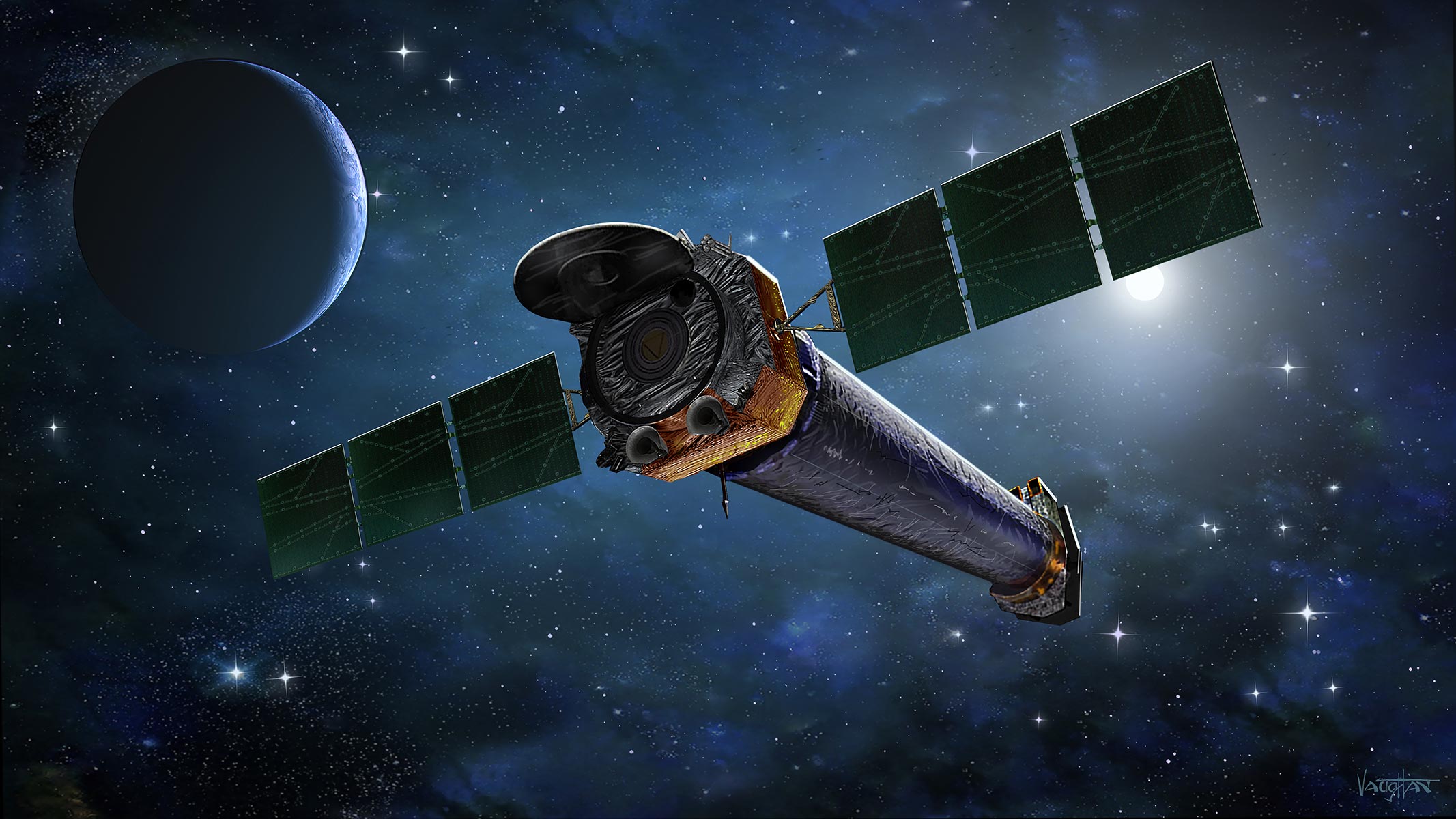
    NASA Chandra X-ray Observatory Illustration
    Illustration of NASA’s Chandra X-ray Observatory in space. Credit: NASA/CXC/SAO

    Each year, astronomers from around the world follow a rigorously competitive process to receive Chandra time. The telescope was launched aboard the space shuttle Columbia in 1999 and orbits Earth, offering previously unavailable views of deep space at wavelengths that are not accessible from ground telescopes. During its more than two decades in space, the telescope has revolutionized the field of X-ray astronomy.

    “The main idea is to study nearby star-forming galaxies,” Antoniou said. “It gives us an opportunity to study analogs of much more distant galaxies, yet obviously outside our Milky Way galaxy.”

    Large Magellanic Cloud VISTA
    ESO’s VISTA telescope reveals a remarkable image of the Large Magellanic Cloud, one of our nearest galactic neighbors. VISTA has been surveying this galaxy and its sibling the Small Magellanic Cloud, as well as their surroundings, in unprecedented detail. This survey allows astronomers to observe a large number of stars, opening up new opportunities to study stellar evolution, galactic dynamics, and variable stars. Credit: ESO/VMC Survey

    The program focuses on the Large Magellanic Cloud, the nearest star-forming galaxy which orbits the Milky Way at approximately 160,000 light-years from Earth.

    Antoniou, also the director of the Preston Gott Skyview Observatory about 15 miles north of Lubbock, was awarded one mega-second of Chandra telescope time, which equates to roughly 11.5 days (a mega-second is 1 million seconds).

    Her proposal in the Very Large Program (VLP) category was approved for the specific viewing cycle in late June. Since the VLP category was first introduced in 2017, only seven VLPs have been awarded time from among the 64 proposed.

    Vallia Antoniou
    Vallia Antoniou, an assistant professor of practice in the Department of Physics and Astronomy at Texas Tech. Credit: Texas Tech

    Early findings should be available to the public late this summer, she said.

    Advancing Research on X-Ray Binaries

    Her research focuses on understanding the formation and evolution of X-ray binaries in different galactic environments. The sheer distances involved can impede this work, making access to powerful telescopes necessary.

    “Chandra’s proposal selection process is highly competitive, and Vallia’s research program was the only VLP approved out of nine submitted in Cycle 24,” said Sung-Won Lee, chair of the physics and astronomy department. “This project is an international collaboration of scientists, and I am very pleased that our very own faculty is recognized internationally and will lead this important scientific mission.”

    Antoniou said the awarded telescope time should give the team additional insights into the populations of stellar remnants such as pulsars and black holes and their behavior when they consume the stars orbiting them (so-called X-ray binaries).”

    The team has selected 10 regions of the Large Magellanic Cloud, focusing on areas of the galaxy that they expect to have high X-ray binary formation rates, which in turn will provide a deeper understanding of the system and stars. The program completes an effort started by Antoniou studying the smaller sibling of the Large Magellanic Cloud, the Small Magellanic Cloud, which was awarded time as a Chandra X-Ray Visionary Program.

    “This is another good example that our department is conducting very competitive research internationally,” Lee said.

    Never miss a breakthrough: Join the SciTechDaily newsletter.
    Follow us on Google and Google News.

    Astronomy Astrophysics Chandra X-ray Observatory Texas Tech University
    Share. Facebook Twitter Pinterest LinkedIn Email Reddit

    Related Articles

    Fragments of Titanium Found Blasting Out of a Famous Supernova

    Evidence of “Pulsar Wind Nebula” May Solve 34-Year-Old Astronomical Mystery

    How Do the Most Massive Stars Explode? Bubbles With Titanium Trigger Titanic Explosions

    Record-Breaking Jet of Particles Spied From a Supermassive Black Hole in the Early Universe

    Massive X-ray Jet – Extending for 160,000 Light-Years – Spied From Supermassive Black Hole in Early Universe

    New Clues to Remains of Star That Exploded Just Outside Our Galaxy

    Reclusive Neutron Star May Have Been Found in Famous Supernova SN 1987A

    Deepening Mystery: Astronomers on the Hunt for a Missing Supermassive Black Hole [Video]

    Chandra X-ray Observatory Studies Extraordinary Magnetar [Video]

    Leave A Reply Cancel Reply

    • Facebook
    • Twitter
    • Pinterest
    • YouTube

    Don't Miss a Discovery

    Subscribe for the Latest in Science & Tech!

    Trending News

    Scientists Uncover Potential Brain Risks of Popular Fish Oil Supplements

    Scientists Discover a Surprising Way To Make Bread Healthier and More Nutritious

    After 60 Years, Scientists Uncover Unexpected Brain Effects of Popular Diabetes Drug Metformin

    New Research Uncovers Hidden Side Effects of Popular Weight-Loss Drugs

    Scientists Rethink Extreme Warming After Surprising Ocean Discovery

    Landmark Study Links Never Marrying to Significantly Higher Cancer Risk

    Researchers Discover Unknown Beetle Species Just Steps From Their Lab

    Largest-Ever Study Finds Medicinal Cannabis Ineffective for Anxiety, Depression, PTSD

    Follow SciTechDaily
    • Facebook
    • Twitter
    • YouTube
    • Pinterest
    • Newsletter
    • RSS
    SciTech News
    • Biology News
    • Chemistry News
    • Earth News
    • Health News
    • Physics News
    • Science News
    • Space News
    • Technology News
    Recent Posts
    • Scientists Discover Hidden Pathway Inside Catalysts That Defies Decades of Assumptions
    • Scientists Finally Crack Decades-Old Mystery of “Breathing” Lasers
    • “Like Liquid Metal”: Scientists Create Strange Shape-Shifting Material
    • Early Warning Signals of Esophageal Cancer May Be Hiding in Plain Sight
    • Researchers Have Discovered a THC-Free Cannabis Compound That May Replace Opioids
    Copyright © 1998 - 2026 SciTechDaily. All Rights Reserved.
    • Science News
    • About
    • Contact
    • Editorial Board
    • Privacy Policy
    • Terms of Use

    Type above and press Enter to search. Press Esc to cancel.