
Close Menu
    Facebook X (Twitter) Instagram
    SciTechDaily
    • Biology
    • Chemistry
    • Earth
    • Health
    • Physics
    • Science
    • Space
    • Technology
    Facebook X (Twitter) Pinterest YouTube RSS
    SciTechDaily
    Home»Physics»Exploring Strangeness in the Universe’s First Ten Microseconds
    Physics

    Exploring Strangeness in the Universe’s First Ten Microseconds

    By SpringerJanuary 31, 20201 Comment2 Mins Read
    Facebook Twitter Pinterest Telegram LinkedIn WhatsApp Email Reddit
    Share
    Facebook Twitter LinkedIn Pinterest Telegram Email Reddit
    Primordial Universe Artist Concept
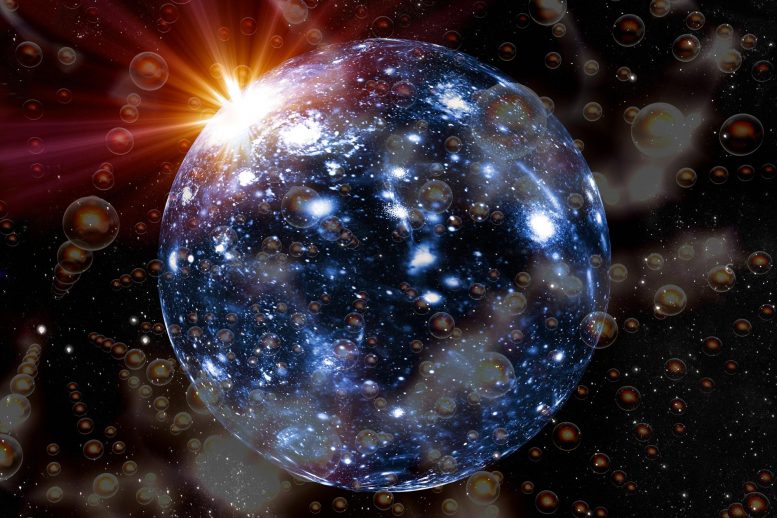
    Primordial universe artist’s concept.

    Having studied quark-gluon plasma since the late 1970s, Dr. Johann Rafelski summarizes the evolution in our understanding of the exotic quark signature of this primordial material which once filled the whole Universe.

    Physicists believe that in the Universe’s first ten microseconds, free quarks and gluons filled all of spacetime, forming a new phase of matter named ‘quark-gluon plasma’ (QGP). Experimental and theoretical work at CERN was instrumental in the discovery of this hot soup of primordial matter, which is recreated today in accelerator-based lab experiments.

    To discover QGP in such experiments, the observation of exotic ‘strange’ quarks is very important. If QGP is created, strangeness is readily produced through collisions between gluons. In an analysis published in The European Physical Journal Special Topics, Dr. Johann Rafelski from The University of Arizona, United States, also working at CERN, presents how our understanding of this characteristic strangeness production signature has evolved over the span of his long career.

    Using the style of a ‘personal diary’, Rafelski firstly reviews and summarizes decades of work. Describing leading experimental and theoretical contributions, he recounts how and why strange quarks are produced so efficiently in QGP, and how this behavior has been exploited for QGP discovery. He also explores strangeness as a tool in the search and discovery of this primordial phase of matter; existent at unimaginably high temperatures and pressures. He then follows the line of research through to the ongoing experimental ultra-high-energy experiments involving head-on collisions between both heavy nuclei and lighter protons, carried out at CERN’s Large Hadron Collider (LHC).

    Secondly, Rafelski follows the narrative with a commented set of his own unpublished work, focusing on pioneering theories and QGP discovery. He also includes a selection from the comments of referees offering both criticism and praise for these studies; along with his own present-day perspectives. This review highlights the numerous successes enjoyed by theorists, through decades of tireless effort to explain and understand the primordial QGP. All the same, it shows that many pressing questions remain to be answered. Rafelski continues to contribute to the field through his rich research experience and will undoubtedly inspire new generations of physicists to continue the study of exotic quarks in the primordial Universe.

    Reference: “Discovery of Quark-Gluon Plasma: Strangeness Diaries” by Johann Rafelski, 24 January 2020, The European Physical Journal Special Topics.
    DOI: 10.1140/epjst/e2019-900263-x

    Never miss a breakthrough: Join the SciTechDaily newsletter.
    Follow us on Google and Google News.

    Astrophysics Particle Physics Springer
    Share. Facebook Twitter Pinterest LinkedIn Email Reddit

    Related Articles

    ‘Zee Burst’ – Ghost Particles Studied Through Ultra-High Energy Events

    When Impacted by Positrons Spherical Nanoparticles Release Electron-Positron Pairs in Forward Directions

    An Exotic Analysis Technique Places Another Piece in the Dark Matter Puzzle

    Quantum Vacuum: Negative Energy & Repulsive Gravity

    Matter Without Antimatter? Closing In on Elusive Particles.

    Chameleon Theory Could Change How Scientists Think About Gravity

    DarkSide-20k Will Push the Search for WIMP Dark Matter to New Levels

    Mathematical Model May Explain What Dark Matter Consists Of

    Black Holes Have Properties That Resemble the Dynamics of Solids and Liquids

    1 Comment

    1. Torbjörn Larsson on February 1, 2020 8:15 am

      He starts with a list of 3 factors that increases “strange production”, and one stands out to me. Since all production has some likelihood and we start out without a symmetry breaking into having particles with strange flavor, production will promote strange flavor. (It would promote other non-up, non-down flavors as well, but those particles have higher masses I take it.)

      Reply
    Leave A Reply Cancel Reply

    • Facebook
    • Twitter
    • Pinterest
    • YouTube

    Don't Miss a Discovery

    Subscribe for the Latest in Science & Tech!

    Trending News

    Scientists Discover How Coffee Impacts Memory, Mood, and Gut Health

    Why Did the Neanderthals Disappear? Scientists Reveal Humans Had a Hidden Advantage

    Physicists Propose Strange Experiment Where Time Goes Quantum

    Magnesium Magic: New Drug Melts Fat Even on a High-Fat, High-Sugar Diet

    Weight-Loss Drugs Like Ozempic May Come With an Unexpected Cost

    Mezcal “Worm” in a Bottle Mystery: DNA Testing Reveals a Surprise

    New Research Reveals That Your Morning Coffee Activates an Ancient Longevity Switch

    This Is What Makes You Irresistible to Mosquitoes

    Follow SciTechDaily
    • Facebook
    • Twitter
    • YouTube
    • Pinterest
    • Newsletter
    • RSS
    SciTech News
    • Biology News
    • Chemistry News
    • Earth News
    • Health News
    • Physics News
    • Science News
    • Space News
    • Technology News
    Recent Posts
    • Scientists Just Captured Killer T Cells in Action Inside Tumors
    • Alaska’s Sky Explodes With Swirling Clouds and a Hidden Polar Storm
    • Warming Oceans Could Trigger a Dangerous Methane Surge
    • Harvard Scientists Reveal Secret Structure Behind How You Smell
    • Scientists Just Discovered the Hidden Trick That Keeps Your Cells Alive
    Copyright © 1998 - 2026 SciTechDaily. All Rights Reserved.
    • Science News
    • About
    • Contact
    • Editorial Board
    • Privacy Policy
    • Terms of Use

    Type above and press Enter to search. Press Esc to cancel.