
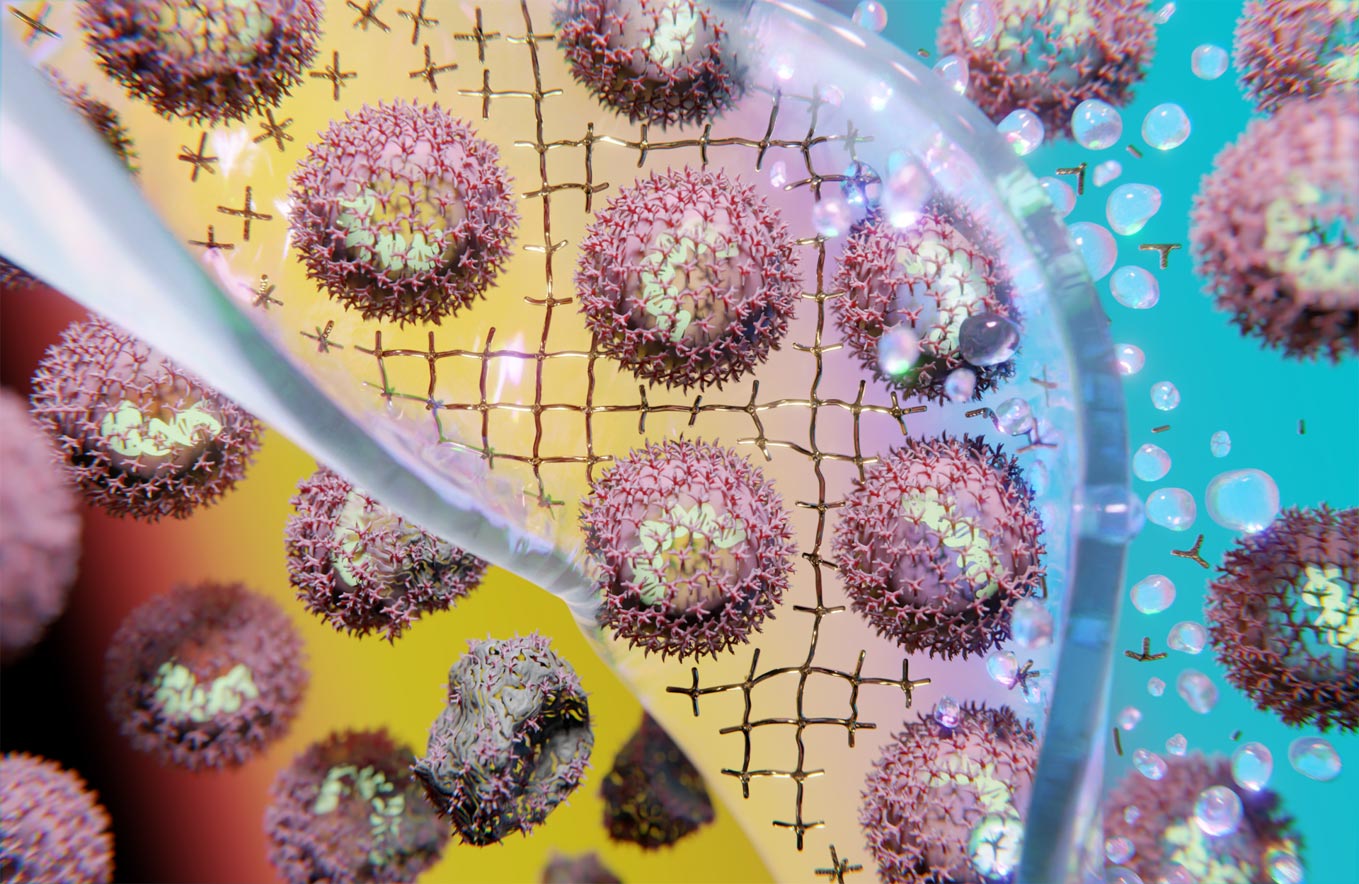
A new hydrogel technology enhances vaccine stability, reducing cold chain costs and improving distribution.
Nearly half of all vaccines produced go to waste. This is because transporting them to diverse regions of the world involves many logistical challenges. Another major factor is that most vaccines require strict temperature regulation from the manufacturing line to injection into a human arm. Maintaining a constant temperature along the cold (supply) chain can be a challenging feat in the best of circumstances. Moreover, in Sub-Saharan Africa and other developing regions, for example, limited transport infrastructure and unreliable electricity service compound the already immense challenges of delivering viable vaccines.
Rising to the challenge, researchers from ETH Zurich’s Macromolecular Engineering and Organic Chemistry Labs and entrepreneurs from Colorado-based Nanoly Bioscience worked together to develop a safe, versatile platform to increase the thermal stability of vaccines. Their goal? To vastly improve the distribution of viable vaccines and reduce the economic costs of the cold chain.
Like “Tupperware” for Proteins
“Think of it like an egg,” explains Bruno Marco-Dufort, a doctoral researcher in Professor Mark Tibbitt’s Macromolecular Engineering lab. “At room temperature or in the refrigerator the egg maintains its viscous-like protein structure, but once it hits boiling water or the frying pan its structure changes permanently.” It is similar for the proteins in a vaccine – once exposed to certain temperatures they clump together. Cooling them down again will not reverse their denaturation – you cannot ‘un-cook’ the egg.
So rather than altering mother nature, Marco-Dufort and the team of scientists developed a new type of hydrogel, the details of which were just published in the journal Science Advances on August 5. The gel is based on a biocompatible, synthetic polymer known as “PEG” or polyethylene glycol. It serves as a protective, “cloaking device” for very large – yet invisible to the naked eye – complex molecules such as the proteins found in vaccines, antibodies, or gene therapies. The packaging works somewhat like a molecular Tupperware, encapsulating the proteins and keeping them separated. It enables the proteins to withstand a higher range of temperature fluctuations. Instead of the traditional +2 to +8 °C (35 to 45 °F) range for the cold chain, encapsulation allows for a range of 25 to 65 °C (75 to 150 °F). Most importantly, the encapsulated cargo is released simply by adding a sugar solution. This enables easy on-demand recovery of the vaccines at their point of use.
Usage in Cancer Research
This new biomedical hydrogel technology could provide higher rate of vaccine viability. However, the real game changer is the potential economic effect it could have on reducing costs and health risks associated with the cold chain. “In 2020, the overall market for cold chain services (from manufacturing to distribution) was $17.2 billion and forecasted to rise,” the researchers reported. Rising costs pose potentially dire consequences for public health and public trust if vaccines arrive via a compromised cold chain.
“Most vaccines are sensitive to hot and cold. This creates a large barrier for global immunization campaigns, because vaccine distribution and administrative costs often exceed the costs of production,” explains Marco-Dufort. While more investment will be needed to shore up the cold chain, encapsulation offers a cost-saving solution that could be put towards the production of more vaccines and thus, save more lives.
Yet, there is still a long way to go in terms of further research, safety studies, and clinical trials before the hydrogels can be implemented for vaccine distribution. Their more immediate use is for transporting heat-sensitive enzymes used in cancer research, for example, or protein molecules for research in lab settings.
One Step Towards Solving a Global Issue
While new biotechnologies and cost savings are a step in the right direction, there are still tremendous logistical, political, and socio-economic challenges in resolving the global issues surrounding equitable vaccine distribution and vaccine hesitancy. Marco-Dufort’s motivation is undeterred. His childhood experience living in the Democratic Republic of the Congo instilled a deep appreciation for the need for vaccines against infectious diseases, not just for COVID-19, but also for Polio, Meningitis, and Ebola. He, more than most, is aware of the tremendous challenges people living in Sub-Saharan Africa face in terms of access to vaccines where infectious diseases are still prevalent.
Mark Tibbitt, Bruno Marco-Dufort, and the team’s work represent a substantial advancement in vaccine excipient development. Their progress also offers a glimmer of hope for a positive societal impact. Even a small relief of the economic factors associated with the distribution of vaccines, medicines, and biomedical research could result in larger impacts down the road.
Reference: “Thermal stabilization of diverse biologics using reversible hydrogels” by Bruno Marco-Dufort, John R. Janczy, Tianjing Hu, Marco Lütolf, Francesco Gatti, Morris Wolf, Alex Woods, Stephan Tetter, Balaji V. Sridhar and Mark W. Tibbitt, 5 August 2022, Science Advances.
DOI: 10.1126/sciadv.abo0502
Never miss a breakthrough: Join the SciTechDaily newsletter.
Follow us on Google and Google News.