
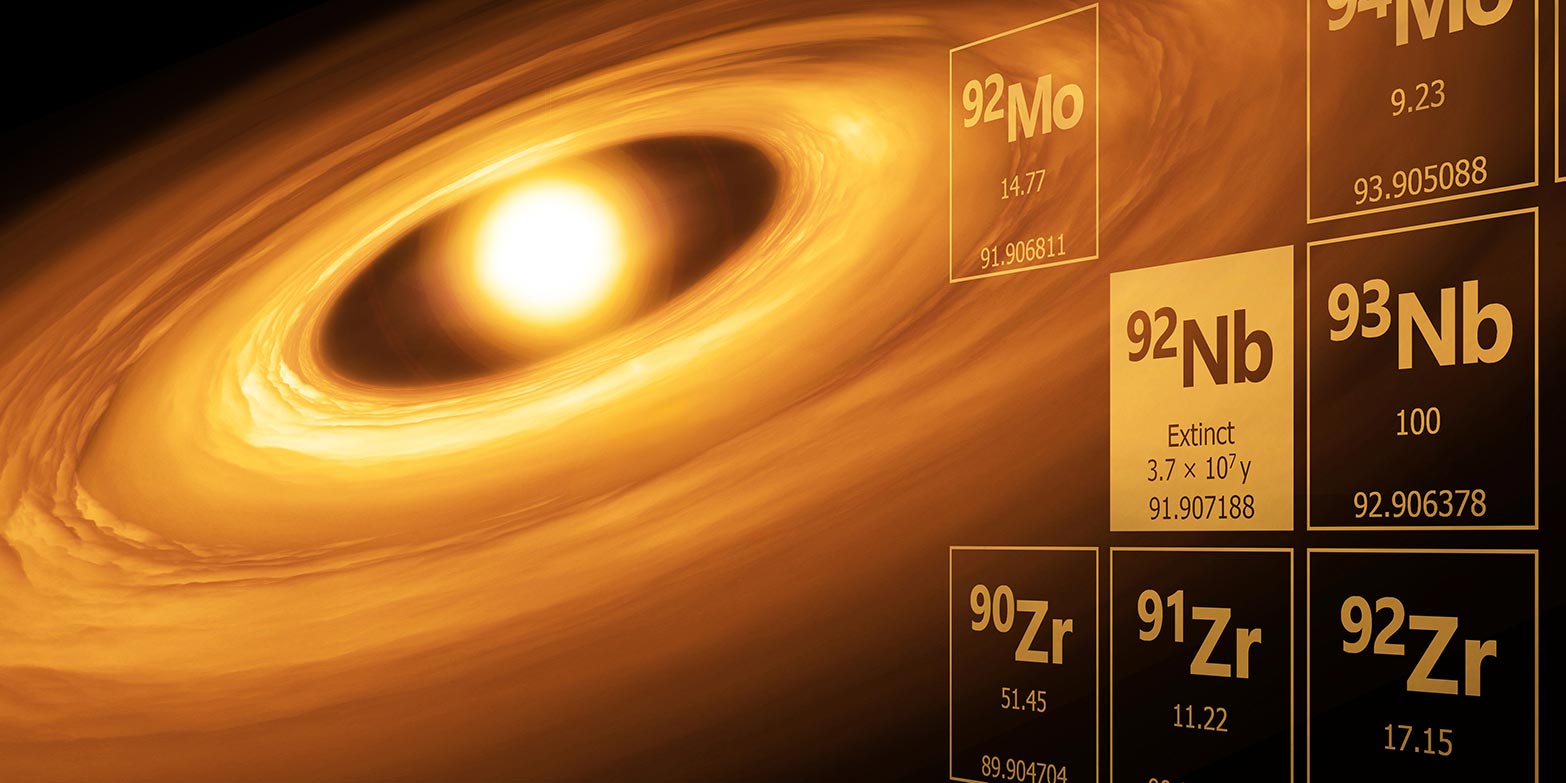
Using the extinct niobium-92 atom, ETH researchers have been able to date events in the early solar system with greater precision than before. The study concludes that supernova explosions must have taken place in the birth environment of our sun.
If an atom of a chemical element has a surplus of protons or neutrons, it becomes unstable. It will shed these additional particles as gamma radiation until it becomes stable again. One such unstable isotope is niobium-92 (92Nb), which experts also refer to as a radionuclide. Its half-life of 37 million years is relatively brief, so it went extinct shortly after the formation of the solar system. Today, only its stable daughter isotope, zirconium-92 (92Zr), bears testimony to the existence of 92Nb.
Yet scientists have continued to make use of the extinct radionuclide in the form of the 92Nb-92Zr chronometer, with which they can date events that took place in the early solar system some 4.57 billion years ago.
Use of the 92Nb-92Zr chronometer has hitherto been limited by a lack of precise information regarding the amount of 92Nb that was present at the birth of the solar system. This compromises its use for dating and determining the production of these radionuclides in stellar environments.
Meteorites Hold the Key to the Distant Past
Now a research team from ETH Zurich and the Tokyo Institute of Technology (Tokyo Tech) has greatly improved this chronometer. The researchers achieved this improvement by means of a clever trick: they recovered rare zircon and rutile minerals from meteorites that were fragments of the protoplanet Vesta. These minerals are considered to be the most suitable for determining 92Nb, because they give precise evidence of how common 92Nb was at the time of the meteorite’s formation. Then, with the uranium-lead dating technique (uranium atoms that decay into lead), the team calculated how abundant 92Nb was at the time of the solar system’s formation. By combining the two methods, the researchers succeeded in considerably improving the precision of the 92Nb-92Zr chronometer.
“This improved chronometer is thus a powerful tool for providing precise ages for the formation and development of asteroids and planets – events that happened in the first tens of millions of years after the formation of the solar system,” says Maria Schönbächler, Professor at the Institute of Geochemistry and Petrology at ETH Zurich, who led the study.
Supernovas Released Niobium-92
Now that the researchers know more precisely how abundant 92Nb was at the very beginnings of our solar system, they can determine more accurately where these atoms were formed and where the material that makes up our sun and the planets originated.
The research team’s new model suggests that the inner solar system, with the terrestrial planets Earth and Mars, is largely influenced by material ejected by Type Ia supernovae in our Milky Way galaxy. In such stellar explosions, two orbiting stars interact with each other before exploding and releasing stellar material. In contrast, the outer solar system was fed primarily by a core-collapse supernova – probably in the stellar nursery where our sun was born –, in which a massive star collapsed in on itself and exploded violently.
Reference: “Precise initial abundance of Niobium-92 in the Solar System and implications for p-process nucleosynthesis” by Makiko K. Haba, Yi-Jen Lai, Jörn-Frederik Wotzlaw, Akira Yamaguchi, Maria Lugaro and Maria Schönbächler, 23 February 2021, Proceedings of the National Academy of Sciences.
DOI: 10.1073/pnas.2017750118
Never miss a breakthrough: Join the SciTechDaily newsletter.
Follow us on Google and Google News.