
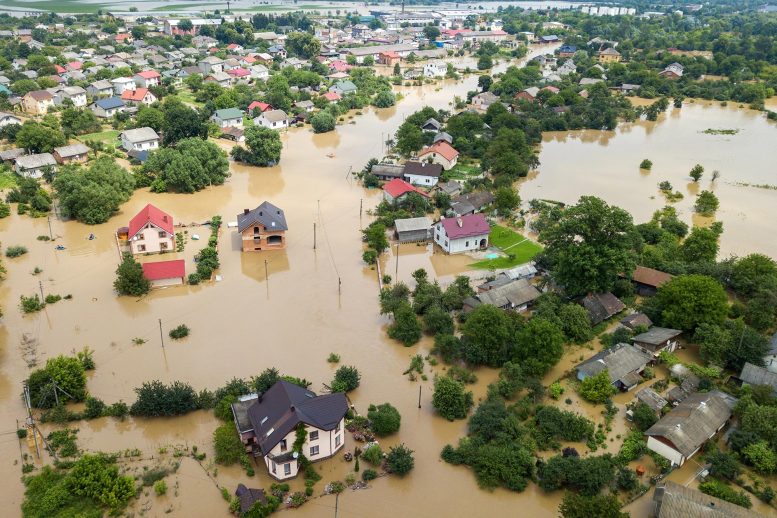
Global Warming Could Make Extreme Sea Levels Nearly Annual Worldwide by 2100
Global warming will cause extreme sea levels to occur almost every year by the end of the century, impacting major coastlines worldwide, according to new research from an international team of scientists.
Published recently in Nature Climate Change, the research predicts that because of rising temperatures, extreme sea levels along coastlines across the world will become 100 times more frequent by the end of the century in about half of the 7,283 locations studied.
Co-author of the study, University of Melbourne’s Dr. Ebru Kirezci, an ocean engineering researcher said areas where frequency of extreme sea levels are expected to increase faster include the Southern Hemisphere and subtropic areas, the Mediterranean Sea and the Arabian Peninsula, the southern half of North America’s Pacific Coast, and areas including Hawaii, the Caribbean, the Philippines and Indonesia.
“What we can also infer from this study, is that most of the eastern, southern, and southwestern coastlines of Australia will be impacted with almost an annual frequency of these extreme sea levels by 2100,” Dr. Kirezci said.
“This increased frequency of extreme sea levels will occur even with a global temperature increase of 1.5 degrees Celsius (2.7 degrees Fahrenheit). And the changes are likely to come sooner than the end of the century, with many locations experiencing a 100-fold increase in extreme events even by 2070.”
Lead author of the study, climate scientist at the US Department of Energy’s Pacific Northwest National Laboratory, Dr Claudia Tebaldi said it was no surprise that sea level rise will be dramatic even at 1.5 degrees and will have substantial effects on extreme sea level frequencies and magnitude.
“This study gives a more complete picture around the globe. We were able to look at a wider range of warming levels in very fine spatial detail,” Dr. Tebaldi said.
The researchers called for more detailed studies to understand how the changes will impact communities within different countries. They added that the physical changes that the study describes will have varying impacts at local scales, depending on several factors, including how vulnerable the site is to rising waters and how prepared a community is for change.
Urgent Need for Coastal Adaptation Strategies
“Public policymakers should take note of these studies and work towards improving coastal protection and mitigation measures. Building dykes and sea walls, retreating from shorelines, and deploying early warning systems are some of the steps which can be taken to adapt to this change,” Dr. Kirezci said.
For more on this research, read Extreme Sea Levels to Become Far More Common Worldwide as Earth Warms.
Reference: “Extreme sea levels at different global warming levels” by Claudia Tebaldi, Roshanka Ranasinghe, Michalis Vousdoukas, D. J. Rasmussen, Ben Vega-Westhoff, Ebru Kirezci, Robert E. Kopp, Ryan Sriver and Lorenzo Mentaschi, 30 August 2021, Nature Climate Change.
DOI: 10.1038/s41558-021-01127-1
The research was led by the US based Joint Global Change Research Institute in collaboration with researchers from the University of Melbourne, IHE Delft Institute for Water Education in the Netherlands, the European Joint Research Centre in Italy, Princeton University, the University of Illinois, Rutgers University and the University of Bologna.
The study was funded by the US Environmental Protection Agency and their Department of Energy’s Office of Science.
Never miss a breakthrough: Join the SciTechDaily newsletter.
Follow us on Google and Google News.
4 Comments
“And the changes are likely to come sooner than the end of the century, with many locations experiencing a 100-fold increase in extreme events even by 2070.”
It is generally accepted that the rate of rise of the oceans is 3 mm or less, per year. That means one can expect sea level to rise less than 15 cm (~6″) in the next 50 years. Why did the authors not present similar calculations to back up their hand waving?
So, the authors would have us believe that a 6″ change is going to cause flooding of three or four feet, as shown in the lead photograph? It seems more reasonable to me that if weather should cause coastal flooding, it will only be about 6″ deeper than it would be without sea level rise! An exception to that might be if a dike or seawall only has a free-board of less than 6″ for extreme events.
Their linked article says, “… with locations adjacent to one another either experiencing a large change in frequency at very low warming levels, or not experiencing it even for the highest warming levels considered here, …” I would interpret this to mean that the uncertainty in their modeling is too large to make trustworthy predictions!
The message should be to not build where there is likely to be ANY incursions of water within the expected lifetime of the buildings, with or without sea level rise. A prudent person would also add another 6” elevation to the foundation if near the flooding boundary.
This is just in time for the scheduled CoP-26 meeting; however, few if any of the authors will still be alive in 70 years to stand behind their claims, or more likely, to acknowledge their errors.
Annual subsidence from lost aquifer pressure and liquefaction has dropped parts of Houston & Gavelston 10 feet in 100 years, with gps tracking currently showing a 1.5-2 cm drop per year in some of those areas. It’s a multi-faceted problem. This is happening in a combined national area of 17,000 sq mi and in 45 states.
You’d have some interesting things to say if you spent as much time reading as you do ranting.
To whom are you directing your criticism about “ranting?”
https://www.usgs.gov/faqs/what-liquefaction?qt-news_science_products=0#qt-news_science_products