
Close Menu
    Facebook X (Twitter) Instagram
    SciTechDaily
    • Biology
    • Chemistry
    • Earth
    • Health
    • Physics
    • Science
    • Space
    • Technology
    Facebook X (Twitter) Pinterest YouTube RSS
    SciTechDaily
    Home»Space»“Farfarout” Indeed: Planetoid Confirmed to Be Solar System’s Most Distant Known Object
    Space

    “Farfarout” Indeed: Planetoid Confirmed to Be Solar System’s Most Distant Known Object

    By Association of Universities for Research in Astronomy (AURA)February 14, 2021No Comments6 Mins Read
    Facebook Twitter Pinterest Telegram LinkedIn WhatsApp Email Reddit
    Share
    Facebook Twitter LinkedIn Pinterest Telegram Email Reddit
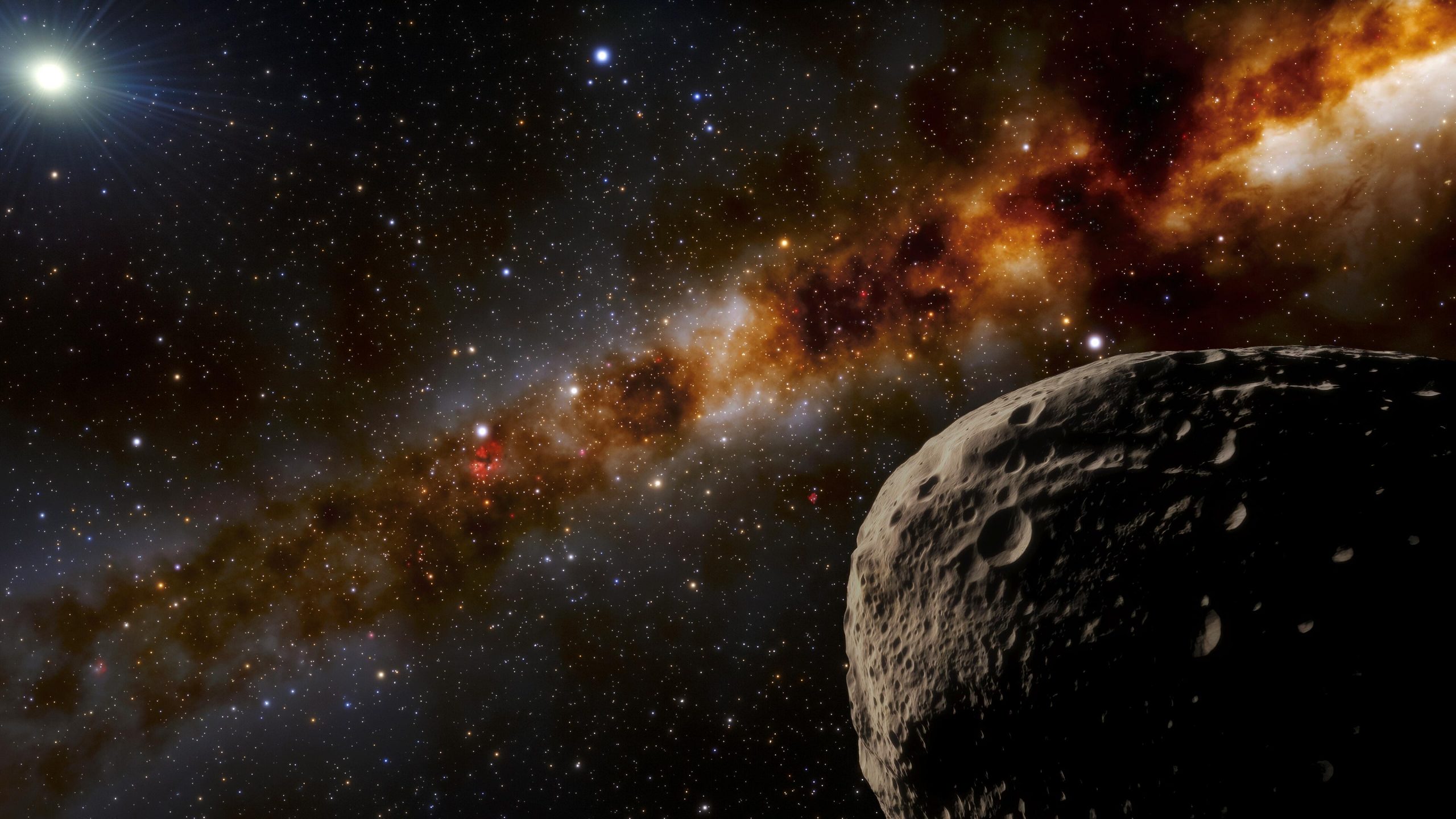
    Farfarout Illustration
    This illustration imagines what the distant object nicknamed “Farfarout” might look like in the outer reaches of our Solar System. The most distant object yet discovered in our Solar System, Farfarout is 132 astronomical units from the Sun, which is 132 times farther from the Sun than Earth is. Estimated to be about 400 kilometers (250 miles) across, Farfarout is shown in the lower right, while the Sun appears in the upper left. The Milky Way stretches diagonally across the background. Credit: NOIRLab/NSF/AURA/J. da Silva

    Gemini North Helps Define Remote Object’s Distance and Orbit

    With the help of the international Gemini Observatory, a Program of NSF’s NOIRLab, and other ground-based telescopes, astronomers have confirmed that a faint object discovered in 2018 and nicknamed “Farfarout” is indeed the most distant object yet found in our Solar System. The object has just received its designation from the International Astronomical Union.

    Farfarout was first spotted in January 2018 by the Subaru Telescope, located on Maunakea in Hawai‘i. Its discoverers could tell it was very far away, but they weren’t sure exactly how far. They needed more observations.

    “At that time we did not know the object’s orbit as we only had the Subaru discovery observations over 24 hours, but it takes years of observations to get an object’s orbit around the Sun,” explained co-discoverer Scott Sheppard of the Carnegie Institution for Science. “All we knew was that the object appeared to be very distant at the time of discovery.”
    Solar System Object Distances
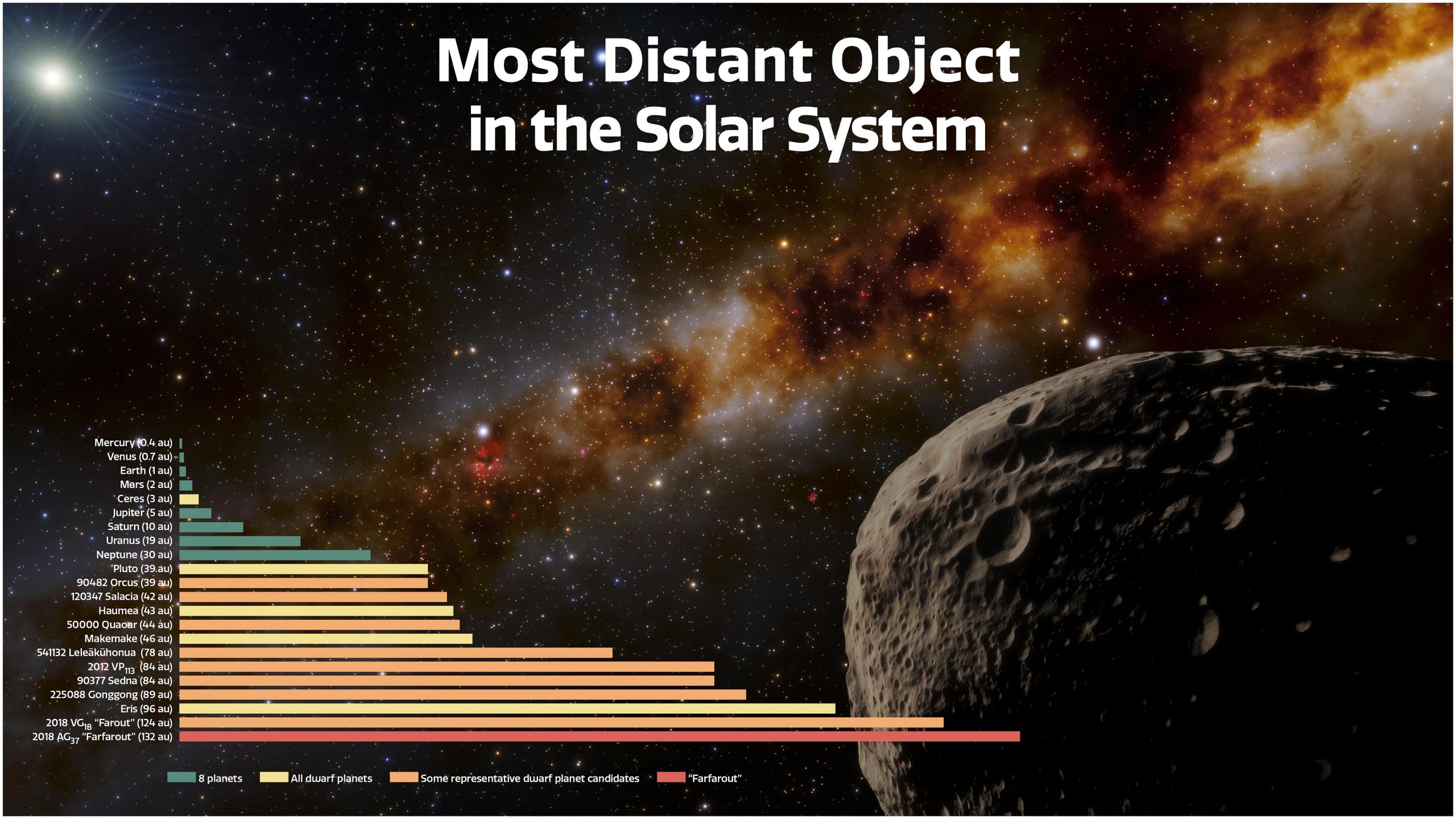
    This illustration depicts the most distant object yet found in our Solar System, nicknamed “Farfarout,” in the lower right. In the lower left, a graph shows the distances of the planets, dwarf planets, candidate dwarf planets, and Farfarout from the Sun in astronomical units (au). One au is equal to Earth’s average distance from the Sun. Farfarout is 132 au from the Sun. Credit: NOIRLab/NSF/AURA/J. da Silva

    Sheppard and his colleagues, David Tholen of the University of Hawai‘i and Chad Trujillo of Northern Arizona University, spent the next few years tracking the object with the Gemini North telescope (also on Maunakea in Hawai‘i) and the Carnegie Institution for Science’s Magellan Telescopes in Chile to determine its orbit.[1] They have now confirmed that Farfarout currently lies 132 astronomical units (au) from the Sun, which is 132 times farther from the Sun than Earth is. (For comparison, Pluto is 39 au from the Sun, on average.) 

    Farfarout is even more remote than the previous Solar System distance record-holder, which was discovered by the same team and nicknamed “Farout.” Provisionally designated 2018 VG18, Farout is 124 au from the Sun.
    Most Distance Objects in Solar System
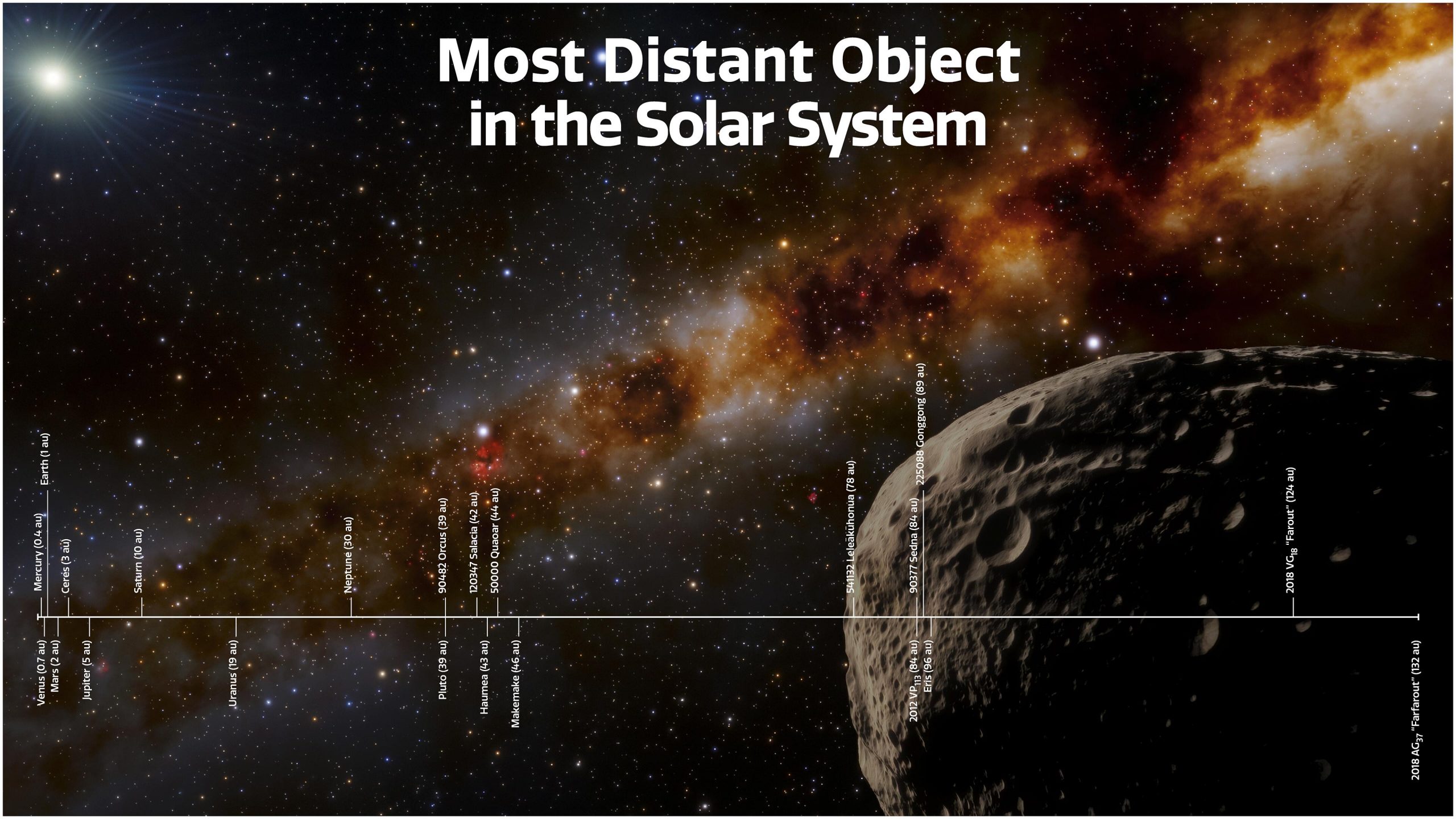
    This illustration depicts the most distant object yet found in our Solar System, nicknamed “Farfarout,” in the lower right. Along the bottom, various Solar System objects are plotted according to their distance from the Sun, with the planets and closest dwarf planet (Ceres) appearing at the far left and the most distant Solar System objects known, including Farfarout, on the far right. Their distances are provided in astronomical units (au), with 1 au equal to Earth’s average distance from the Sun. Credit: NOIRLab/NSF/AURA/J. da Silva

    However, the orbit of Farfarout is quite elongated, taking it 175 au from the Sun at its farthest point and around 27 au at its closest, which is inside the orbit of Neptune. Because its orbit crosses Neptune’s, Farfarout could provide insights into the history of the outer Solar System.

    “Farfarout was likely thrown into the outer Solar System by getting too close to Neptune in the distant past,” said Trujillo. “Farfarout will likely interact with Neptune again in the future since their orbits still intersect.”
    Farfarout on 15 January 2018
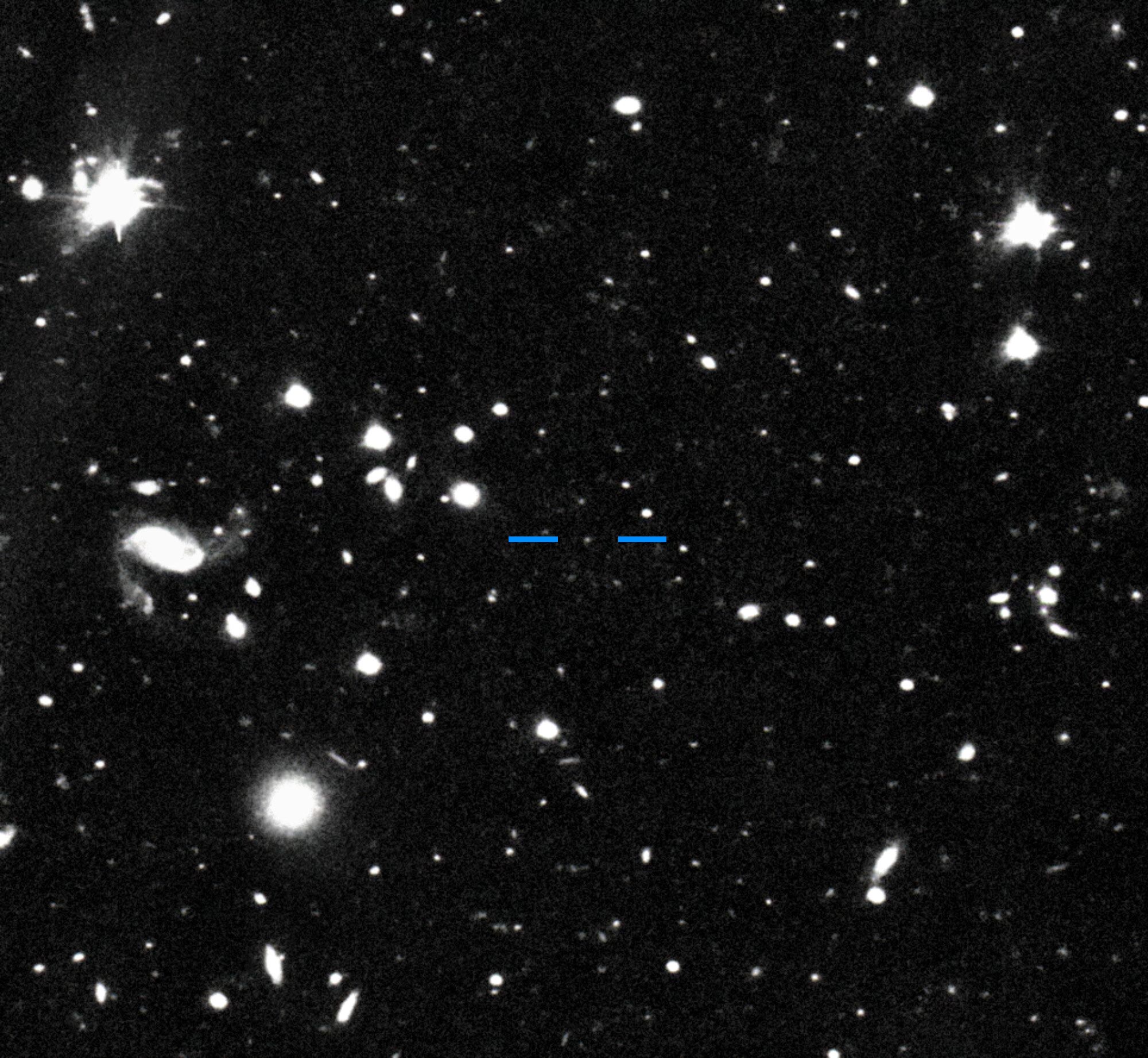
    This discovery image of Farfarout (2018 AG37) was taken with the Subaru Telescope on the night of January 15, 2018, Universal Time (UT). By comparing this image with one taken on the following night, it is possible to see that Farfarout (marked by blue horizontal lines) moves while the background stars and galaxies do not. Credit: S. Sheppard

    Farfarout is very faint. Based on its brightness and distance from the Sun, the team estimates it to be about 400 kilometers (250 miles) across, putting it at the low end of possibly being designated a dwarf planet by the International Astronomical Union (IAU).

    The IAU’s Minor Planet Center in Massachusetts announced today that it has given Farfarout the provisional designation 2018 AG37. The Solar System’s most distant known member will receive an official name after more observations are gathered and its orbit becomes even more refined in the coming years.
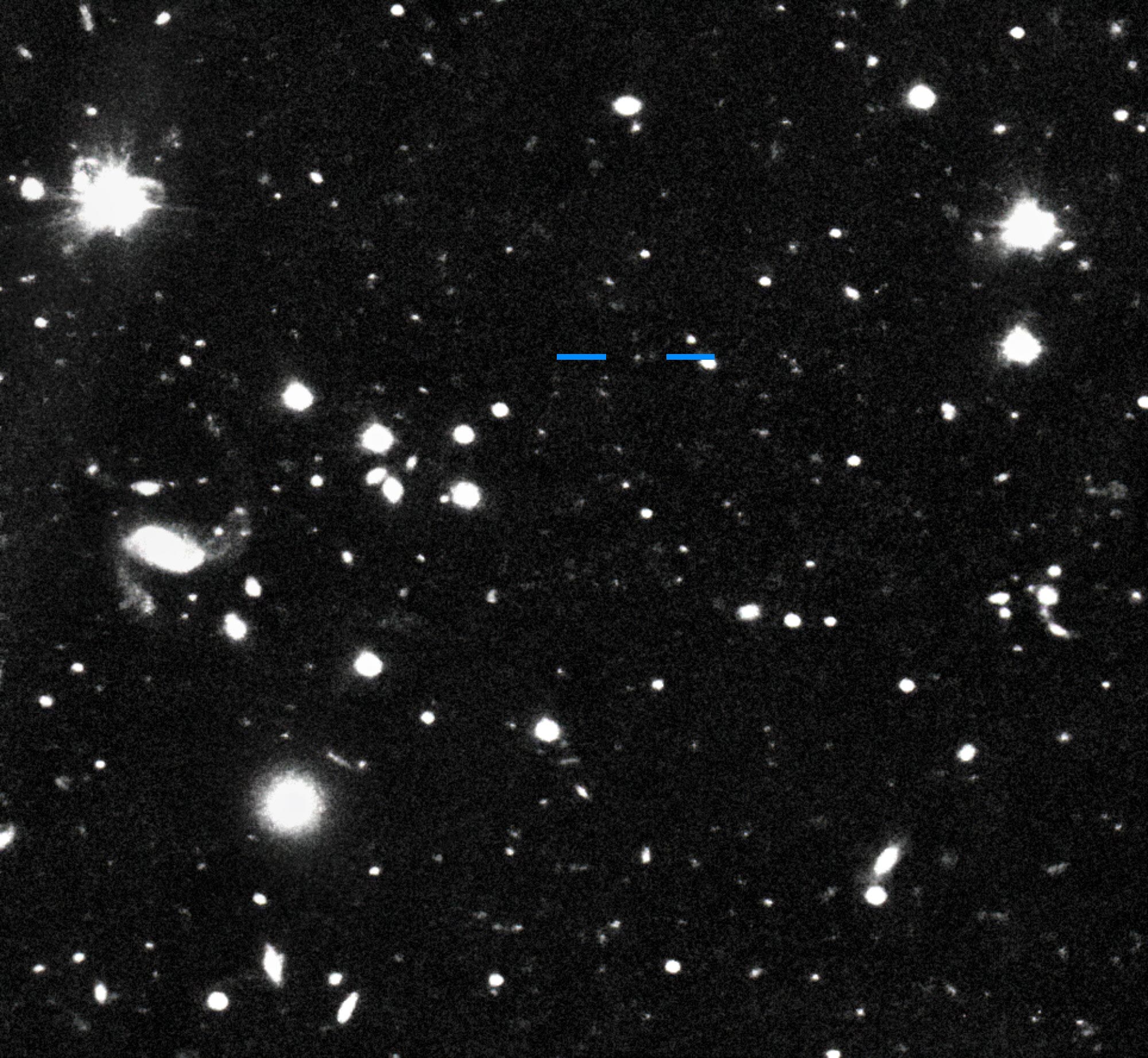
    Farfarout on 16 January 2018
    This discovery image of Farfarout (2018 AG37) was taken with the Subaru Telescope on the night of January 16, 2018, Universal Time (UT). By comparing this image with one taken on the previous night, it is possible to see that Farfarout (marked by blue horizontal lines) moves while the background stars and galaxies do not. Credit: S. Sheppard

    “Farfarout takes a millennium to go around the Sun once,” said Tholen. “Because of this, it moves very slowly across the sky, requiring several years of observations to precisely determine its trajectory.” 

    Farfarout’s discoverers are confident that even more distant objects remain to be discovered on the outskirts of the Solar System, and that its distance record might not stand for long.

    “The discovery of Farfarout shows our increasing ability to map the outer Solar System and observe farther and farther towards the fringes of our Solar System,” said Sheppard. “Only with the advancements in the last few years of large digital cameras on very large telescopes has it been possible to efficiently discover very distant objects like Farfarout. Even though some of these distant objects are quite large — the size of dwarf planets — they are very faint because of their extreme distances from the Sun. Farfarout is just the tip of the iceberg of objects in the very distant Solar System.”

    Notes

    1. The Gemini North observations of Farfarout were done on 1 May and 2 May 2019 Universal Time, using Director’s Discretionary Time.

    Read “Farfarout” – Astronomers Confirm Solar System’s Most Distant Planetoid for more on this research.

    Never miss a breakthrough: Join the SciTechDaily newsletter.
    Follow us on Google and Google News.

    Astronomy Astrophysics AURA Planets
    Share. Facebook Twitter Pinterest LinkedIn Email Reddit

    Related Articles

    Four Tiny Planets Discovered Near Earth, After Century-Long Search

    Scientists Just Found a Hidden Planet That’s Absolutely Massive

    “Marshmallow” World Discovered: Giant Fluffy Planet Orbiting a Cool Red Dwarf Star

    At Least 70 Free-Floating Planets Discovered in a Nearby Region of the Milky Way

    Unlike Anything in Our Solar System: Rocky Exoplanets Are Even Stranger Than We Thought

    “Failed Stars” Caught Speeding: Astronomers Clock the Fastest-Spinning Brown Dwarfs

    Striped or Spotted? Planetary Scientists Solve a Brown Dwarf Mystery

    AB Aur: A Rosetta Stone for Planet Formation

    Astronomers Discover Pair of Lonely Exotic Planet-Like Objects Born Like Stars

    Leave A Reply Cancel Reply

    • Facebook
    • Twitter
    • Pinterest
    • YouTube

    Don't Miss a Discovery

    Subscribe for the Latest in Science & Tech!

    Trending News

    Even Occasional Binge Drinking May Triple Liver Damage Risk

    Liftoff! NASA’s Artemis II Launch Sends Astronauts Around the Moon for First Time in 50 Years

    Scientists Discover New Way To Eliminate “Zombie Cells” Driving Aging

    This New Quantum Theory Could Change Everything We Know About the Big Bang

    This One Vitamin May Help Protect Your Brain From Dementia Years Later

    Stopping Weight-Loss Drugs Like Ozempic Can Quickly Erase Heart Benefits

    A 500-Million-Year-Old Surprise Is Forcing Scientists to Rethink Spider Evolution

    Coffee and Blood Pressure: What You Need To Know Before Your Next Cup

    Follow SciTechDaily
    • Facebook
    • Twitter
    • YouTube
    • Pinterest
    • Newsletter
    • RSS
    SciTech News
    • Biology News
    • Chemistry News
    • Earth News
    • Health News
    • Physics News
    • Science News
    • Space News
    • Technology News
    Recent Posts
    • Atomic Chains Turn Electric Fields into Measurable Quantum Signals
    • 12,000-Year-Old Native American Dice Rewrite the History of Gambling
    • Researchers Break a 150-Year-Old Math Law With a Surprising Donut Discovery
    • Are You Adding Too Much Salt? New Study Identifies Who’s Most at Risk
    • Scientists Finally Crack Decades-Old Mystery Behind Statins’ Painful Side Effects
    Copyright © 1998 - 2026 SciTechDaily. All Rights Reserved.
    • Science News
    • About
    • Contact
    • Editorial Board
    • Privacy Policy
    • Terms of Use

    Type above and press Enter to search. Press Esc to cancel.