
Close Menu
    Facebook X (Twitter) Instagram
    SciTechDaily
    • Biology
    • Chemistry
    • Earth
    • Health
    • Physics
    • Science
    • Space
    • Technology
    Facebook X (Twitter) Pinterest YouTube RSS
    SciTechDaily
    Home»Technology»Fastest High-Precision 3D Printer – Unmatched Speed With Submicrometer Accuracy
    Technology

    Fastest High-Precision 3D Printer – Unmatched Speed With Submicrometer Accuracy

    By Karlsruher Institut für Technologie (KIT)March 6, 2020No Comments3 Mins Read
    Facebook Twitter Pinterest Telegram LinkedIn WhatsApp Email Reddit
    Share
    Facebook Twitter LinkedIn Pinterest Telegram Email Reddit
    3D Printed Metamaterial
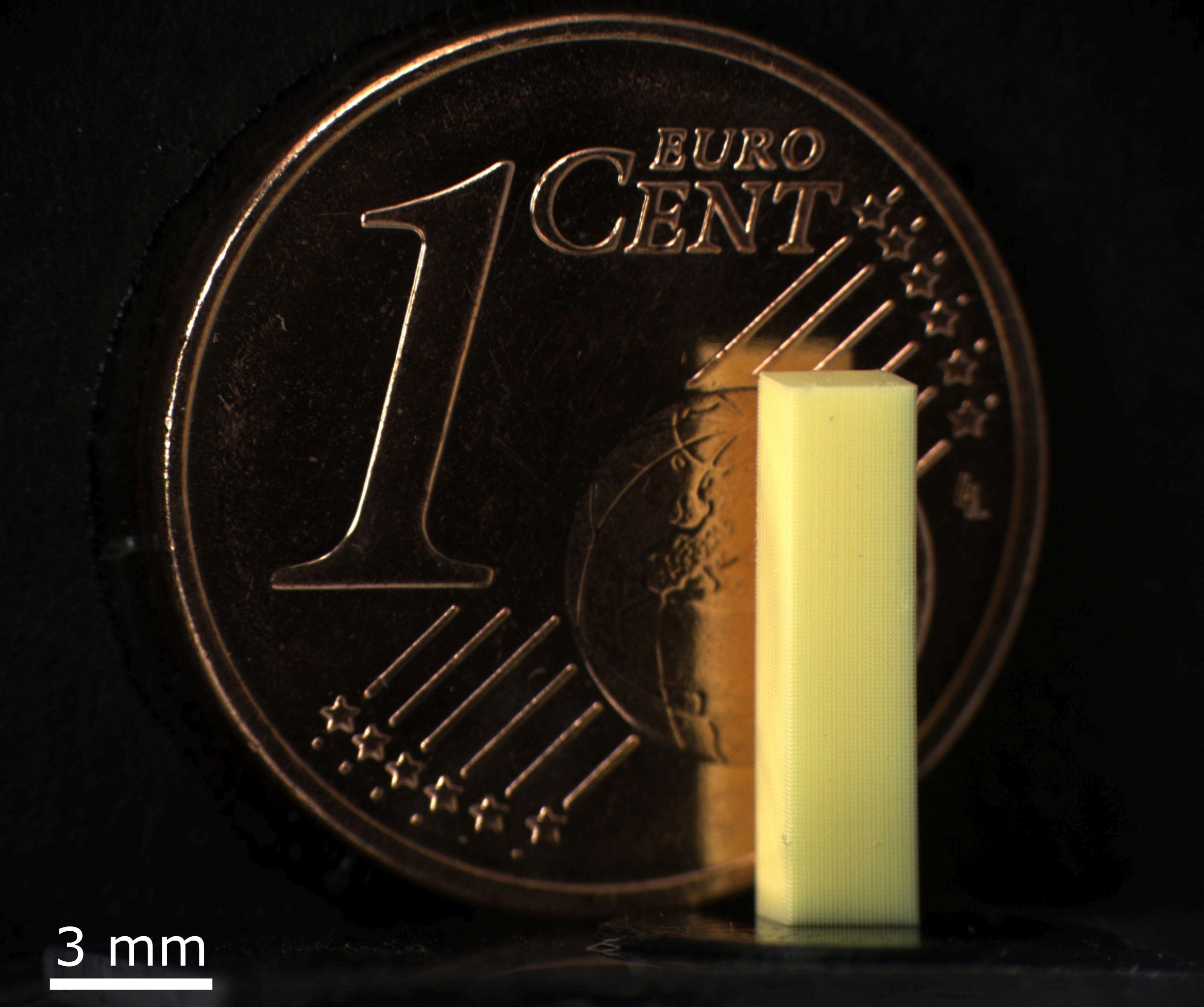
    The metamaterial printed with the new system consists of a complex three-dimensional lattice structure on the micrometer scale. Credit: Vincent Hahn, KIT

    KIT scientists develop new 3D system to print structures of submicrometer accuracy at record speed.

    3D printers working in the millimeter range and larger are increasingly used in industrial production processes. Many applications, however, require precise printing on the micrometer scale at a far higher speed. Researchers of Karlsruhe Institute of Technology (KIT) have now developed a system to print highly precise, centimeter-sized objects with submicrometer details at a so far unmatched speed. This system is presented in a special issue of Advanced Functional Materials.

    To demonstrate not only the speed, but also the reliability of their setup, the researchers have printed a lattice structure of 60 cubic millimeters in size with details down to the micrometer scale. It contains more than 300 billion voxels (a voxel is the 3D counterpart of a pixel or 2D picture element).

    “We have by far outperformed the record reached by 3D-printed aircraft wings. This is a new world record,” says Professor Martin Wegener, Spokesperson of the Cluster of Excellence “3D Matter Made to Order” (3DMM2O), within which the system was developed.

    For this type of 3D printing, the beam of a laser passes a liquid photoresist in a computer-controlled manner. The material located in the focus of the laser only is exposed and hardened.

    “The focal points correspond to the nozzles of an inkjet printer, the only difference being that they work three-dimensionally,” Vincent Hahn, first author of the publication, says. In this way, highly precise filigree structures can be produced for various applications, such as optics and photonics, material sciences, bioengineering, or safety engineering.

    Typically, several hundred thousands of voxels per second have been produced with a single laser light spot so far. This means that it was nearly a hundred times slower than graphical inkjet printers, which impeded many applications so far.

    Scientists of KIT and Queensland University of Technology (QUT) in Brisbane/Australia have now developed a new system within the 3DMM2O Cluster of Excellence. Using special optics, the laser beam is divided into nine partial beams that focus on a focal point each. All nine partial beams can be used in parallel and, thanks to improved electronic control, they can be moved precisely much more rapidly than ever. This and some other technical improvements made the researchers reach 3D printing speeds of about 10 million voxels per second, which corresponds to the speed reached by graphical 2D inkjet printers. KIT will continue research and development work in this area.

    “After all, 3D printers will be used to print not just one page, but thick volumes,” Hahn says. This will also require progress in chemistry. For example, more sensitive photoresists are needed to generate more focal points at the same laser output.

    Reference: “Rapid Assembly of Small Materials Building Blocks (Voxels) into Large Functional 3D Metamaterials” by Vincent Hahn, Pascal Kiefer, Tobias Frenzel, Jingyuan Qu, Eva Blasco, Christopher Barner‐Kowollik and Martin Wegener, 22 January 2020, Advanced Functional Materials.
    DOI: 10.1002/adfm.201907795

    Never miss a breakthrough: Join the SciTechDaily newsletter.
    Follow us on Google and Google News.

    Electrical Engineering Materials Science Popular Printer
    Share. Facebook Twitter Pinterest LinkedIn Email Reddit

    Related Articles

    “Mount Everest” of Electronic Materials: Stretching Diamond for Next-Generation Microelectronics

    Smarter Artificial Intelligence Technology in a New Light-Powered Chip

    Stretchy “Electronic Skin” Promises Cheap and Recyclable Alternative to Wearable Devices

    Two Layers Are Better Than One for Efficient Solar Cells – Affordable, Thin Film Solar Cells With 34% Efficiency

    New Electronic Skin Can React to Pain Like Human Skin – For Better Prosthetics and Smarter Robots

    Engineers Design Ion-Based Device That Operates Like an Energy-Efficient Brain Synapse

    New Recipe for Single-Atom Transistors May Enable Quantum Computers With Unparalleled Memory and Processing Power

    Remarkable New Coating Helps Electronics Stay Cool by “Sweating”

    Chance Discovery Results in New Type of Transistor for High-Power Electronic Devices

    Leave A Reply Cancel Reply

    • Facebook
    • Twitter
    • Pinterest
    • YouTube

    Don't Miss a Discovery

    Subscribe for the Latest in Science & Tech!

    Trending News

    Popular Sugar-Free Sweetener Linked to Liver Disease, Study Warns

    What Is Hantavirus? The Deadly Disease Raising Alarm Worldwide

    Scientists Just Discovered How the Universe Builds Monster Black Holes

    Scientists Unveil New Treatment Strategy That Could Outsmart Cancer

    A Simple Vitamin May Hold the Key to Treating Rare Genetic Diseases

    Scientists Think the Real Fountain of Youth May Be Hiding in Your Gut

    Ravens Don’t Follow Wolves, They Predict Them

    This Common Knee Surgery May Be Doing More Harm Than Good

    Follow SciTechDaily
    • Facebook
    • Twitter
    • YouTube
    • Pinterest
    • Newsletter
    • RSS
    SciTech News
    • Biology News
    • Chemistry News
    • Earth News
    • Health News
    • Physics News
    • Science News
    • Space News
    • Technology News
    Recent Posts
    • Scientists Build a Living AI Device Using Real Brain Cells
    • Why Are So Many New Fathers Dying? Scientists Say the U.S. Has a Dangerous Blind Spot
    • Scientists Identify Simple Supplement That Greatly Reduces Alzheimer’s Damage
    • You May Have a Dangerous Type of Cholesterol Even if Your Tests Look Normal
    • Study Reveals Dangerous Flaw in AI Symptom Checkers
    Copyright © 1998 - 2026 SciTechDaily. All Rights Reserved.
    • Science News
    • About
    • Contact
    • Editorial Board
    • Privacy Policy
    • Terms of Use

    Type above and press Enter to search. Press Esc to cancel.