
Scientists have uncovered a hidden feedback mechanism in Earth’s carbon cycle that could explain past ice ages and reveal how global warming might eventually lead to extreme cooling.
UC Riverside scientists have uncovered a key element missing from earlier explanations of how Earth recycles its carbon. Their findings suggest that global warming could eventually swing in the opposite direction, tipping the planet into an ice age.
For decades, scientists have believed that Earth’s climate is balanced by a slow yet dependable process called rock weathering.
In this process, rain absorbs carbon dioxide from the atmosphere and reacts with exposed rocks on land (especially silicate rocks such as granite), gradually dissolving them. The rainwater then carries the captured CO2 and dissolved minerals into the ocean. There, the carbon combines with calcium to create seashells and limestone reefs, which trap the carbon on the seafloor for millions of years.
“As the planet gets hotter, rocks weather faster and take up more CO2, cooling the planet back down again,” said Andy Ridgwell, UCR geologist and co-author of the paper published in Science.
Yet, geological records reveal that some ancient ice ages were so severe that nearly the entire planet froze over. According to the researchers, such extreme events cannot be explained by a simple, self-regulating system alone.
The missing factor involves the burial of carbon in the ocean. When atmospheric CO2 rises and global temperatures climb, increased rainfall carries more nutrients such as phosphorus into the sea. These nutrients boost the growth of plankton, which absorb carbon dioxide through photosynthesis. After the plankton die, their remains sink to the ocean floor, carrying the carbon with them and altering the planet’s long-term climate balance.
A Runaway Cooling Feedback
However, in a warmer world with more algal activity, oceans lose oxygen, causing phosphorus to get recycled instead of being buried. This creates a feedback loop where more nutrients in the water create more plankton, whose decay removes even more oxygen, and more nutrients get recycled. At the same time, massive amounts of carbon are buried, and the Earth cools.
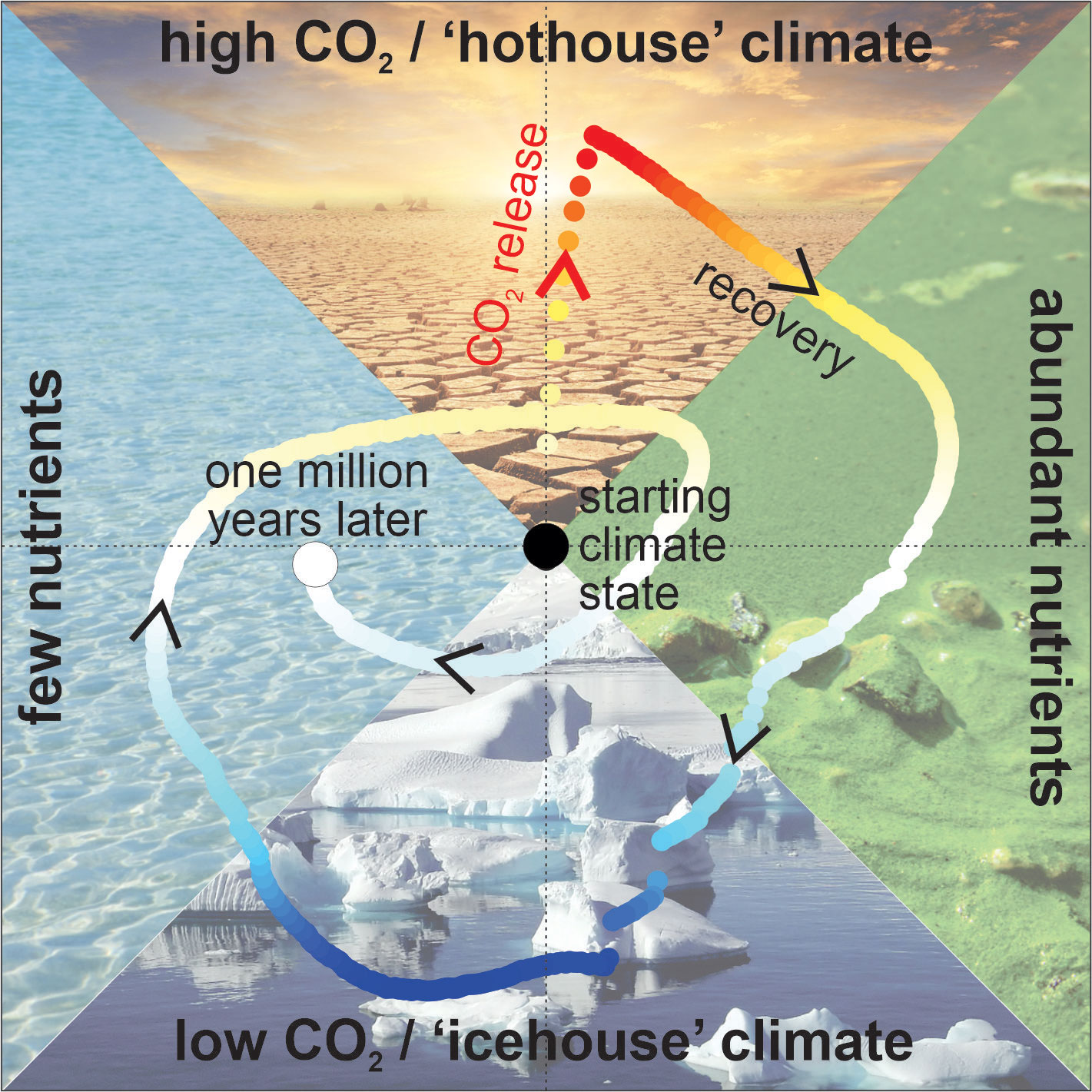
This system doesn’t gently stabilize the climate, but instead overshoots, cooling Earth far below its starting temperature. In the study’s computer model, this could trigger an ice age.
Ridgwell compares all this to a thermostat working overtime to cool a house.
“In summer, you set your thermostat around 78°F. As the air temperature climbs outside during the day, the air conditioning removes the excess heat inside until the room temperature comes down to 78° and then it stops,” Ridgwell said.
When Earth’s Thermostat Overreacts
Using his analogy, Earth’s thermostat isn’t broken, but Ridgwell suggests it might not be in the same room as the air conditioning unit, making performance uneven.
In the study, lower atmospheric oxygen in the geological past made the thermostat much more erratic, hence ancient extreme ice ages.
As humans add more CO2 to the atmosphere today, the planet will continue to warm in the short term. The authors’ model predicts a cooling overshoot will occur. However, the next one will likely be milder because there is more oxygen in the atmosphere now than in the distant past, which dampens the nutrient feedback.
“Like placing the thermostat closer to the AC unit,” Ridgwell added. Still, it could be enough to bring forward the start of the next ice age.
“At the end of the day, does it matter much if the start of the next ice age is 50, 100, or 200 thousand years into the future?” Ridgwell wondered. “We need to focus now on limiting ongoing warming. That the Earth will eventually cool back down, in however wobbly a way, is not going to happen fast enough to help us out in this lifetime.”
Reference: “Instability in the geological regulation of Earth’s climate” by Dominik Hülse and Andy Ridgwell, 25 September 2025, Science.
DOI: 10.1126/science.adh7730
Never miss a breakthrough: Join the SciTechDaily newsletter.
Follow us on Google and Google News.
14 Comments
The fatal flaw is dumb people. You believe the first thing you were told and stopping thinking right there = dumb.
Global worming is a natural process as is cooling. Many weather scientist know this but fear going against the globalist and their peers because they will loose grant money and be ostracized. All this BS is based on computer modeling and even the models are widely disparate. Climate does change and warming/cooling is normal, but when you look at weather trends over the past 100,00 years we are actually in a cooling stage. Do the research and you’ll know. Modeling climate using data from the last 100 or 200 years means nothing add to that, data prior to the last 20 years is not reliable. Do your research. We have ruined mental health GenZ and younger because they say what’s the use? Sea level rise is not as dire as many say and ice in artic is actually increasing – do the research.
This research is fatally flawed because all the model predictions compared with reality show CLEARLY, that CO2 sensitivity is extremely low, meaning CO2 doesn’t impact temperature much at all -despite the claims of globalists who want more and more control of the people.
Back in the 1850s some scientist demonstrated that CO2 is indeed a greenhouse gas as surmised by Frencch scientists in 1824 and 1827.in 1894-1895 the Swedish scientist Arrhenius modelled both global cooling and global warming as a by-product of the CO2 content in the atmosphere. 270ppm CO2 as seemingly nonsensically little concentration enabled the Earth to maintain a decently habitable climate. 450ppm is today’s concentration of CO2 in the atmosphere, a mere 150ppm greater than in during the industrial revolution in the UK. That pathetically small increased amount of CO2 has caused accelerated melting of glaciers in the Himalayas, Andes and other mountain ranges, whatever else it may or may not have done, unless one wants to believe that the match between the massive increase in burning of hydrocarbons, the world’s huge increase in population and the rapid increase in CO2, all in lockstep since since 1945, are mere coincidental random fluctuations.
You are welcome to your beliefs based on the latest conspiracy bruited abroad on the internet.
You are basically saying that any leak discovered in a water tower is evidence of impending failure. However, if that leak is only a drop of water every few days it can probably be safely ignored, or just monitored to see if it increases.
Rates of change are important, which is why numbers are important in understanding natural processes. Arm waving alone, without any numerical predictions, is not good science.
“That pathetically small increased amount of CO2 has CAUSED accelerated melting of glaciers in the Himalayas, Andes and other mountain ranges, …”
That is an assumption based on correlation. I have pointed out previously that correlation rarely establishes causation. Looking at the bigger picture, warming started about 20,000 years ago, not after 1945. You are welcome to your own beliefs, but not just your own facts.
” (especially silicate rocks such as granite)”
No! Especially carbonate rocks like limestones. Even mafic and ultramafic rocks that are rich in calcium end-member plagioclase feldspars can weather faster than a granite or granodiorite.
Furthermore, the authors have made the unstated assumption that all weathering is the same, which it isn’t. Chemical weathering proceeds fastest in warm, wet environments, while alpine climates are dominated by mechanical weathering and erosion, such as with freeze/thaw wedging and glaciation. Therefore, the behavior of chemical weathering, as implied by the authors, will be most effective at the beginning of an orogeny (mountain building) when limestones and marbles on top of a granitic intrusion are first exposed by uplift. During the apex of the mountain building, when the core intrusion is exposed, chemical weathering will become significantly reduced because of the cold mountain air. As the mountain range is reduced in elevation by erosion, chemical weathering will again start to become important, but it will proceed more slowly than the first phase because the feldspars, and especially quartz of granitic rocks, are not as soluble and reactive as marbles and limestones.
The authors’ analysis and conclusion is overly simplistic and conclusions likely invalid because they view Earth as being flat with no change in elevation. Topography even impacts the availability of water. Therefore, the global average temperature is a poor predictor because locally or regionally the temperature, and hence rate of chemical weathering, may vary significantly. Fundamental relationships, such as the rate of chemical weathering versus elevation aren’t even mentioned.
Many geologists are guilty of having a ‘flat Earth’ bias because of how humans inherently view the world. While they would loudly deny that they believe the Earth is flat, they carry an inherited bias that they probably aren’t even aware of, which influences their hypotheses and conclusions. I can’t help but wonder if they are from the generation of geologists for whom reading of T. C. Chamberlain’s ‘Method of Multiple Working Hypotheses’ was not required. There is hope, however, that with time and additional experience, they may come to view the Earth three-dimensionally. Meanwhile, I’m surprised that this was published. In the days when I was teaching, if a student turned in a similar paper it would have received a ‘C’ at best because of the narrow view of geologic processes, to the exclusion of topographic effects and the relative amount of terrestrial weathering, which varies during epochs.
I would suggest that chemical weathering of both mafic and ultramafic rocks occurs relative rapidly because they contain minerals such as olivines, pyroxenes and amphiboles. Some mountain ranges are not cored by granitic intrusions in which occur also calcic plagioclases. There are no doubt a great many geological variations controlling the rate of chemical weathering in rocks, grain-size and prior alteration being just two such. Most geologists I have met think in 3D-time concepts and whether some believe that the Earth is flat doesn’t really matter at the scale of the outcrop. Once one gets into more broad concepts, such as plate tectonics, it helps to understand spherical geometry as the Earth is not a cube with flat sides. Understanding the value of assorted working hypotheses is essential for the geologist as geology is a science where key data may well be unobtainable in the time available to do the job; that is why geophysics, geochronology and cored drill-holes and other sub-disciplinary geological works are essential for discovery of assorted minerals.
You appear to have some acquaintance with geology. Have you EVER read anything by a paleontologist that explicitly describes the evolutionary adaptations of extinct creatures in the context of the elevation of their biological niche? Have you ever read a description of a fossilized dinosaur that might have filled the same ecological niche as as a mountain goat or pika?
To be fair, for a creature or even plant to be fossilized, requires that it be buried. Anything buried in an alpine environment will eventually be destroyed by the erosion of the mountains, and the particles will be moved to lower elevations closer to the sea, or in the sea. It has been my experience that paleontologists who specialize in terrestrial fossils (in contrast to marine fossils) use broad-brush descriptions that work as well for a flat Earth as for a spherical Earth.
Bowen’s Reaction Series provides a guideline for the stability of minerals on the surface. One of the earliest minerals to form from a(n) (ultra)mafic magma, is olivine. Because it crystallized at high temperatures and high pressures it tends to be metastable at surface conditions or low temperatures and low pressures. It is rare to find olivine as a sediment in rivers and streams, even in ultramafic terranes. It usually turns into serpentine. Chromite is more resistant to weathering.
Upshot: In a high carbon world, we should be very careful seeding algae growth in the ocean.
Milutin Milankovitch, a Serbian scientist, figured out ice ages in the early 20th century and you’ll never believe what he found. I can tell you it wasn’t about rocks, rain, CO2, and oceans. It was about the sun. Turns out our orbit goes through cycles. Sometimes it is more elliptical, sometimes it wobbles, sometimes it tilts. These cycles line up with ice core samples and prove his theories as the most reliable explainer of ice ages. Other explainers like asteroids, long solar cycles, and seismic events are present too, but the Milankovitch cycles are the biggies. Drive whatever car you want because you can’t change our orbit.
The carbon cycle is complex and not well understood. What we do know: Significant volcanic eruptions during the early Cretaceous period released large amounts of carbon dioxide, impacting global climate and ecosystems. During periods of high CO2, dinosaurs and other organisms adapted to changing climates. There have been at least five major ice ages in Earth’s history, with the most recent one starting about 2 million years ago and still ongoing in a modified form. There are interglacial warmer periods between ice ages. The current interglacial period, known as the Holocene, began approximately 11,700 years ago, and includes recent warming (Medieval) and cooling (Little Ice Age) periods. The litany at the end of this article follows the standard line of climate change today: rapid changes in carbon levels today pose a threat to current ecosystems, as the rate of change is much faster than in the past. However, the dynamics of the past are mostly disregarded. Here some of that is reprised to conclude we will have another ice age, feedback leading to cooling and not runaway warming. Finally, rock weathering theories are dodgy, many geologists can’t conceive of how rocks (including fossilized dino bone, trees) and minerals form in the first place, let alone complexity of weathering.
“…, as the rate of change is much faster than in the past.”
Which “past?” Do you have a citation that supports your assertion? I doubt it because time tends to act as a low-pass filter, suppressing the peaks and broadening the Full-Width Half-Maximum of spikes. That is, few proxies for something like temperature have a correlation high enough to faithfully reproduce what actually happened and the discrepancy invariably makes past estimates appear lower and wider than what actually happened.