

Dr. Chris Macdonald has developed a free virtual reality platform that helps users become skilled and confident public speakers.
March 15th was World Speech Day, a time to encourage and embrace public speaking. However, for many, this can be a daunting challenge, as speech anxiety and the fear of public speaking are common. Fortunately, a new, free, and highly effective solution is now available.
At Lucy Cavendish College, University of Cambridge, researchers are harnessing digital technology to enhance and accelerate learning. Their Immersive Technology Lab, recognized with a national innovation award for its work in visualizing emissions data through VR, is now applying its expertise to public speaking. They have recently launched a free online platform designed to help users become confident and skilled speakers. The platform offers tailored course materials to develop key skills, along with realistic virtual reality training environments that build confidence through immersive practice.
Lab Director and platform founder, Dr Chris Macdonald, explains, “In physical reality, a user might be practicing a presentation alone in their bedroom but on the new virtual reality platform, they can experience the sensation of presenting to a wide range of increasingly challenging photorealistic audiences.”
Impact at scale
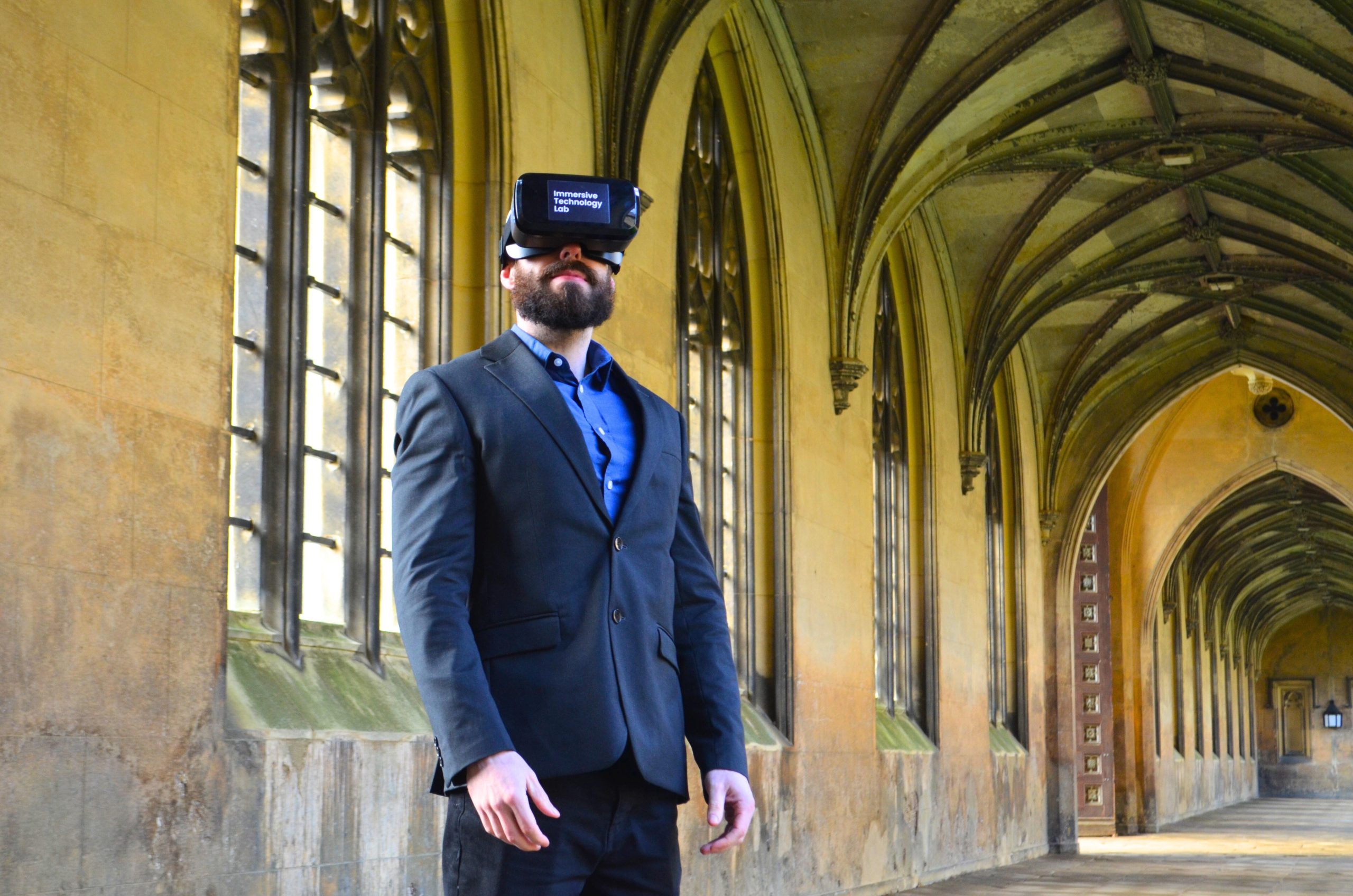
By developing a method that converts smartphones into VR headsets, Dr Macdonald has made sure that the platform is accessible to all. For reference, only 5% of UK households have a VR headset but 99% have smartphones. And while VR headsets can cost thousands, a device mount (pictured below) costs around £15.
A device mount could be thought of as a low-cost ‘conversion kit’ that transforms a user’s smartphone into a functional VR headset. Importantly, the platform has been built in such a way that whether a participant is using the latest standalone VR headset or an old smartphone inserted into a device mount, they will get the same content and the same experience.
Impact at speed
As recently revealed in the academic journal, Frontiers, the platform has been clinically proven to significantly increase levels of confidence for most users after a single 30-minute session. And, in the most recent trial with students from Cambridge and UCL, it was found that a week of self-guided use was beneficial to 100% of participants; the platform helped all users in one or more of the following ways: to feel more prepared, more adaptable, more resilient, more confident, to be better able to manage nerves, and to feel less anxious.
Further findings will be revealed at the upcoming International Conference on Research in Psychology at Oxford.
User-centric design
A user-centric iterative process ensured that the platform would work ‘in the wild’. In between each rebuild thus far, the platform has hosted over 50,000 practice presentations from remote beta users. To further stress test the software and hardware, in-person events were organized, one of which involved over 1000 members of the public using the platform in suboptimal conditions in a demo room in Cambridge. To further expand and deepen the participant pool, the lab went on tour. This included stops at the largest science and technology events such as New Scientist Live as well as less formal settings such as a local market, library, community center, church, and even someone’s living room.
Dr Macdonald says, “I wanted to build something that is not only highly effective but that can and will be used by those who need it the most. As a result, it was essential to gather diverse user feedback from a variety of settings. The lab cannot develop in a silo, it needs to work closely with end users. Through constant public engagement, we can maximize our positive impact and ensure that we remain deeply grounded in public service.”
World firsts
Multiple firsts were achieved to make the platform uniquely accessible and effective.
To increase accessibility, it was essential that the platform worked on both Android and iOS operating systems. To achieve this, a first-of-its-kind, dual-compatible VR player was created. As a result, not only is this the first time that this treatment is available for free worldwide, but it is also the first time it is accessible via multiple devices and multiple operating systems. In short, many firsts were completed to achieve impact at scale.
The efficacy is increased with Overexposure Therapy (the ability to repeatedly practice in extreme scenarios that one is unlikely to encounter in real life, such as hyper-distracting stadiums—a concept Dr Macdonald pioneered). It provides the psychological equivalent of running with weights or at high altitudes; it builds extra adaptability, grit, and resilience.
Dr Macdonald explains, “Prior to a presentation, most students tend to practice on their own, in a highly-controlled environment—normally in their bedrooms to an ‘audience’ of zero. As a result, it will feel like a significant ‘step up’ when they present to even a small group of people—and even a subtle audience gesture can throw them off. By contrast, students who use the VR platform can practice in a different venue every night to a wide range of highly distracting audiences and fear-inducing scenarios. They can, for example, practice in a stadium in front of 10,000 animated spectators, with loud noises, stadium lights, and flashing cameras. Accordingly, a subsequent presentation to a small group can feel like a significant ‘step down’. The data shows that this process not only increases confidence, adaptability, and resilience but also the enjoyment of public speaking. Students are enjoying the challenge of pushing themselves and progressing to each new level. This increased enjoyment is highly encouraging because we know that fear and anxiety are maintained or worsened through avoidance.”
“In addition to the range of presentation-style audiences, the platform also provides more specialized environments and challenges, such as reading a teleprompter in a virtual TV studio or responding to questions in a job or radio interview. To offer additional support in perfecting your scripts, I built and embedded an AI coach. Beyond the main platform, which is now freely available via a dedicated website, I have created licensing plans and an app for healthcare providers. I am also collaborating with organizations that seek to support specific groups such as children who stammer; the goal is to create more targeted treatment options for those who need it the most.”
“Speech anxiety and the fear of public speaking impact most people, and it is becoming increasingly more common over time. This is concerning because we know that it is detrimental to mental health, physical health, academic attainment, and career progression. Therefore, the problem is prevalent, it is getting worse, it is causing harm, and ultimately, it is capping human potential. However, this no longer needs to be the case. If you or anyone you know would like to become a skilled and confident public speaker, there is now an effective and accessible solution—please do make use of it.”
“It is very promising to see how effective the platform is given that we already know ways to make it even more effective. However, to continue its development, expand it long-term, and launch additional features and platforms, we need funding. Therefore, I encourage philanthropists and sponsors to reach out. We are data-driven and uniquely committed to impact at scale. With the right funding, together, we could transform millions of lives.”
“The platform has immense potential to empower individuals to overcome their fear of public speaking, ultimately enhancing not only their quality of life but also their capacity to become a driving force of positive change in the world.”
“I set out with a simple but ambitious mission: make the most effective treatment for the most common fear and make it freely accessible to all. Today, with the launch of the free platform, I believe I have achieved that. Please do use it. It will transform your life and greatly expand your opportunities.”
User feedback
“When practicing my presentations, I sometimes find it difficult to visualize the people I’m speaking to, but this platform gave me the opportunity to see the crowd and get comfortable speaking in front of them.” -Toluwalase Agoro, Cambridge University Student
“I usually practice talks alone in my room which makes it very difficult to imagine my audience so I found using the VR headset was very useful … it made the practice much more effective.” -Rowena Davies, Cambridge University Student
“The Platform was very user-friendly and surprisingly easy to experience with just a smartphone. What stands out about this technology is definitely the great accessibility.” -Andrea Rogolino, Cambridge University Student
[The Virtual Reality Public Speaking Platform was embedded into Lucy Cavendish College’s Future Global Leaders program]
“The Future Global Leaders Programme helped me identify the kind of Leader I am and gave me knowledge in how other SDG goals actually contribute to my SDG of interest. What stood out to me was the public speaking practice using VR training environments! I used this method to practice for my presentation, and received positive feedback about my public speaking skills from one of the guest speakers,” said Tadala Mzengo, Future Global Leaders participant.
Never miss a breakthrough: Join the SciTechDaily newsletter.
Follow us on Google and Google News.