
Additional evidence of an unknown particle from a Hungarian lab gives a new impetus to NA64 searches.
Fresh evidence of an unknown particle that could carry a fifth force of nature gives the NA64 collaboration at CERN a new incentive to continue searches.
In 2015, a team of scientists spotted an unexpected glitch, or “anomaly,” in a nuclear transition that could be explained by the production of an unknown particle. About a year later, theorists suggested that the new particle could be evidence of a new fundamental force of nature, in addition to electromagnetism, gravity and the strong and weak forces. The findings caught worldwide attention and prompted, among other studies, a direct search for the particle by the NA64 collaboration at CERN.
A new paper (pdf) from the same team, led by Attila Krasznahorkay at the Atomki institute in Hungary, now reports another anomaly, in a similar nuclear transition, that could also be explained by the same hypothetical particle.
The first anomaly spotted by Krasznahorkay’s team was seen in a transition of beryllium-8 nuclei. This transition emits a high-energy virtual photon that transforms into an electron and its antimatter counterpart, a positron. Examining the number of electron–positron pairs at different angles of separation, the researchers found an unexpected surplus of pairs at a separation angle of about 140º. In contrast, theory predicts that the number of pairs decreases with increasing separation angle, with no excess at a particular angle. Krasznahorkay and colleagues reasoned that the excess could be interpreted by the production of a new particle with a mass of about 17 million electronvolts (MeV), the “X17” particle, which would transform into an electron–positron pair.
The latest anomaly reported by Krasznahorkay’s team, in a paper (pdf) that has yet to be peer-reviewed, is also in the form of an excess of electron–positron pairs, but this time the excess is from a transition of helium-4 nuclei. “In this case, the excess occurs at an angle 115º but it can also be interpreted by the production of a particle with a mass of about 17 MeV,” explained Krasznahorkay. “The result lends support to our previous result and the possible existence of a new elementary particle,” he adds.
Sergei Gninenko, spokesperson for the NA64 collaboration at CERN, which has not found signs of X17 in its direct search, says: “The Atomki anomalies could be due to an experimental effect, a nuclear physics effect or something completely new such as a new particle. To test the hypothesis that they are caused by a new particle, both a detailed theoretical analysis of the compatibility between the beryllium-8 and the helium-4 results as well as independent experimental confirmation is crucial.”
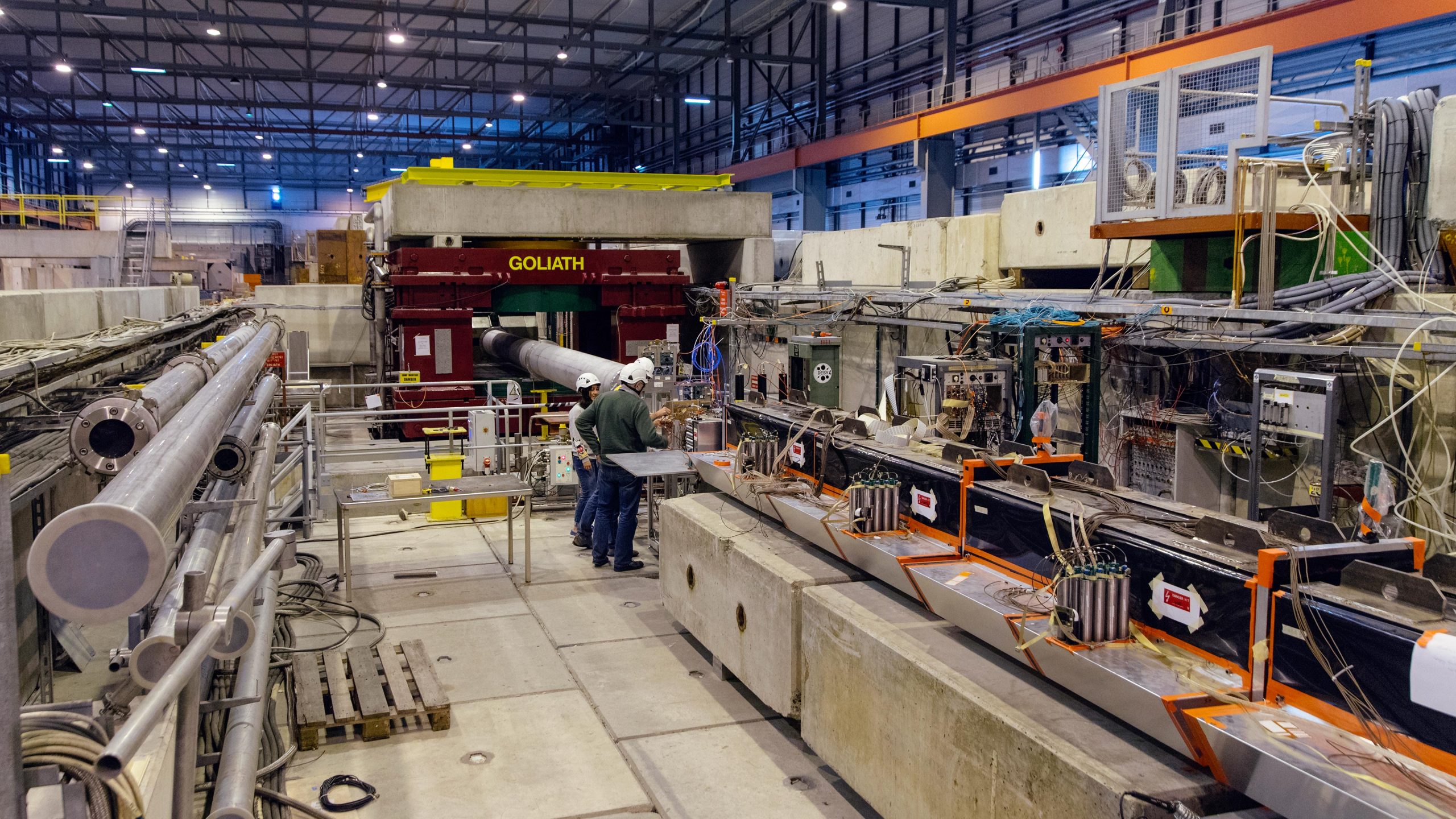
The NA64 collaboration searches for X17 by firing a beam of tens of billions of electrons from the Super Proton Synchrotron accelerator onto a fixed target. If X17 did exist, the interactions between the electrons and nuclei in the target would sometimes produce this particle, which would then transform into an electron–positron pair. The collaboration has so far found no indication that such events took place, but its datasets allowed them to exclude part of the possible values for the strength of the interaction between X17 and an electron. The team is now upgrading their detector for the next round of searches, which are expected to be more challenging but at the same time more exciting, says Gninenko.
Among other experiments that could also hunt for X17 in direct searches is the LHCb experiment. Jesse Thaler, a theoretical physicist from the Massachusetts Institute of Technology, says: “By 2023, the LHCb experiment should be able to make a definitive measurement to confirm or refute the interpretation of the Atomki anomalies as arising from a new fundamental force. In the meantime, experiments such as NA64 can continue to chip away at the possible values for the hypothetical particle’s properties, and every new analysis brings with it the possibility (however remote) of discovery.”
Never miss a breakthrough: Join the SciTechDaily newsletter.
Follow us on Google and Google News.