

Findings may fill gap for climate change, atmospheric research beyond tropical regions.
According to a new study by scientists at Pacific Northwest National Laboratory (PNNL), plant-foliage-derived gases generate a previously unknown atmospheric phenomenon over the Amazon rainforest. The discovery has significant implications for atmospheric science and climate change modeling.
“The tropical Amazon rainforest constitutes the lungs of the Earth, and this study connects natural processes in the forest to aerosols, clouds, and the Earth’s radiative balance in ways that have not been previously recognized,” said Manish Shrivastava, PNNL Earth scientist and primary investigator of the study.
The research was recently published in the journal ACS Earth and Space Chemistry.
Filling the Missing Data Gap
Shrivastava and his colleagues were researching fine particles in the upper atmosphere when they observed a significant difference between their results and what would have been expected based on estimates from existing atmospheric models. Further investigation revealed that key forest–atmosphere interactions were missing from current atmospheric models that govern the number of fine particles in the upper atmosphere.
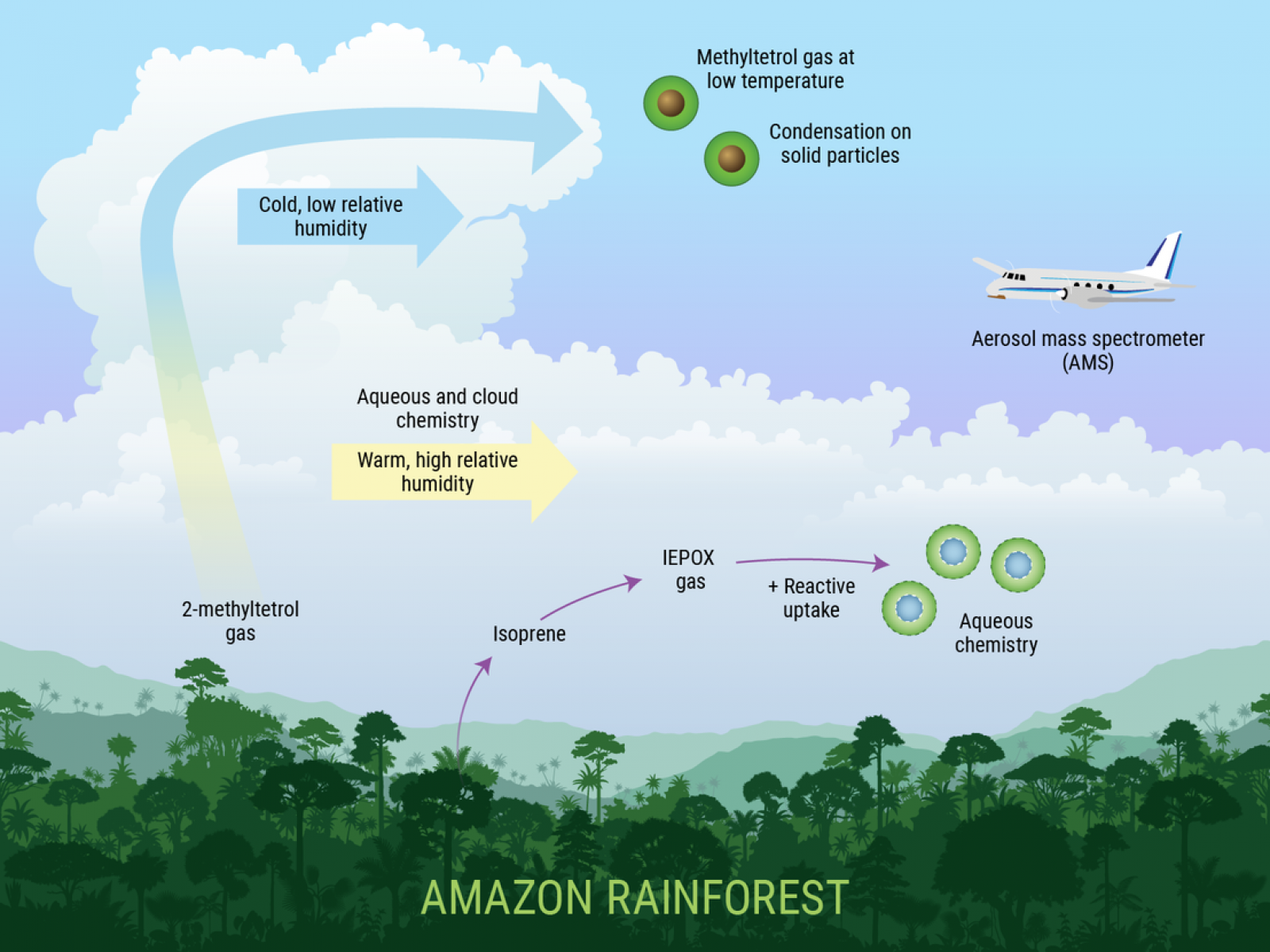
The researchers discovered a previously unrecognized process involving semi-volatile gases produced by plants in the Amazon rainforest and carried into the upper atmosphere by clouds. These gases are natural carbon-based chemical compounds that condense readily in the high atmosphere to create fine particles. Shrivastava states that this method is particularly efficient at producing fine particles at high elevations and low temperatures. These fine particles chill the earth by lowering the amount of sunlight that reaches it. They also produce clouds, which influence precipitation and the water cycle.
“Without a full understanding of the semi-volatile source of organic gases, we simply cannot explain the presence and role of key particle components at high altitudes,” Shrivastava said.
Crucial Discovery in Atmospheric Processes
Shrivastava’s research project, funded through a Department of Energy (DOE) Early Career Research Award, involved investigating the formation of aerosol particles known as isoprene epoxydiol secondary organic aerosols (IEPOX-SOAs), which are measured by aircraft flying at different altitudes.
IEPOX-SOAs are essential building blocks for fine particles found at all altitudes of the troposphere—the region of the atmosphere extending from the Earth’s surface to approximately 20 kilometers (12 miles) in altitude above tropical regions. However, atmospheric models did not sufficiently account for these particles and their influence on clouds high above the Earth.
“As models wouldn’t predict the observed IEPOX-SOA loadings at 10-to-14-kilometer (6-to-9 kilometers) altitudes in the Amazon, we were getting what I believed to be either model failures or a lack of understanding of the measurements,” Shrivastava said. “I could explain it at the surface but couldn’t explain it at higher altitudes.”

Before the team’s research, it was believed that IEPOX-SOAs were formed primarily by multiphase atmospheric chemistry pathways involving reactions of isoprene in the gas phase and particles containing liquid water. However, the atmospheric chemistry pathways required to create IEPOX-SOAs do not occur in the upper troposphere because of its extremely cold temperatures and dry conditions. At that altitude, the particles and clouds are frozen and lack liquid water. Researchers therefore could not explain their formation observed at 10 to 14 kilometers in altitude using available models.
To unravel the mystery, the researchers combined specialized high-altitude aircraft measurements and detailed regional model simulations conducted using supercomputing resources at the Environmental Molecular Sciences Laboratory at PNNL. Their study revealed the undiscovered component of atmospheric processes. A semi-volatile gas known as 2-methyltetrol is transported by cloud updrafts into the cold upper troposphere. The gas then condenses to form particles that are detected as IEPOX-SOAs by the aircraft.
“This is certainly an important discovery because it aids in our understanding of how these fine particles are formed, and therefore shines a new light on how natural processes in the forest cool the planet and contribute to clouds and precipitation,” Shrivastava said. “Along with a changing global climate and rapid deforestation in many parts of the Amazon, humans are perturbing the key natural processes that make fine particles in the atmosphere and modulate global warming.”
Opening Doors to Further Atmospheric Research
The team’s finding only scratches the surface, Shrivastava said, in learning about this newfound atmospheric process and how it affects the formation of fine particles in the atmosphere. He said the newly identified process from plants could explain a broad array of atmospheric particle phenomena over other forested locations across the world.
“In the grand scheme, this is just the beginning of what we know and will open new frontiers of research in land–atmosphere–aerosol–cloud interactions,” he said. “Understanding how the forest produces these particles could help us understand how deforestation and changing climate will affect global warming and the water cycle.”
Reference: “Tight Coupling of Surface and In-Plant Biochemistry and Convection Governs Key Fine Particulate Components over the Amazon Rainforest” by Manish Shrivastava, Quazi Z. Rasool, Bin Zhao, Mega Octaviani, Rahul A. Zaveri, Alla Zelenyuk, Brian Gaudet, Ying Liu, John E. Shilling, Johannes Schneider, Christiane Schulz, Martin Zöger, Scot T. Martin, Jianhuai Ye, Alex Guenther, Rodrigo F. Souza, Manfred Wendisch and Ulrich Pöschl, 12 January 2022, ACS Earth and Space Chemistry.
DOI: 10.1021/acsearthspacechem.1c00356
The research was supported by Shrivastava’s DOE Early Career award and DOE’s Atmospheric System Research, both of the Office of Science Biological and Environmental Research program. Support for data collection onboard the G-1 aircraft was provided by ARM, a DOE Office of Science user facility. Computational resources for the simulations were provided by EMSL, also a DOE Office of Science user facility.
Never miss a breakthrough: Join the SciTechDaily newsletter.
Follow us on Google and Google News.
1 Comment
How is it that in a “settled science,” terpenes have been overlooked in climate models when it has been known for decades that the Great Smokey Mountains (NP) in Tennessee are the result of terpenes released by the forest? This appears to be a serious oversight.
https://en.wikipedia.org/wiki/Terpene