
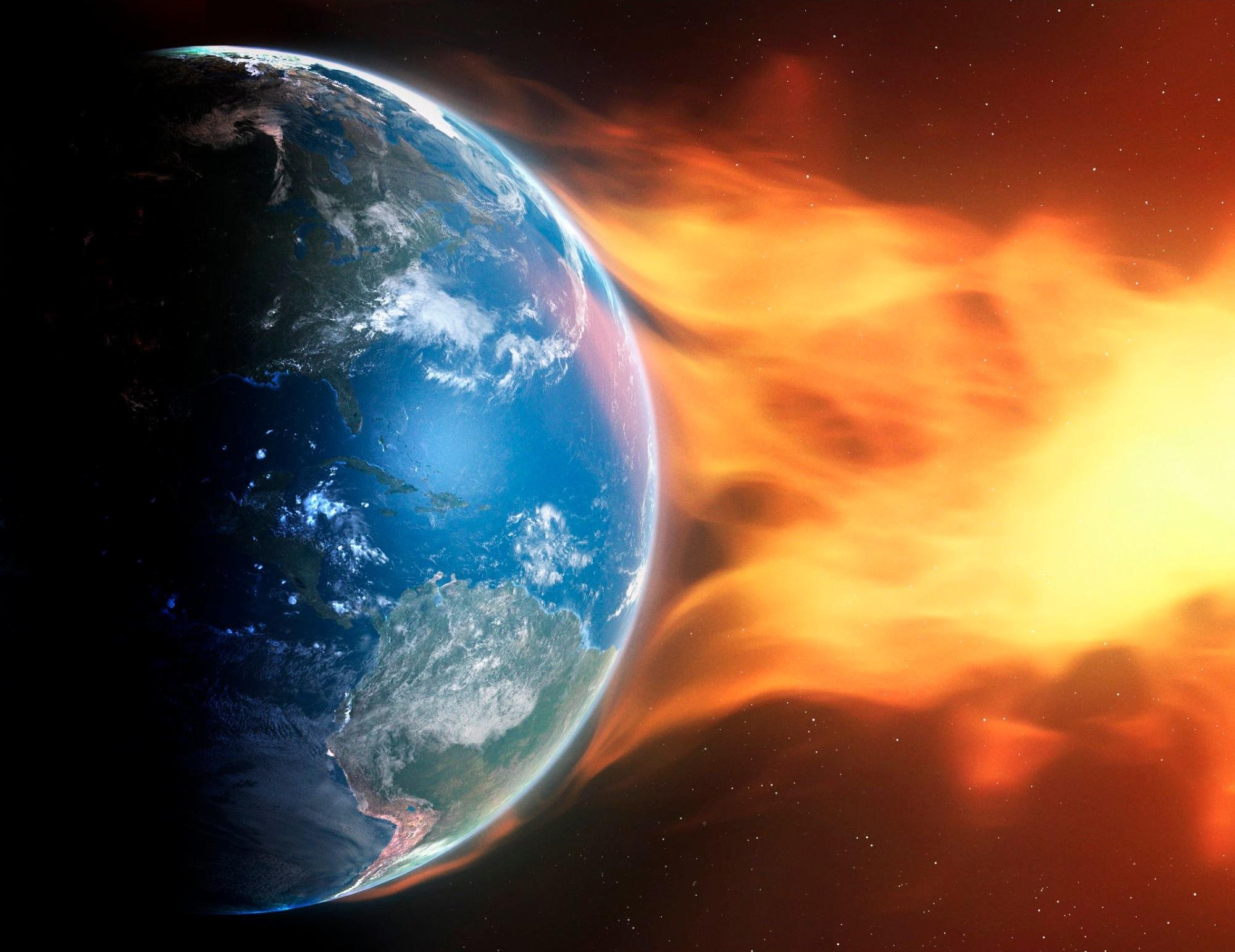
Space radiation poses a significant challenge to humanity’s ambitions in space exploration, particularly in missions to the Moon and Mars. This radiation, primarily from solar energetic particles (SEPs) produced by solar flares, can significantly elevate radiation levels, posing a health risk to astronauts.
Additionally, intense SEP events can trigger ground-level enhancements (GLEs), further raising radiation levels on the surfaces of celestial bodies.
Research on Space Radiation Effects
A research team led by Prof. Guo Jingnan of the University of Science and Technology of China (USTC) of the Chinese Academy of Sciences (CAS), collaborated with researchers from Germany, Bulgaria, and the United States focused on analyzing a SEP event that occurred on October 28, 2021, whose energy was sufficient to cause a GLE event on Earth’s surface.
Additionally, the Chang’e 4 lunar mission on the lunar surface and the Curiosity rover on the Martian surface both detected this high-energy particle event.
This is the first GLE event detected on the surfaces of three planetary bodies. By combining measurement and modeling approaches, the team studied the potential radiation risks posed by SEPs that future humans may face on the Moon and Mars. The results were recently published in the journal Geophysical Research Letter.
Earth’s Protection from SEPs
Earth’s magnetic field and atmosphere provide protection against space-charged particles with lower energy. The GLE the team studied, known as GLE73, is the most recent GLE event that people have ever detected. And although Earth’s shielding mitigates the risks, the Moon and Mars lack similar protection.
The Moon lacks a global magnetic field and atmosphere, making it vulnerable to SEP particles. China’s Chang’e-4 lunar mission and NASA’s Lunar Reconnaissance Orbiter (LRO) observed the GLE73 event, but the radiation doses measured were within safe limits.
However, simulations suggest that without adequate shielding, future lunar missions could face radiation risks during approximately one out of every five SEP events, which will further pose a serious threat to the lives of astronauts.
Radiation Challenges on Mars
Mars, positioned between the Moon and Earth, lacks a global magnetic field but possesses a thin atmosphere that can absorb high-energy particles. The recent GLE73 event, observed by instruments on the ESA ExoMars TGO and NASA’s MSL, showed that radiation levels in Mars orbit were approximately 30 times higher than on the Martian surface.
This indicates the Martian atmosphere’s strong absorption of radiation induced by SEPs. However, it provides limited shielding against background galactic cosmic rays (GCR). Simulations reveal that past GLE events on the Martian surface remained below the acute radiation syndrome (ARS) threshold.
Nevertheless, extreme SEP events during the journey to Mars or in Martian orbit pose a significant radiation risk for future deep space missions.
In conclusion, when the solar high-energy particles reach the Earth, the moon, and Mars, their fates and radiation effects are not the same. The recent detection of a SEP event on the lunar and Martian surfaces highlights the need to address these challenges. Therefore, further research and effective shielding measures are crucial for astronaut safety.
Reference: “The First Ground Level Enhancement Seen on Three Planetary Surfaces: Earth, Moon, and Mars” by Jingnan Guo, Xiaolei Li, Jian Zhang, Mikhail I. Dobynde, Yuming Wang, Zigong Xu, Thomas Berger, Jordanka Semkova, Robert F. Wimmer-Schweingruber, Donald M. Hassler, Cary Zeitlin, Bent Ehresmann, Daniel Matthiä and Bin Zhuang, 2 August 2023, Geophysical Research Letters.
DOI: 10.1029/2023GL103069
Never miss a breakthrough: Join the SciTechDaily newsletter.
Follow us on Google and Google News.
1 Comment
“Mars, positioned between the Moon and Earth,”
Since when?
Are humans involved in any part of the process used to create these articles?