
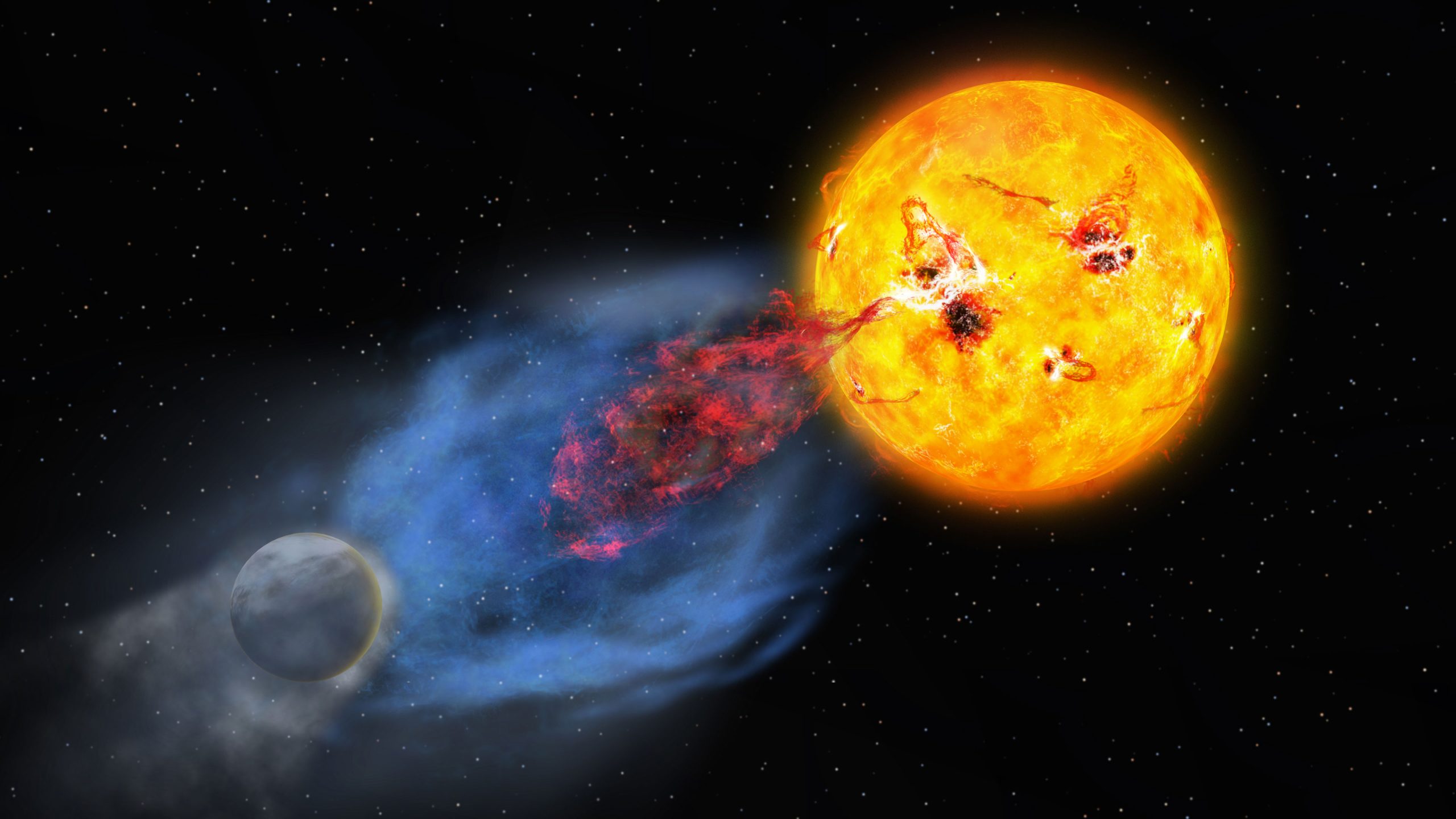
Plasma ejections from young stars may offer valuable insights into the Sun’s early history.
Most of the time, we hardly notice it from Earth, but the Sun is constantly hurling vast clouds of charged plasma into space. These eruptions, known as coronal mass ejections (CMEs), often accompany sudden bursts of light called solar flares. When these energetic events reach far enough to interact with Earth’s magnetic field, they can create space weather, producing dazzling auroras, triggering geomagnetic storms, and in rare cases, disrupting power grids.
Scientists think that billions of years ago, when both the Sun and Earth were young, this solar activity was far more intense. The early Sun may have unleashed CMEs so powerful that they influenced how life first appeared and evolved on our planet. Studies of young, Sun-like stars, which serve as stand-ins for our own star’s early days, show that they frequently generate flares far stronger than any recorded in modern times.
Massive CMEs from the youthful Sun could have dramatically altered the early atmospheres of Earth, Mars, and Venus. Yet researchers are still trying to determine how closely these stellar eruptions resemble the CMEs we see today. In recent years, scientists have managed to detect the cool plasma component of CMEs through ground-based optical telescopes. Even so, capturing the high-speed, energetic CMEs thought to have been common in the early solar system has proven challenging.
Searching for Stellar Explosions
In order to resolve this problem, an international team of researchers, including Kosuke Namekata of Kyoto University, sought to test whether young Sun-like stars produce solar-like CMEs.
“What inspired us most was the long-standing mystery of how the young Sun’s violent activity influenced the nascent Earth,” says Namekata. “By combining space- and ground-based facilities across Japan, Korea, and the United States, we were able to reconstruct what may have happened billions of years ago in our own solar system.”
The team’s analysis included simultaneous ultraviolet observations by the Hubble Space Telescope and optical observations by ground-based telescopes in Japan and Korea. Their target was the young solar analog EK Draconis. Hubble observed far-ultraviolet emission lines sensitive to hot plasma, while the three ground-based telescopes simultaneously observed the hydrogen Hα line, which traces cooler gases. These simultaneous, multi-wavelength spectroscopic observations allowed the research team to capture both the hot and cool components of the ejection in real time.
First Detection of a Multi-Temperature CME
These observations led to the first evidence of a multi-temperature coronal mass ejection from EK Draconis. The team found that hot plasma of 100,000 degrees Kelvin was ejected at 300 to 550 kilometers per second, followed about ten minutes later by a cooler gas of about 10,000 degrees ejected at 70 kilometers per second. The hot plasma carried much greater energy than cool plasma, suggesting that frequent strong CMEs in the past could drive strong shocks and energetic particles capable of eroding or chemically altering early planetary atmospheres.
Theoretical and experimental studies support the critical role that strong CMEs and energetic particles can play in initiating biomolecules and greenhouse gases, which are essential for the emergence and maintenance of life on an early planet. Therefore, this discovery has major implications for understanding planetary habitability and the conditions under which life emerged on Earth, and possibly elsewhere.
The research team noted that the success of this study was achieved through international teamwork and precise coordination between space- and ground-based observatories.
“We were happy to see that, although our countries differ, we share the same goal of seeking truth through science,” says Namekata.
Reference: “Discovery of multi-temperature coronal mass ejection signatures from a young solar analogue” by Kosuke Namekata, Kevin France, Jongchul Chae, Vladimir S. Airapetian, Adam Kowalski, Yuta Notsu, Peter R. Young, Satoshi Honda, Soosang Kang, Juhyung Kang, Kyeore Lee, Hiroyuki Maehara, Kyoung-Sun Lee, Cole Tamburri, Tomohito Ohshima, Masaki Takayama and Kazunari Shibata, 27 October 2025, Nature Astronomy.
DOI: 10.1038/s41550-025-02691-8
Funding: Japan Society for the Promotion of Science, National Aeronautics and Space Administration, National Institute of Natural Sciences
Never miss a breakthrough: Join the SciTechDaily newsletter.
Follow us on Google and Google News.