
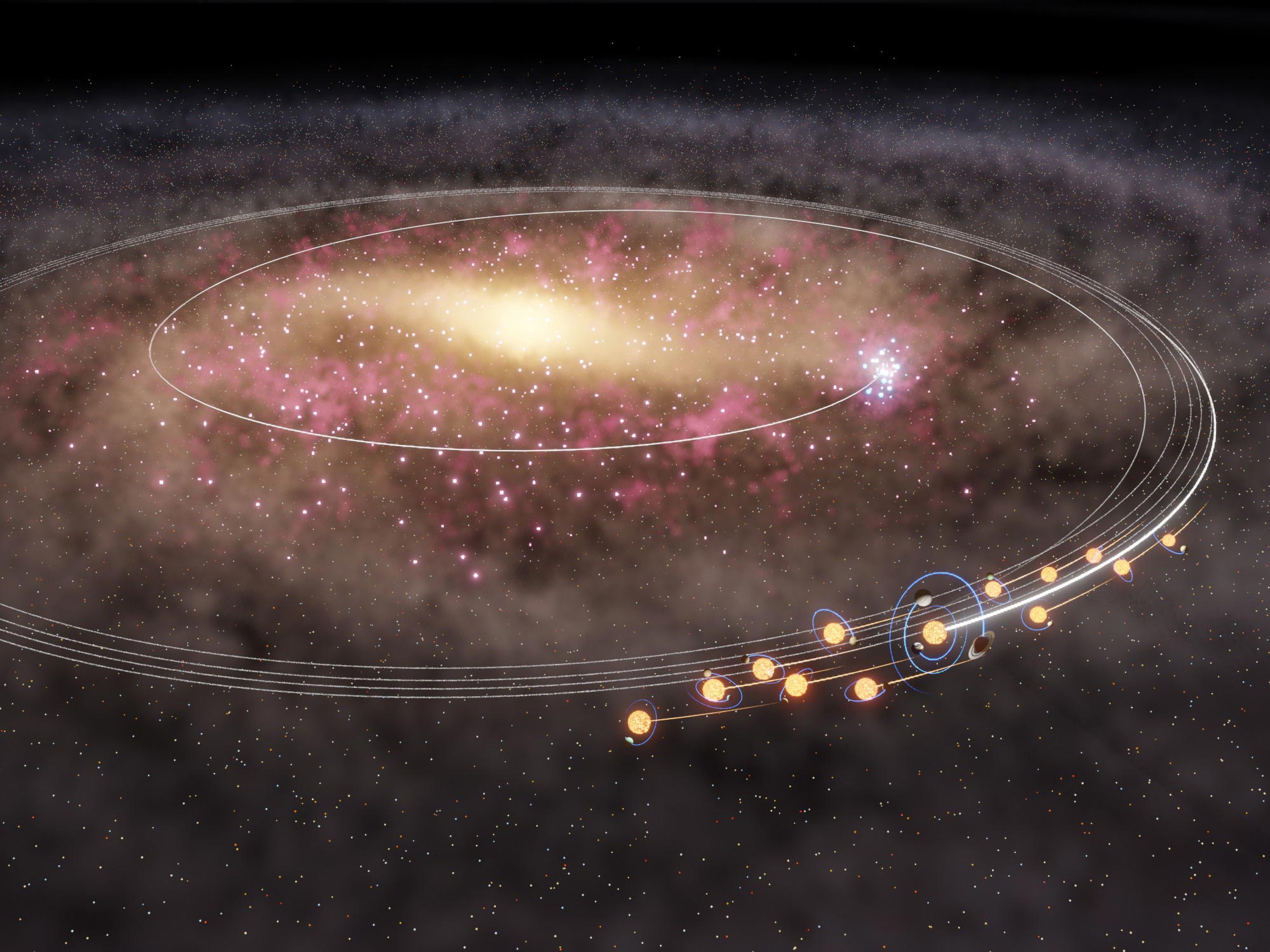
New research suggests our Sun was part of a huge migration of Sun-like stars that moved away from the Milky Way’s center billions of years ago.
Scientists have found new evidence that our Sun may have been part of a large-scale movement of similar stars that left the inner regions of the Milky Way about 4 to 6 billion years ago. Using data from the European Space Agency’s Gaia satellite, researchers built and analyzed an exceptionally detailed catalog of stars and their characteristics. Their results provide important clues about how our galaxy evolved, especially the formation of the rotating bar-shaped structure at its center.
Galactic Archaeology and the Sun’s Birthplace
On Earth, archaeology examines the past through artifacts and ruins. In space, a similar approach called galactic archaeology investigates the history of stars and galaxies. Scientists already know that the Sun formed around 4.6 billion years ago at a location more than 10,000 light-years closer to the center of the Milky Way than its current position.
The chemical composition of stars supports this idea, but it has puzzled astronomers for years. Observations of the Milky Way reveal a huge bar-like structure at the galactic center. This feature creates what scientists call a “corotation barrier,” a gravitational effect that makes it difficult for stars to travel far away from the central region.
A Massive Study of Solar Twins Using Gaia Data
To understand how the Sun could have reached its current location, a research team led by Assistant Professors Daisuke Taniguchi from Tokyo Metropolitan University and Takuji Tsujimoto from the National Astronomical Observatory of Japan conducted an unusually large investigation of solar “twins.” These stars closely resemble the Sun in temperature, surface gravity, and chemical composition.
The team relied on observations from the Gaia satellite mission, which has mapped roughly two billion stars and other celestial objects. From this enormous dataset, the researchers assembled a catalog of 6,594 solar twins. This sample is about 30 times larger than those used in earlier studies.
Solar Twin Ages Reveal a Shared Migration
With this expanded catalog, the scientists were able to determine the ages of these stars with greater precision than before. They also accounted for selection bias caused by brighter and easier-to-detect stars being overrepresented in observations.
When the team examined the age distribution, they found a noticeable concentration of stars between 4 and 6 billion years old. The Sun falls within this same age range, and many of these stars appear to occupy similar distances from the galactic center. This pattern suggests that the Sun did not arrive at its current position by chance. Instead, it likely moved outward as part of a much larger migration of similar stars.
Clues About the Milky Way’s Central Bar
The discovery also offers insight into the Milky Way’s development. Under normal conditions, the corotation barrier created by the galaxy’s central bar would prevent such a large-scale movement of stars away from the inner regions. However, the situation would have been different if the bar structure was still forming at that time.
The ages of the solar twins indicate not only when this migration likely occurred but also the period during which the central bar took shape. In other words, the outward movement of these stars may have happened while the galaxy’s structure was still evolving.
Why the Sun’s Migration May Have Mattered for Life
The inner regions of the Milky Way are far harsher environments than the outer parts of the galaxy. Radiation levels are higher and stellar interactions occur more frequently near the galactic center. The team’s findings suggest that the Sun’s journey away from this crowded region may have helped place our solar system in a more stable location.
This quieter part of the galaxy provided conditions where life on Earth could eventually develop and evolve.
References:
“Solar twins in Gaia DR3 GSP-Spec – I. Building a large catalog of solar twins with ages” by Daisuke Taniguchi, Patrick de Laverny, Alejandra Recio-Blanco, Takuji Tsujimoto and Pedro A. Palicio, 12 March 2026, Astronomy & Astrophysics.
DOI: 10.1051/0004-6361/202658913
“Solar twins in Gaia DR3 GSP-Spec – II. Age distribution and its implications for the Sun’s migration” by Takuji Tsujimoto, Daisuke Taniguchi, Alejandra Recio-Blanco, Pedro A. Palicio and Patrick de Laverny, 12 March 2026, Astronomy & Astrophysics.
DOI: 10.1051/0004-6361/202658914
This release brings together key findings from both studies to provide a comprehensive overview of the research outcomes.
This work made use of data products from the European Space Agency (ESA) space mission Gaia and the Two Micron All Sky Survey. It was supported by the Tokyo Center For Excellence Project, Tokyo Metropolitan University, JSPS KAKENHI Grant Numbers 23KJ2149 and 23H00132, the European Union’s Horizon 2020 Research and Innovation Program under SPACE-H2020 Grant Agreement Number 101004214 (EXPLORE project).
Never miss a breakthrough: Join the SciTechDaily newsletter.
Follow us on Google and Google News.
5 Comments
BUT, how can you say SOL was born in the Milky Way if it is CANNIBALISTIC…
We were placed in a fine-tuned place by God. We are God’s terranium.
Perhaps some advanced alien race wanted to move these stars to safer positions so that they could use them in the future.
Maybe we should keep a look out.
i love this website
i love this website it is not as good as it could be you should make it less confusing