
Close Menu
    Facebook X (Twitter) Instagram
    SciTechDaily
    • Biology
    • Chemistry
    • Earth
    • Health
    • Physics
    • Science
    • Space
    • Technology
    Facebook X (Twitter) Pinterest YouTube RSS
    SciTechDaily
    Home»Science»First-of-Its Kind Seismic Study Challenges Concepts of Geology
    Science

    First-of-Its Kind Seismic Study Challenges Concepts of Geology

    By Todd B. Bates, Rutgers UniversityNovember 30, 2017No Comments4 Mins Read
    Facebook Twitter Pinterest Telegram LinkedIn WhatsApp Email Reddit
    Share
    Facebook Twitter LinkedIn Pinterest Telegram Email Reddit
    Geologists Reveal Warm Rock Rising Beneath New England
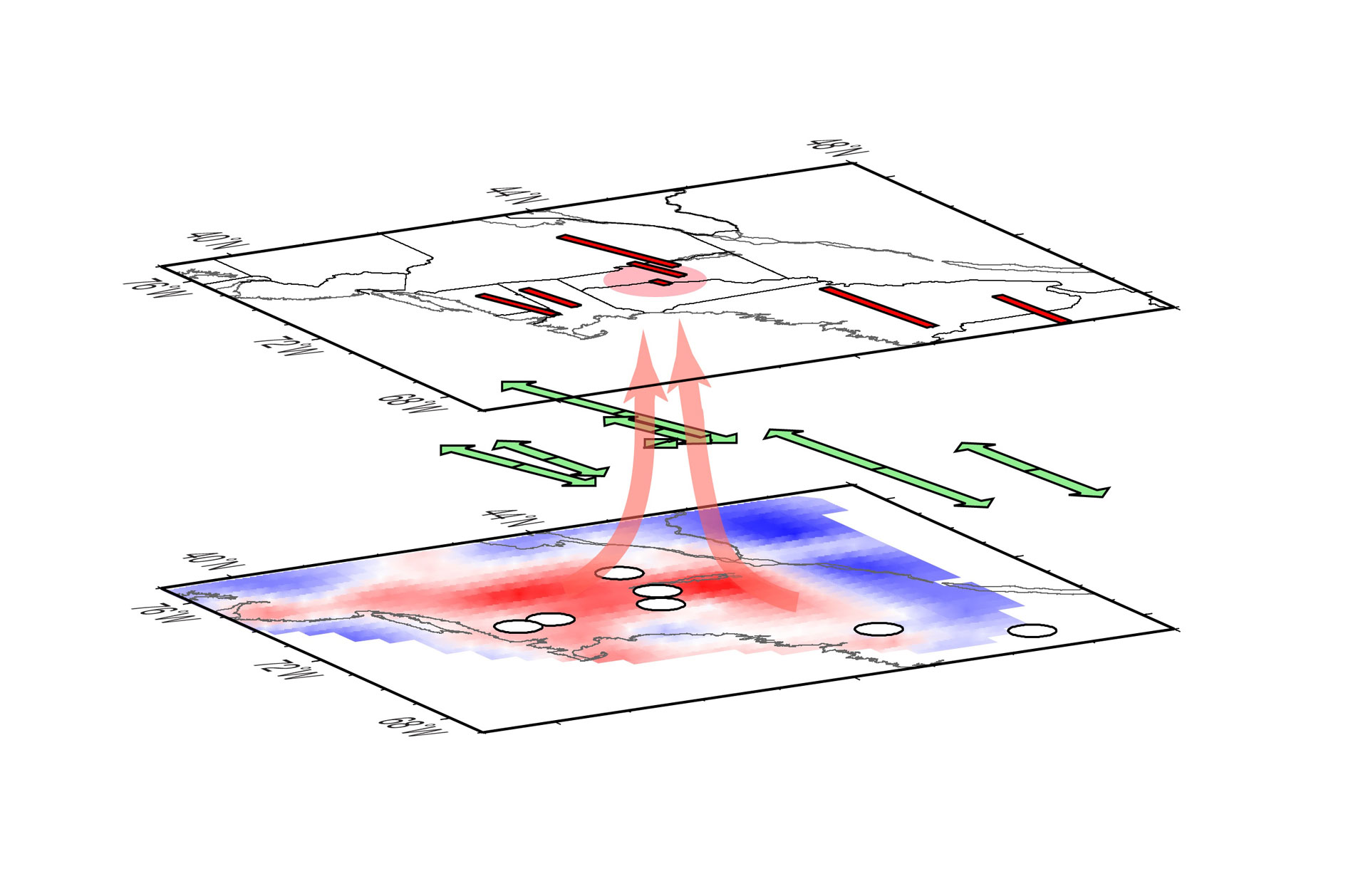
    In the figure, measurements of the strength of mantle flow are shown along with the colored map of seismic wave speed at 195 kilometers (121 miles) beneath the Earth’s surface, under the North American tectonic plate. The warm colors indicate lower speed, implying that rock in those regions is less dense, likely warmer and rising toward the surface. The key finding is that mantle flow indicators are smallest above the warm region, likely because warmer rock flows upward and disrupts the horizontal flow. Image: Vadim Levin/Rutgers University-New Brunswick

    Slowly but steadily, an enormous mass of warm rock is rising beneath part of New England, although a major volcanic eruption isn’t likely for millions of years, a Rutgers University-led study suggests. The research is groundbreaking in its scope and challenges textbook concepts of geology.

    “The upwelling we detected is like a hot air balloon, and we infer that something is rising up through the deeper part of our planet under New England,” said lead author Vadim Levin, a geophysicist and professor in the Department of Earth and Planetary Sciences at Rutgers University–New Brunswick. “It is not Yellowstone (National Park)-like, but it’s a distant relative in the sense that something relatively small – no more than a couple hundred miles across – is happening.”

    The study, which tapped seismic data through the National Science Foundation’s EarthScope program, was published online today in Geology. Study co-authors include Yiran Li and Peter Skryzalin, who did their research through Rutgers’ Aresty Research Assistant Program, and researchers at Yale University.

    “Our study challenges the established notion of how the continents on which we live behave,” Levin said. “It challenges the textbook concepts taught in introductory geology classes.”

    Through EarthScope, thousands of seismic measurement devices, which were 46.6 miles apart, covered the continental United States for two years. Nothing on Earth has been done on this scale, Levin said. The EarthScope program seeks to reveal the structure and evolution of the North American continent and the processes that cause earthquakes and volcanic eruptions, the NSF says.

    Levin studies seismic waves, or the vibrations that pass through our planet following earthquakes. Seismic waves provide a window into the Earth’s interior by revealing the shapes of objects, changes in the state of materials and clues about their texture. The Rutgers-led study focused on New England, where scientists had previously documented an area of great warmth (hundreds of degrees Celsius warmer than neighboring areas) in the Earth’s upper mantle. The lithosphere, Earth’s solid outer shell, consists of the upper mantle and the crust that includes the surface.

    “We’re interested in what happens at the interface between tectonic plates – thick, solid parts that cover our planet – and material in the upper mantle beneath the plates,” Levin said. “We want to see how North America is gliding over the deeper parts of our planet. It is a very large and relatively stable region, but we found an irregular pattern with rather abrupt changes in it.”
    Levin thinks the upwelling pattern detected is largely beneath central Vermont and western New Hampshire, but it’s also under western Massachusetts. It may be present elsewhere, but the study’s findings were based on available seismic observations.

    “The Atlantic margin of North America did not experience intense geologic activity for nearly 200 million years,” Levin said. “It is now a so-called ‘passive margin’ – a region where slow loss of heat within the Earth and erosion by wind and water on the surface are the primary change agents. So we did not expect to find abrupt changes in physical properties beneath this region, and the likely explanation points to a much more dynamic regime underneath this old, geologically quiet area.”

    “It will likely take millions of years for the upwelling to get where it’s going,” he added. “The next step is to try to understand how exactly it’s happening.”

    Reference: “Seismic evidence for a recently formed mantle upwelling beneath New England” by Vadim Levin, Maureen D. Long, Peter Skryzalin, Yiran Li and Ivette López, 29 November 2017, Geology.
    DOI: 10.1130/G39641.1

    Never miss a breakthrough: Join the SciTechDaily newsletter.
    Follow us on Google and Google News.

    Earth Science Geology Rutgers University
    Share. Facebook Twitter Pinterest LinkedIn Email Reddit

    Related Articles

    Sea Levels Rising Faster than at Any Time in 4,000 Years, Study Warns

    New Grand Canyon Discovery Could Rewrite Geology Textbooks

    Sulfur’s Secret Role in the Origin of Life – Scientists Unveil Prebiotic Secrets

    Common Ingredient Could Play Key Role in Energy Transition

    Initial Pulse of Siberian Traps Sills Triggered End-Permian Extinction

    New Study Traces the Impact of Volcanic Activity on Climate Change

    New Timescale Firmly Implicates Volcanic Eruptions as the Dominant Drivers of Past Climate Variability

    Isotopic Evidence Shows Life Could Have Flourished on Earth 3.2 Billion Years Ago

    Fossilized Crinoids Yield the Oldest Biomolecules Found Inside a Fossil

    Leave A Reply Cancel Reply

    • Facebook
    • Twitter
    • Pinterest
    • YouTube

    Don't Miss a Discovery

    Subscribe for the Latest in Science & Tech!

    Trending News

    Even Occasional Binge Drinking May Triple Liver Damage Risk

    Liftoff! NASA’s Artemis II Launch Sends Astronauts Around the Moon for First Time in 50 Years

    Scientists Discover New Way To Eliminate “Zombie Cells” Driving Aging

    This New Quantum Theory Could Change Everything We Know About the Big Bang

    This One Vitamin May Help Protect Your Brain From Dementia Years Later

    Stopping Weight-Loss Drugs Like Ozempic Can Quickly Erase Heart Benefits

    A 500-Million-Year-Old Surprise Is Forcing Scientists to Rethink Spider Evolution

    Coffee and Blood Pressure: What You Need To Know Before Your Next Cup

    Follow SciTechDaily
    • Facebook
    • Twitter
    • YouTube
    • Pinterest
    • Newsletter
    • RSS
    SciTech News
    • Biology News
    • Chemistry News
    • Earth News
    • Health News
    • Physics News
    • Science News
    • Space News
    • Technology News
    Recent Posts
    • Your Child’s Clothes Could Contain Toxic Lead, Study Finds
    • Atomic Chains Turn Electric Fields into Measurable Quantum Signals
    • 12,000-Year-Old Native American Dice Rewrite the History of Gambling
    • Researchers Break a 150-Year-Old Math Law With a Surprising Donut Discovery
    • Are You Adding Too Much Salt? New Study Identifies Who’s Most at Risk
    Copyright © 1998 - 2026 SciTechDaily. All Rights Reserved.
    • Science News
    • About
    • Contact
    • Editorial Board
    • Privacy Policy
    • Terms of Use

    Type above and press Enter to search. Press Esc to cancel.