
Close Menu
    Facebook X (Twitter) Instagram
    SciTechDaily
    • Biology
    • Chemistry
    • Earth
    • Health
    • Physics
    • Science
    • Space
    • Technology
    Facebook X (Twitter) Pinterest YouTube RSS
    SciTechDaily
    Home»Biology»Flashes of Light Can Break Habits
    Biology

    Flashes of Light Can Break Habits

    By SciTechDailyNovember 2, 20121 Comment2 Mins Read
    Facebook Twitter Pinterest Telegram LinkedIn WhatsApp Email Reddit
    Share
    Facebook Twitter LinkedIn Pinterest Telegram Email Reddit
    habit-light-disruption
    Habits require ongoing supervision from the infralimbic cortex (ILC) and other brain areas. They’re ingrained but can be precisely controlled and disrupted. Credit: Image by Roland

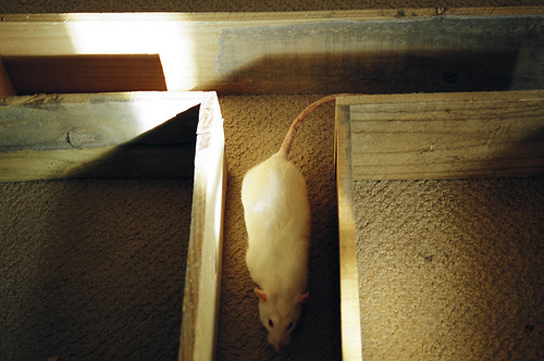
    The addition of a light-sensitive protein to a small part of a rat’s brain allowed researchers to silence the neurons in the infralimbic cortex (ILC) with a flash of yellow light, delivered to the rat’s brain via an optic fiber. The light flashes for three seconds and the habit disappears.

    The scientists published their findings in the journal PNAS. While habits seem automatic, they still depend on an ongoing supervision from the ILC and other parts of the brain. They are ingrained, but subject to precise control. And they can also be disrupted.
    rat-maze-light

    The researchers were stunned by how immediate these effects were. The change in activity of this small cortex area can profoundly change how habitual behavior was, in a matter of seconds.

    Scientists have already identified other parts of the brain responsible for habits, but previous experiments have been a bit less refined than this light-based alternative.

    Optogenetics takes light-sensitive proteins and uses viruses to introduce them to an animal’s neurons. By choosing the right proteins and targeting the right part of the brain, scientists can excite or silence a chosen group of neurons with precision.

    The flash of light doesn’t wipe the rat’s memory. Instead, it disrupts the ILC and restores the importance of outcomes in the rat’s decision-making. Before the flash of light, it ran wherever the ingrained habit told it to go. Now, it weighs up what happens when it reaches its destination.

    The ILC acts like a behavioral overseer that toggles between different habits. The old ones are still encoded in neural networks, but the overseer ignores these in favor of new ones. Behaviors can be stacked over each one another, and the ILC promotes the one that is the most appropriate to the current environmental conditions.

    The ILC isn’t directly connected to the putamen or striatum, other parts of the brain involved in habits, so it’s hard to say why infralimbic inactivation works.

    Reference: “Reversible online control of habitual behavior by optogenetic perturbation of medial prefrontal cortex” by Kyle S. Smith, Arti Virkud, Karl Deisseroth and Ann M. Graybiel, 29 October 2012, Proceedings of the National Academy of Sciences.
    DOI: 10.1073/pnas.1216264109

    Never miss a breakthrough: Join the SciTechDaily newsletter.
    Follow us on Google and Google News.

    Brain Habit Neurology Neuroscience Optogenetics
    Share. Facebook Twitter Pinterest LinkedIn Email Reddit

    Related Articles

    Reactivation of the Hippocampus Causes Memory Recall

    Researchers Use FDDNP–PET Scanning to Predict Cognitive Decline

    Stimulating the Entorhinal Cortex of the Brain Boosts Memory

    Neuroscientists Create Model to Study Burst Suppression and Brain States

    Scientists Create Brain Cells from Skin Cells

    Alzheimer’s Spreads Throughout the Brain by Jumping From Neuron to Neuron

    Researchers Use fMRI to Study How Humor Activates Kids’ Brain Regions

    Neuroscientists Decode Correlation Between Sound and Brain Activity

    Mother’s Nurturing Results in Larger Hippocampus in Children

    1 Comment

    1. Madanagopal.V.C. on November 6, 2012 9:08 am

      It is a dangerous experiment with brain neurons by introducing virus vectors carrying light sensitive proteins to change the habit. There are other non-invasive therapies to stop a habit, however worse they are for the human kind. Thank You.

      Reply
    Leave A Reply Cancel Reply

    • Facebook
    • Twitter
    • Pinterest
    • YouTube

    Don't Miss a Discovery

    Subscribe for the Latest in Science & Tech!

    Trending News

    Scientists May Have Found the Key to Jupiter and Saturn’s Moon Mystery

    Scientists Uncover Brain Changes That Link Pain to Depression

    Saunas May Do More Than Raise Body Temperature – They Activate Your Immune System

    Exercise in a Pill? Metformin Shows Surprising Effects in Cancer Patients

    Hidden Oceans of Magma Could Be Protecting Alien Life

    New Study Challenges Alzheimer’s Theories: It’s Not Just About Plaques

    Artificial Sweeteners May Harm Future Generations, Study Suggests

    Splashdown! NASA Artemis II Returns From Record-Breaking Moon Mission

    Follow SciTechDaily
    • Facebook
    • Twitter
    • YouTube
    • Pinterest
    • Newsletter
    • RSS
    SciTech News
    • Biology News
    • Chemistry News
    • Earth News
    • Health News
    • Physics News
    • Science News
    • Space News
    • Technology News
    Recent Posts
    • Ancient DNA Reveals Irish Goats Have a 3,000-Year-Old Lineage Still Alive Today
    • Historians Reveal Secrets of the Strange Hat Wars That Shook Early Modern England
    • “A Plague Is Upon Us”: The Mass Death That Changed an Ancient City Forever
    • This Strange Material Can Turn Superconductivity on and off Like a Switch
    • Scientists Discover Game-Changing New Way To Treat High Cholesterol
    Copyright © 1998 - 2026 SciTechDaily. All Rights Reserved.
    • Science News
    • About
    • Contact
    • Editorial Board
    • Privacy Policy
    • Terms of Use

    Type above and press Enter to search. Press Esc to cancel.