
Scientists at Goethe University within the international consortium COVID19-NMR refine previous 2D models.
For the first time, an international research alliance has observed the RNA folding structures of the SARS-CoV2 genome with which the virus controls the infection process. Since these structures are very similar among various beta coronaviruses, the scientists not only laid the foundation for the targeted development of novel drugs for treating COVID-19, but also for future occurrences of infection with new coronaviruses that may develop in the future.
The genetic code of the SARS-CoV2 virus is exactly 29,902 characters long, strung through a long RNA molecule. It contains the information for the production of 27 proteins. This is not much compared to the possible 40,000 kinds of protein that a human cell can produce. Viruses, however, use the metabolic processes of their host cells to multiply. Crucial to this strategy is that viruses can precisely control the synthesis of their own proteins.
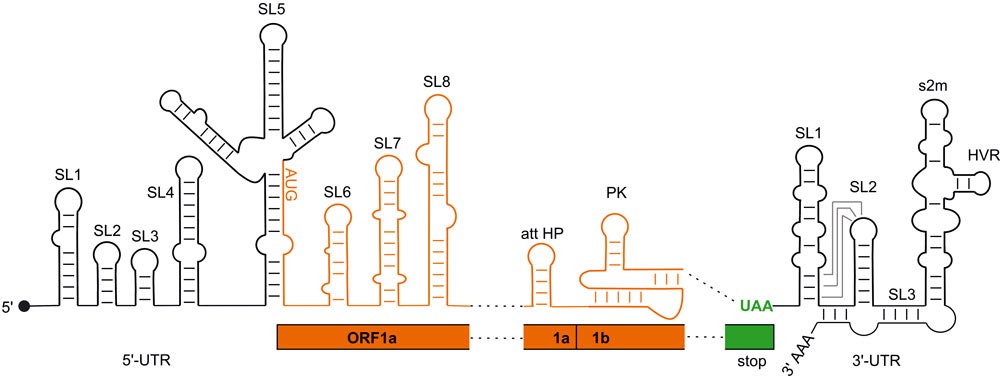
SARS-CoV2 uses the spatial folding of its RNA hereditary molecule as control element for the production of proteins: predominantly in areas that do not code for the viral proteins, RNA single strands adopt structures with RNA double-strand sections and loops. However, until now the only models of these foldings have been based on computer analyses and indirect experimental evidence.
Now, an international team of scientists led by chemists and biochemists at Goethe University and TU Darmstadt have experimentally tested the models for the first time. Researchers from the Israeli Weizmann Institute of Science, the Swedish Karolinska Institute, and the Catholic University of Valencia were also involved.
The researchers were able to characterize the structure of a total of 15 of these regulatory elements. To do so, they used nuclear magnetic resonance (NMR) spectroscopy in which the atoms of the RNA are exposed to a strong magnetic field, and thereby reveal something about their spatial arrangement. They compared the findings from this method with the findings from a chemical process (dimethyl sulfate footprint) which allows RNA single-strand regions to be distinguished from RNA double-strand regions.
The coordinator of the consortium, Professor Harald Schwalbe from the Center for Biomolecular Magnetic Resonance at Goethe University Frankfurt, explains: “Our findings have laid a broad foundation for future understanding of how exactly SARS-CoV2 controls the infection process. Scientifically, this was a huge, very labor-intensive effort which we were only able to accomplish because of the extraordinary commitment of the teams here in Frankfurt and Darmstadt together with our partners in the COVID-19-NMR consortium. But the work goes on: together with our partners, we are currently investigating which viral proteins and which proteins of the human host cells interact with the folded regulatory regions of the RNA, and whether this may result in therapeutic approaches.”
Worldwide, over 40 working groups with 200 scientists are conducting research within the COVID-19-NMR consortium, including 45 doctoral and postdoctoral students in Frankfurt working in two shifts per day, seven days a week since the end of March 2020.
Schwalbe is convinced that the potential for discovery goes beyond new therapeutic options for infections with SARS-CoV2: “The control regions of viral RNA whose structure we examined are, for example, almost identical for SARS-CoV and also very similar for other beta-coronaviruses. For this reason, we hope that we can contribute to being better prepared for future ‘SARS-CoV3’ viruses.”
The Center for Biomolecular Magnetic Resonance was founded in 2002 as research infrastructure at Goethe University Frankfurt and has since then received substantial funding from the State of Hessen.
Reference: “Secondary structure determination of conserved SARS-CoV-2 RNA elements by NMR spectroscopy” by Anna Wacker, Julia E Weigand, Sabine R Akabayov, Nadide Altincekic, Jasleen Kaur Bains, Elnaz Banijamali, Oliver Binas, Jesus Castillo-Martinez, Erhan Cetiner, Betül Ceylan, Liang-Yuan Chiu, Jesse Davila-Calderon, Karthikeyan Dhamotharan, Elke Duchardt-Ferner, Jan Ferner, Lucio Frydman, Boris Fürtig, José Gallego, J Tassilo Grün, Carolin Hacker, Christina Haddad, Martin Hähnke, Martin Hengesbach, Fabian Hiller, Katharina F Hohmann, Daniel Hymon, Vanessa de Jesus, Henry Jonker, Heiko Keller, Bozana Knezic, Tom Landgraf, Frank Löhr, Le Luo, Klara R Mertinkus, Christina Muhs, Mihajlo Novakovic, Andreas Oxenfarth, Martina Palomino-Schätzlein, Katja Petzold, Stephen A Peter, Dennis J Pyper, Nusrat S Qureshi, Magdalena Riad, Christian Richter, Krishna Saxena, Tatjana Schamber, Tali Scherf, Judith Schlagnitweit, Andreas Schlundt, Robbin Schnieders, Harald Schwalbe, Alvaro Simba-Lahuasi, Sridhar Sreeramulu, Elke Stirnal, Alexey Sudakov, Jan-Niklas Tants, Blanton S Tolbert, Jennifer Vögele, Lena Weiß, Julia Wirmer-Bartoschek, Maria A Wirtz Martin, Jens Wöhnert and Heidi Zetzsche, 10 November 2020, Nucleic Acids Research.
DOI: 10.1093/nar/gkaa1013
Never miss a breakthrough: Join the SciTechDaily newsletter.
Follow us on Google and Google News.
2 Comments
REBEL’S DAILY REPORTS @ https://www.facebook.com/ron.mccune.3
Just an idea but since the coronavirus uses a fligger mechanisms to unlock the lock on human cells to get into human cells why don’t we try using lead or copper or something else to slow down drastically the fliggering mechanism that the coronavirus uses to get into human cells. If the coronavirus can’t fligger as much then it will be harder and take longer to infect new cells. Seeing that the coronavirus has only so long to survive in a body before either the body dies or is healed or somewhat healed then perhaps if we were to first give an enama to all serious ill coronavirus patients to flush out whatever coronavirus molecules may be in their digestive tract. Then reload the bodies digestive system with a very high protein diet and a very strong complete multivitamin with minerals. Have the Coronavirus patient take two of the vitamins in one day 7 hours apart with a complete protein rich meal. Then give the coronavirus patient a blood transfusion and make the blood transfusion to transfer as much blood as possible so that to get the coronavirus out of the patient’s bloodstream. Maybe also give massive amounts of lead or and copper in their blood if possible and also in pill form. Maybe lead will negate the electrical charge that the coronavirus uses to activate it’s flickering ability. Or use another way or something to slow or stop the flickering. Perhaps downers would work. Then put the patient in a coma and freeze their body as much as possible. After so many days in a coma maybe the coronavirus will had died off and during that cold time the coronavirus wasn’t able to perform in ways to create death or more serious illness than it already did. Someone in the medical field need to look into these thoughts.
Lead would cause more damage than the virus itself does. One child in a study ate lead painted toys, and had an IQ reduced to below that of the average as a result.