
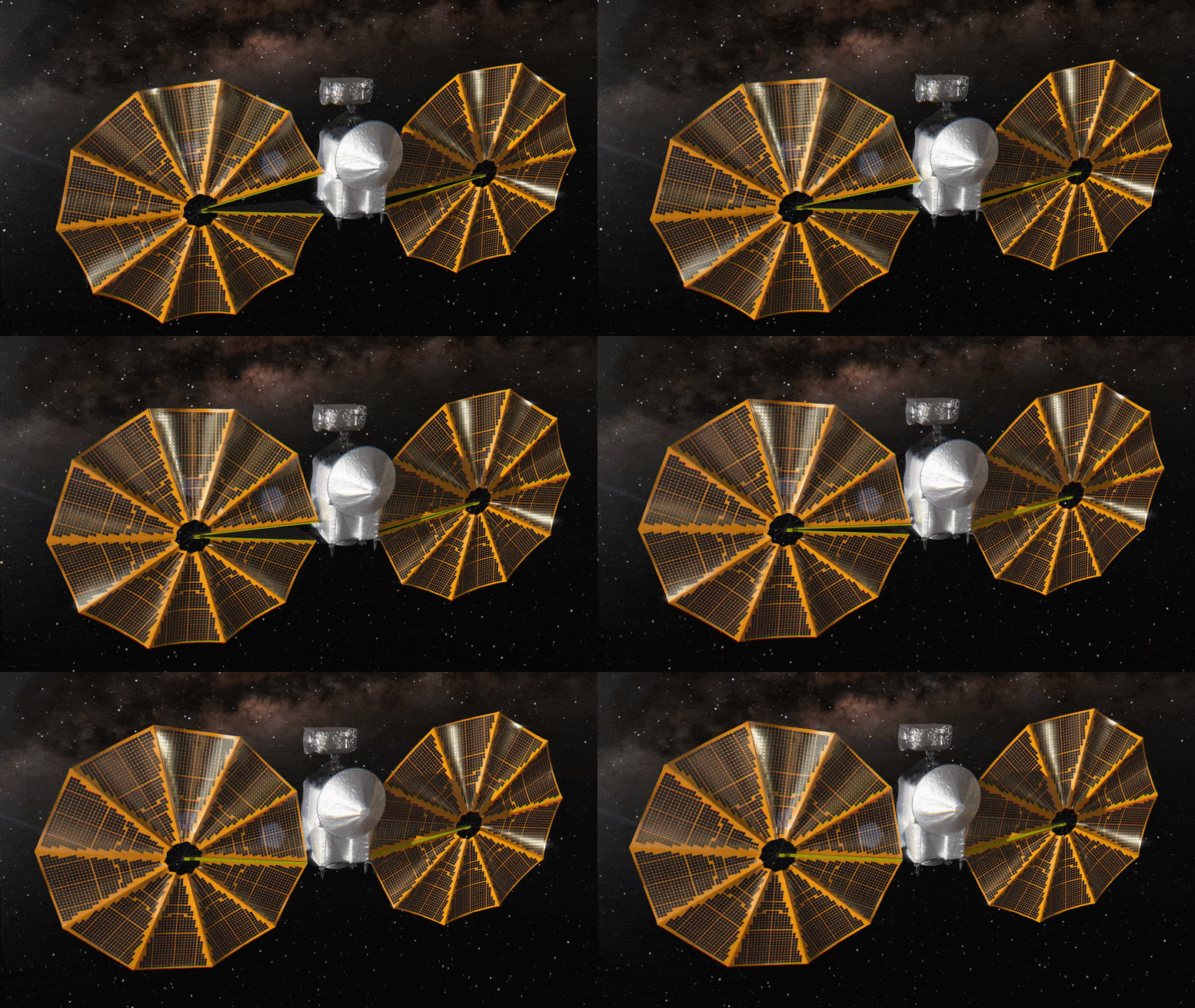
Following a successful launch on October 16, 2021, analysis of NASA’s Lucy spacecraft systems show the spacecraft is operating well and is stable. Lucy’s two solar arrays have deployed, and both are producing power and the battery is charging. While one of the arrays has latched, indications are that the second array may not be fully latched. All other subsystems are normal. In the current spacecraft attitude, Lucy can continue to operate with no threat to its health and safety.
The team is analyzing spacecraft data to understand the situation and determine the next steps to achieve full deployment of the solar array.
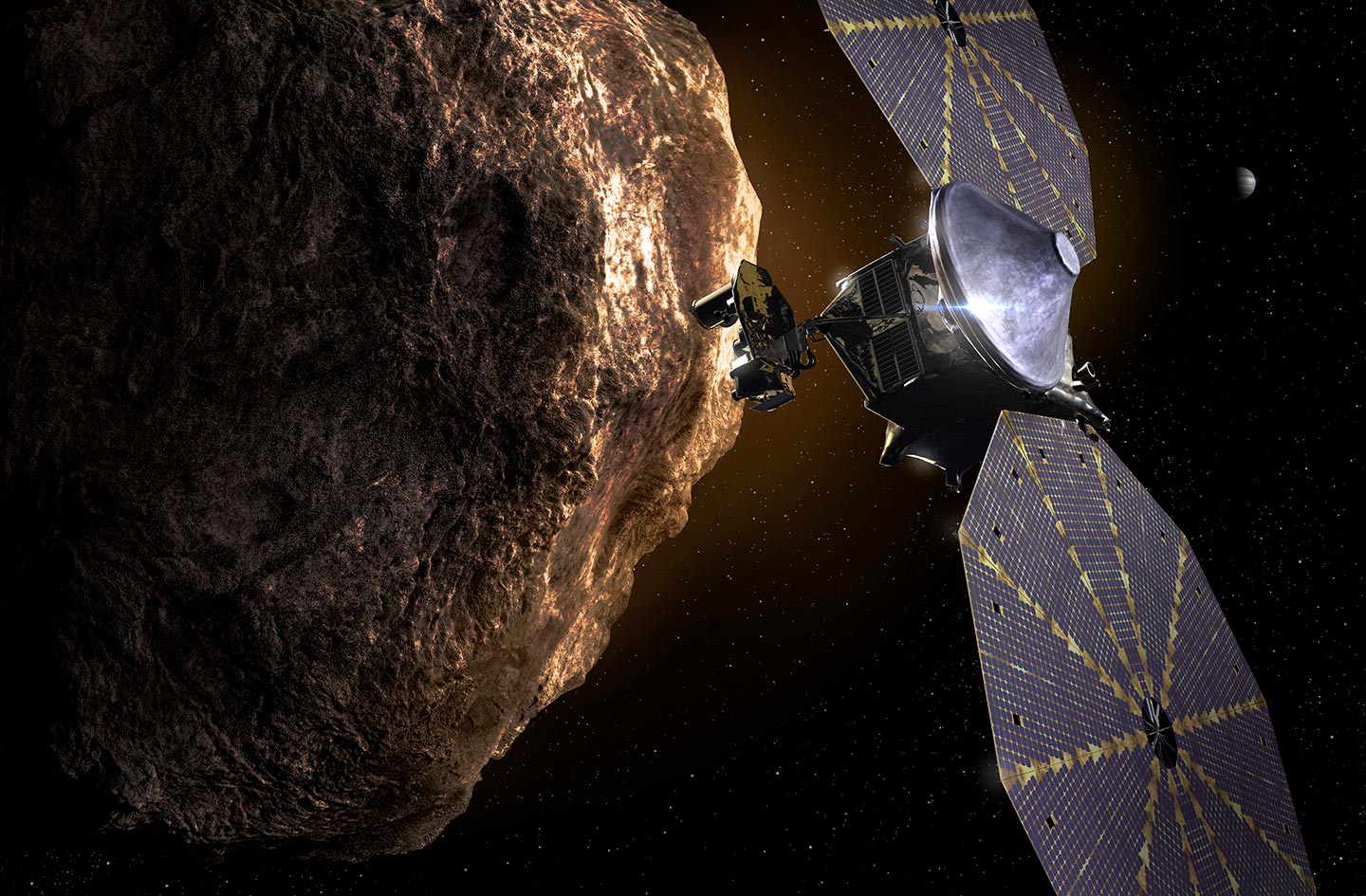
During its 12-year mission, NASA’s Lucy spacecraft will explore eight asteroids. It will explore more asteroids than any previous mission. On its way out to the Trojan asteroids, Lucy will fly by the main belt asteroid (52246) Donaldjohanson on April 20, 2025. There, Lucy will fly by five of these L4 Trojans: Eurybates and its satellite, Queta, on August 27, 2027, Polymele on September 15, 2027, Leucus on April 18, 2028, and Orus on November 11, 2028.
The spacecraft’s orbit will then bring Lucy back to the vicinity of the Earth for another gravity assist, and will take it again out to the distance of Jupiter. Arriving on March 2, 2033, Lucy will fly by Patroclus and its near-twin binary companion Menoetius. While this flyby of the remarkable asteroid pair will mark the expected finale of the mission, Lucy will continue on a stable orbit. This orbit will allow it to revisit the Trojan swarms repeatedly for many thousands, and possibly millions, of years.
Never miss a breakthrough: Join the SciTechDaily newsletter.
Follow us on Google and Google News.
6 Comments
“…for many thousands, and possibly millions, of years.”
In the meantime, humankind will have managed to extinguish itself.
“…for many thousands, and possibly millions, of years.”
In the meantime, humankind will have managed to extinguish itself.”
Maybe so, maybe not. Who knows … but, lol, that’s not the obvious factual error in the article. That’s a suposition.
The fact is that it’s obvious the probe will not have such a huge active lifespan but the asteroids will keep orbiting the sun for millions of years… or not XD. The writer managed to mess it all up in the article. Or he didn”t fully understood the facts behind the science.
JUST CURIOUS, how precisely did the author “mess it up”? I assumed what he meant by “visiting asteroids for many thousands or millions of years” is the Lucy Probe will continue on its trajectory indefinitely NOT that it would still “gather” data for us obviously. ODDS LOW it’ll hit obstruction/come apart for “Many Thousands to Millions of Years” is true (100,000-999,99 ..etc, you get it lol). Space is a vacum and things don’t deteriorate like they would if left in my backyard. Think the 2 Voyager Probes; those babies will be blastin “Satisfaction” through the cosmos for potentially MILLIONS of years LOOONG after we’re gone…well.. save for Roaches and Keith Richards of course.
…que snare drum! 😉
NOTE:sorry if accidentally posted twice.
JUST CURIOUS, how precisely did the author “mess it up”? I assumed what he meant by “visiting asteroids for many thousands or millions of years” is the Lucy Probe will continue on its trajectory indefinitely NOT that it would still “gather” data for us obviously. ODDS LOW it’ll hit obstruction/come apart for “Many Thousands to Millions of Years” is true (100,000-999,99 ..etc, you get it lol). Space is a vacum and things don’t deteriorate like they would if left in my backyard. Think the 2 Voyager Probes; those babies will be blastin “Satisfaction” through the cosmos for potentially MILLIONS of years LOOONG after we’re gone…well.. save for Roaches and Keith Richards of course.
…que snare drum! 😉
I wrote active lifespan for a reason. There is inactive lifespan after loss of power or comunications. A chunk of metal orbiting in space. As many others.
Of course the timmings if each phase are always a guess but I would check my facts regarding the hazards of space. Gama rays and cosmic rays can be troublesome. And shielding wears out pretty fast with those.
I’m curious about the Failure of the one Solar Array to deploy 100 %. Will the resulting reduction in available power from the array be problematic, when Lucy is at her furthest distance from the Sun? Are there any plans for further attempts to get the array fully deployed, or is the decision to continue the mission with the array as-is?
Thanks.