
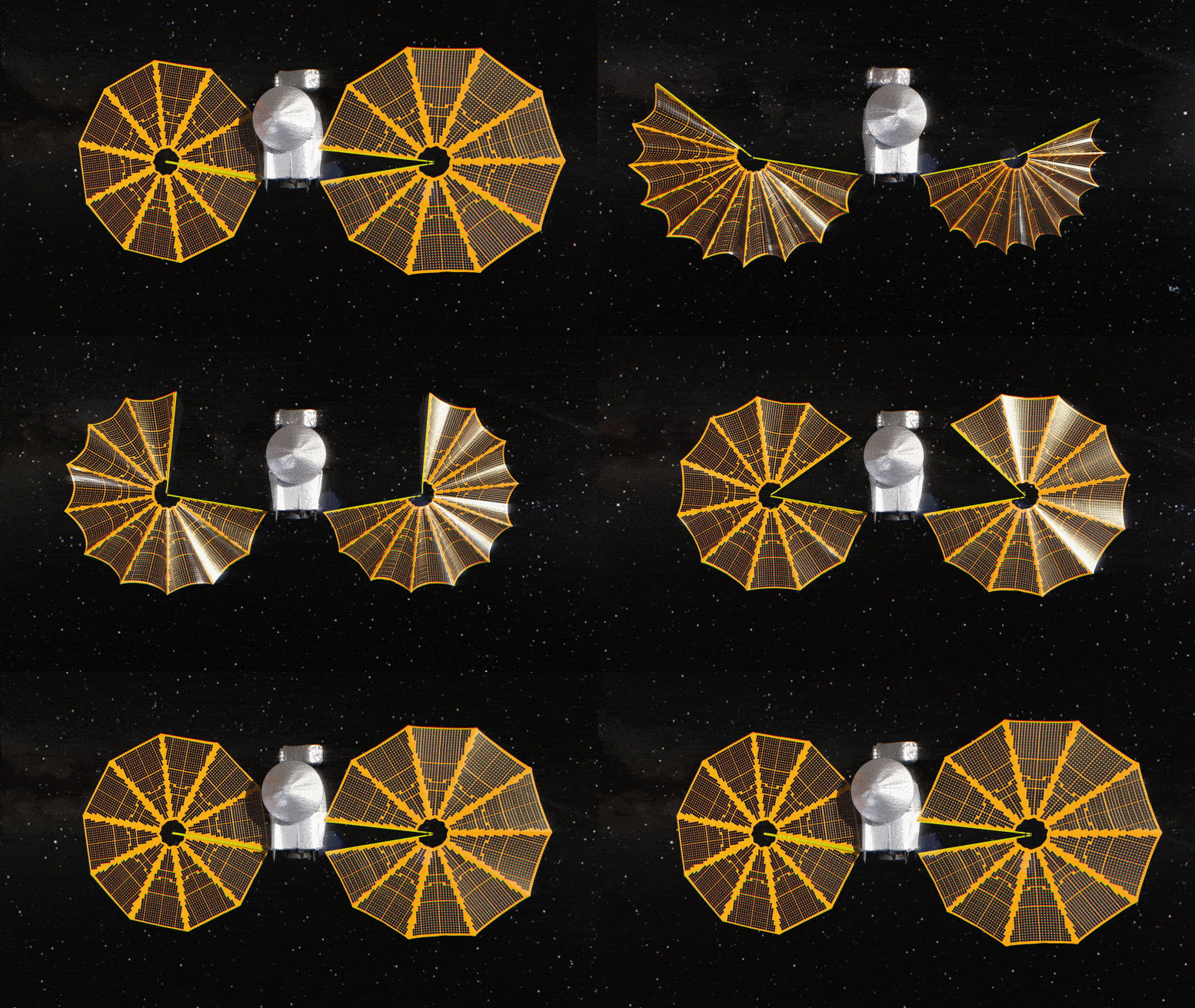
NASA’s Lucy spacecraft encountered a solar array deployment issue after launch. Teams discovered a jammed lanyard and successfully worked to stabilize the array, allowing the mission to proceed.
Just after the successful launch of NASA’s Lucy spacecraft on October 16, 2021, a group of engineers huddled around a long conference table in Titusville, Florida. Lucy was just mere hours into its 12-year journey, but a major unexpected challenge had surfaced for the first-ever Trojan asteroids mission.
Data indicated that one of Lucy’s solar arrays — designed to unfurl like a hand fan — hadn’t fully opened and latched. Since the solar arrays power the spacecraft’s systems, the team had to figure out what to do next.
To troubleshoot the problem, teams from NASA and Lucy mission partners quickly came together. Team members from Lockheed Martin’s Mission Support Area outside of Denver, who were in communication with the spacecraft directly, were on the phone.
Although the conversation was quiet, it was intense. At one end of the room, an engineer sat with furrowed brow, folding and unfolding a paper plate in the same way that Lucy’s enormous circular solar arrays operate.
There were so many unanswered questions. What happened? Was the array open at all? Was there a way to fix it? Without a fully deployed array, would Lucy be able to safely perform the maneuvers needed to accomplish its science mission?
Because Lucy was already speeding on its way through space, the stakes were incredibly high.
NASA’s Lucy mission is heading to the Jupiter Trojans – two swarms of unexplored asteroids trapped in Jupiter’s orbit. Lucy made a picture-perfect launch on October 16, 2021, but when the spacecraft began to unfurl its solar arrays, it encountered an anomaly. One of the arrays failed to fully deploy and latch shut, putting the mission at risk. For months, Lucy’s flight operations team worked meticulously to address the issue and put Lucy back on its solar-powered journey to the Jupiter Trojans.
Within hours, NASA pulled together Lucy’s anomaly response team, which included members from science mission lead Southwest Research Institute (SwRI) in Austin, Texas; mission operations lead NASA’s Goddard Space Flight Center in Greenbelt, Maryland; spacecraft builder Lockheed Martin; and Northrop Grumman in San Diego, solar array system designer and builder.
“This is a talented team, firmly committed to the success of Lucy,” said Donya Douglas-Bradshaw, former Lucy project manager from NASA Goddard. “They have the same grit and dedication that got us to a successful launch during a once-in-a-lifetime pandemic.”
United in their pursuit to ensure Lucy would reach its fullest potential, the team began an exhaustive deep dive to determine the cause of the issue and develop the best path forward.
Given that the spacecraft was otherwise perfectly healthy, the team wasn’t rushing into anything.
“We have an incredibly talented team, but it was important to give them time to figure out what happened and how to move forward,” said Hal Levison, Lucy’s principal investigator from SwRI. “Fortunately, the spacecraft was where it was supposed to be, functioning nominally, and – most importantly – safe. We had time.”
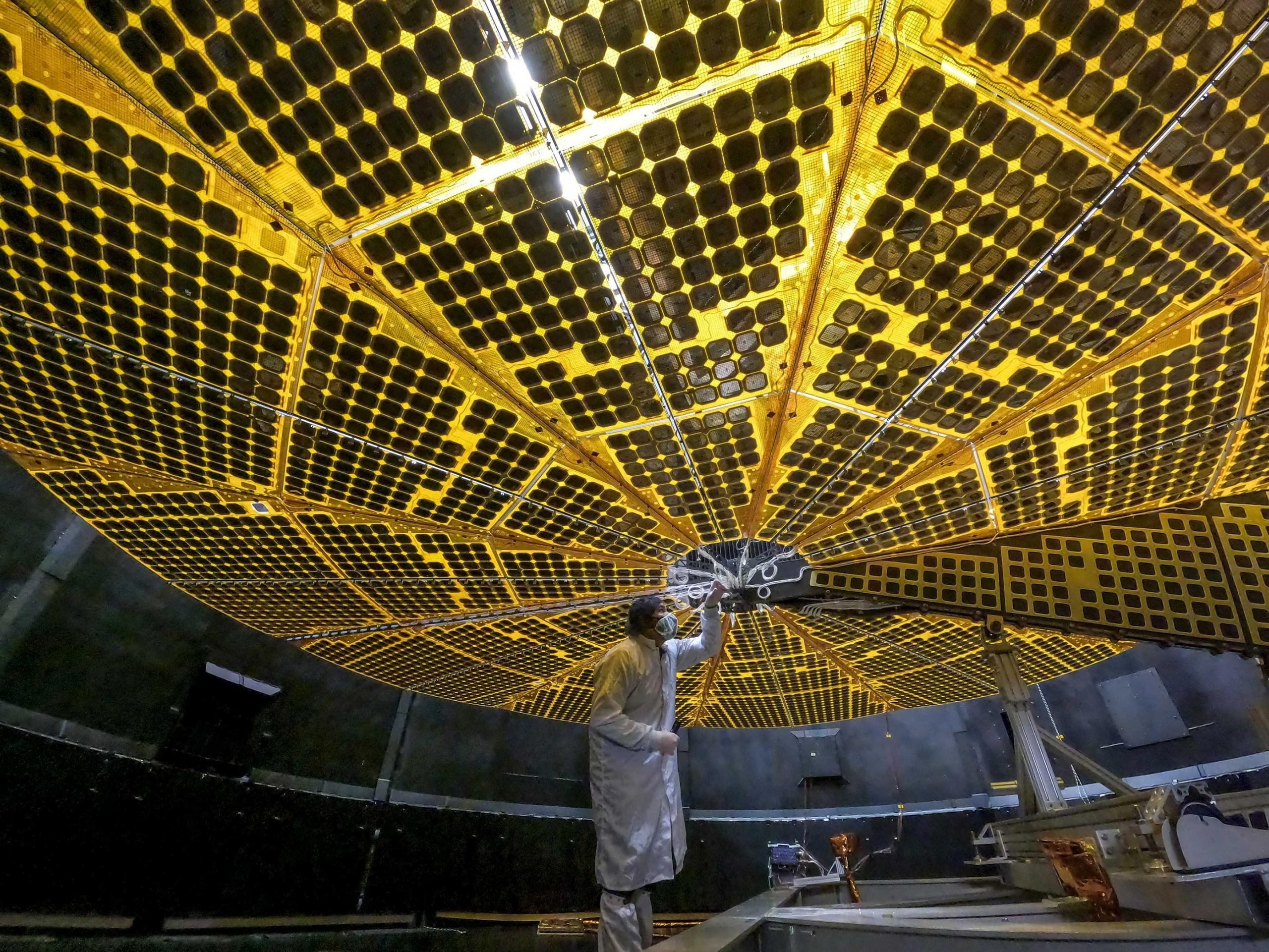
Staying focused during many long days and nights, the team worked through options. To evaluate Lucy’s solar array configuration in real-time, the team fired thrusters on the spacecraft and gathered data on how those forces made the solar array vibrate. Next, they fed the data into a detailed model of the array’s motor assembly to infer how rigid Lucy’s array was – which helped uncover the source of the issue.
At last, they closed in on the root cause: a lanyard designed to pull Lucy’s massive solar array open was likely snarled on its bobbin-like spool.
After months of further brainstorming and testing, Lucy’s team settled on two potential paths forward.
In one, they would pull harder on the lanyard by running the array’s backup deployment motor at the same time as its primary motor. The power from two motors should allow the jammed lanyard to wind in further and engage the array’s latching mechanism. While both motors were never originally intended to operate at the same time, the team used models to ensure the concept would work.
The second option: use the array as it was – nearly fully deployed and generating more than 90% of its expected power.
Shortly after Lucy launched, one of its solar arrays failed to fully deploy, putting the mission at risk. This artist’s concept animation depicts Lucy’s solar array anomaly.
“Each path carried some element of risk to achieve the baseline science objectives,” said Barry Noakes, Lockheed Martin’s deep space exploration chief engineer. “A big part of our effort was identifying proactive actions that mitigate risk in either scenario.”
The team mapped out and tested possible outcomes for both options. They analyzed hours of the array’s test footage, constructed a ground-based replica of the array’s motor assembly, and tested the replica past its limits to better understand risks of further deployment attempts. They also developed special, high-fidelity software to simulate Lucy in space and gauge any potential ripple effects a redeployment attempt could have on the spacecraft.
“The cooperation and teamwork with the mission partners was phenomenal,” said Frank Bernas, vice president, space components and strategic businesses at Northrop Grumman.
After months of simulations and testing, NASA decided to move forward with the first option – a multi-step attempt to fully redeploy the solar array. On seven occasions in May and June, the team commanded the spacecraft to simultaneously run the primary and backup solar array deployment motors. The effort succeeded, pulling in the lanyard, and further opening and tensioning the array.
The mission now estimates that Lucy’s solar array is between 353 degrees and 357 degrees open (out of 360 total degrees for a fully deployed array). While the array is not fully latched, it is under substantially more tension, making it stable enough for the spacecraft to operate as needed for mission operations.
The spacecraft is now ready and able to complete the next big mission milestone – an Earth-gravity assist in October 2022. Lucy is scheduled to arrive at its first asteroid target in 2025.
Never miss a breakthrough: Join the SciTechDaily newsletter.
Follow us on Google and Google News.