

Researchers have uncovered a way to manipulate DNA at the atomic level using electric field gradients to control nitrogen nuclear spins.
Their findings suggest that DNA could be used as both a storage and computation mechanism in future quantum computing devices.
Unlocking DNA for Quantum Computing
A recent study by researchers from Peking University highlights the potential of nuclear electric resonance to control the nuclear spins of nitrogen atoms in DNA using electric field gradients. This breakthrough suggests that DNA could one day be manipulated for computational purposes.
By combining molecular dynamics simulations, quantum chemical calculations, and theoretical analyses, the study reveals how electric field gradients interact with nitrogen atoms in DNA, encoding both genetic and structural information through nuclear spin orientations.
The findings were published recently in Intelligent Computing, a Science Partner Journal, in an open-access article titled “Encoding Genetic and Structural Information in DNA Using Electric Field Gradients and Nuclear Spins.”
Decoding the Spin Patterns in DNA
“Our research has unveiled the patterns of the principal axis directions of the electric field gradient at the nitrogen atom sites in DNA molecules, demonstrating that these directions are closely associated with the types of bases and the 3D structure of DNA,” the authors said. Essentially, the nuclear spin orientations of nitrogen atoms store information about both DNA’s sequence and its 3D form. This insight opens the door to the possibility of using DNA as a data storage system in quantum computing.
For DNA to serve as a computing device, it must also have a processing mechanism. The study suggests that proton nuclear spins — more complex and varied than nitrogen spins — could interact with nitrogen atoms to facilitate computation. This interaction could enable a DNA-based quantum computing system, advancing the potential for biological molecules to be used in next-generation computing technologies.
How Nitrogen Atoms Shape DNA’s Quantum Potential
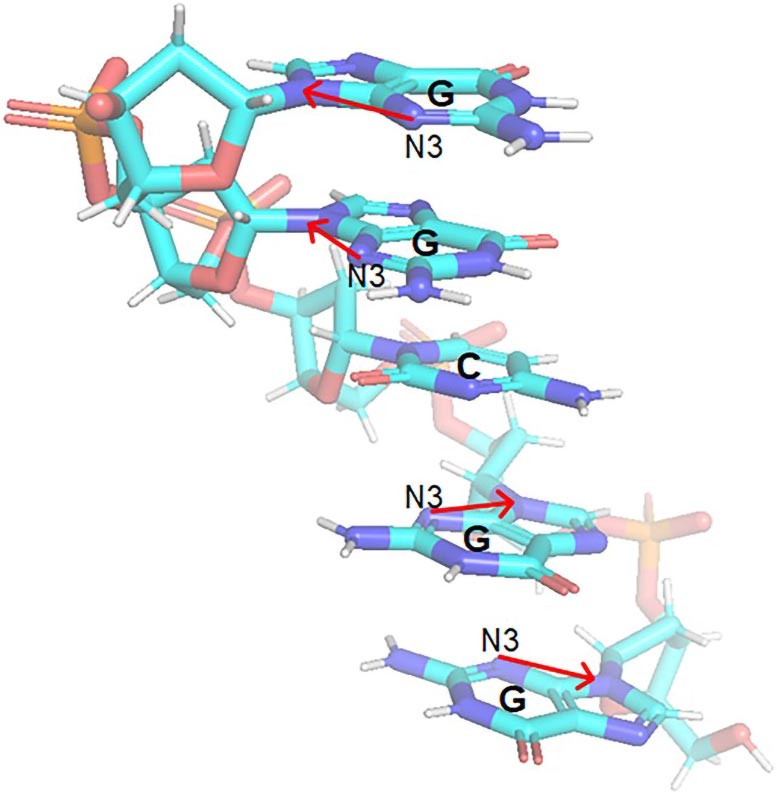
Nitrogen atoms in DNA are bonded with either three or two atoms, resulting in different electric field gradient orientations. In the former case, the principal axis is always perpendicular to the base plane, while in the latter, the principal axis either aligns with the bisector of the bonds or is close to perpendicular to it, depending on the base and nitrogen type. These orientations vary across the four bases: adenine, guanine, cytosine, and thymine.
Furthermore, spin system simulations analyzed the electric field gradient data of adjacent bases, showing that for nitrogen atoms bonded with atoms in adenine and guanine, the deflection angles of nuclear spin orientations align consistently with the structural deflection angles of the bases. However, cytosine and thymine exhibit more variability, with no fixed rules for nitrogen orientations.
Simulating the Invisible: Molecular Modeling in Action
To investigate the electric field gradients in DNA, the authors used molecular dynamics simulations to model the atomic coordinates of the DNA molecule over time. They used a solvated DNA system with added ions to ensure neutrality, applying rigorous equilibration and simulation steps. Quantum chemical calculations were then conducted on selected nucleotide subsets, focusing on the nitrogen atom positions within the DNA bases. The electric field gradient components were analyzed to extract principal axis directions and eigenvalues.
By comparing the deflection angles of the structures of the two adjacent homogeneous bases in DNA with the deflection angles of the electric field gradients of the nuclei, the authors investigated the dependence of deflection angles of nuclear spin orientations on DNA structure, as well as the influence of nitrogen nuclear spins on the spin directions of surrounding proton nuclei under the electric field gradient.
Building on the Past: Expanding Quantum Frontiers
The study follows on the authors’ previous research, which focused on the potential of nuclear electric resonance to control the nuclear spins of sodium ions on phospholipid membranes using electric field gradients.
This new study extended previous findings, uncovers the intricate relationships between electric field gradients, nitrogen atom orientations, and DNA base structures, deepens the understanding of performing DNA computation through artificial intervention at the molecular level, and paves the way for innovative approaches to future quantum computer design and genetic information processing.
Reference: “Encoding Genetic and Structural Information in DNA Using Electric Field Gradients and Nuclear Spins” by Yu Zheng and Quansheng Ren, 12 December 2024, Intelligent Computing.
DOI: 10.34133/icomputing.0094
Never miss a breakthrough: Join the SciTechDaily newsletter.
Follow us on Google and Google News.